
Pulp Fiction, 1865 · page 268 of 400
The Argosy — page 268: what you’re looking at
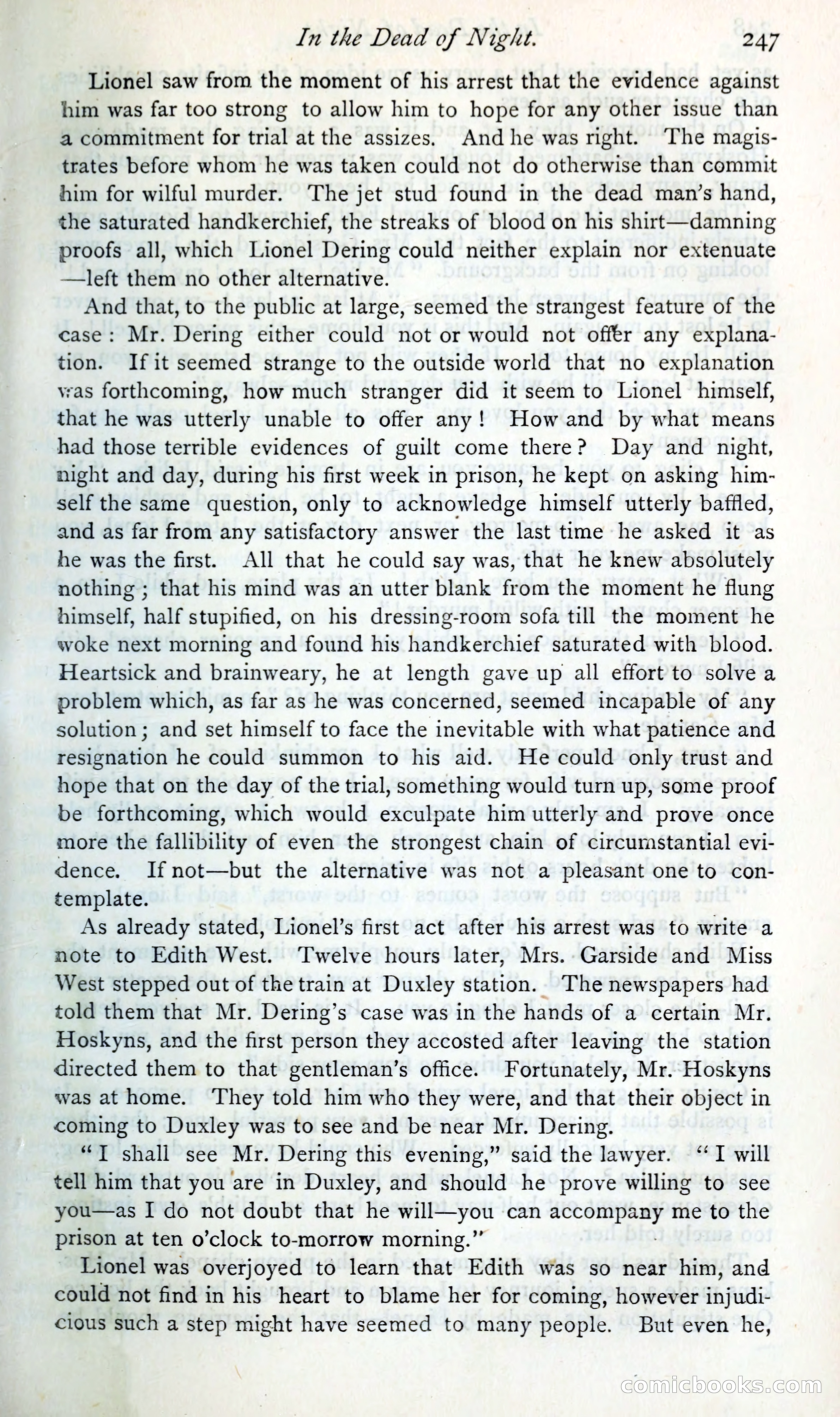
A restored page from Pulp Fiction, 1865. Page through the whole issue in the reader above.
📄 Transcribed text from this page (OCR, searchable)
Machine-transcribed from the original scan — historical spelling and the odd misread are preserved.
In the Dead of Night. 247 Lionel saw from the moment of his arrest that the evidence against him was far too strong to allow him to hope for any other issue than a commitment for trial at the assizes. And he was right. ‘The magis- trates before whom he was taken could not do otherwise than commit him for wilful murder. The jet stud found in the dead man’s hand, the saturated handkerchief, the streaks of blood on his shirt—damning proofs all, which Lionel Dering could neither explain nor extenuate —left them no other alternative. And that, to the public at large, seemed the strangest feature of the case: Mr. Dering either could not or would not offer any explana- tion. Ifit seemed strange to the outside world that no explanation vras forthcoming, how much stranger did it seem to Lionel himself, that he was utterly unable to offer any! Howand by what means had those terrible evidences of guilt come there? Day and night, night and day, during his first week in prison, he kept on asking him- self the same question, only to acknowledge himself utterly baffled, and as far from any satisfactory answer the last time he asked it as he was the first. All that he could say was, that he knew absolutely nothing ; that his mind was an utter blank from the moment he flung himself, half stupified, on his dressing-room sofa till the moment he woke next morning and found his handkerchief saturated with blood. Heartsick and brainweary, he at length gave up all effort to solve a problem which, as far as he was concerned, seemed incapable of any solution; and set himself to face the inevitable with what patience and resignation he could summon to his aid. Hecould only trust and hope that on the day of the trial, something would turn up, some proof be forthcoming, which would exculpate him utterly and prove once more the fallibility of even the strongest chain of circumstantial evi- dence. If not—but the alternative was not a pleasant one to con- template. As already stated, Lionel’s first act after his arrest was to write a note to Edith West. Twelve hours later, Mrs. Garside and Miss West stepped out of the train at Duxley station. ‘The newspapers had told them that Mr. Dering’s case was in the hands of a certain Mr. Hoskyns, and the first person they accosted after leaving the station directed them to that gentleman’s office. Fortunately, Mr. Hoskyns was athome. They told him who they were, and that their object in coming to Duxley was to see and be near Mr. Dering. “IT shall see Mr. Dering this evening,” said the lawyer. “TI will tell him that you are in Duxley, and should he prove willing to see you—as I do not doubt that he oo can apie <= me to the prison at ten o’clock to-morrow morning.’ Lionel was overjoyed to learn that Edith was so near him, and could not find in his heart to blame her for coming, however injudi- cious such a step might have seemed to many people. But even he, ecomicloaoolks (CO)