
Pulp Fiction, 1865 · page 252 of 400
The Argosy — page 252: what you’re looking at
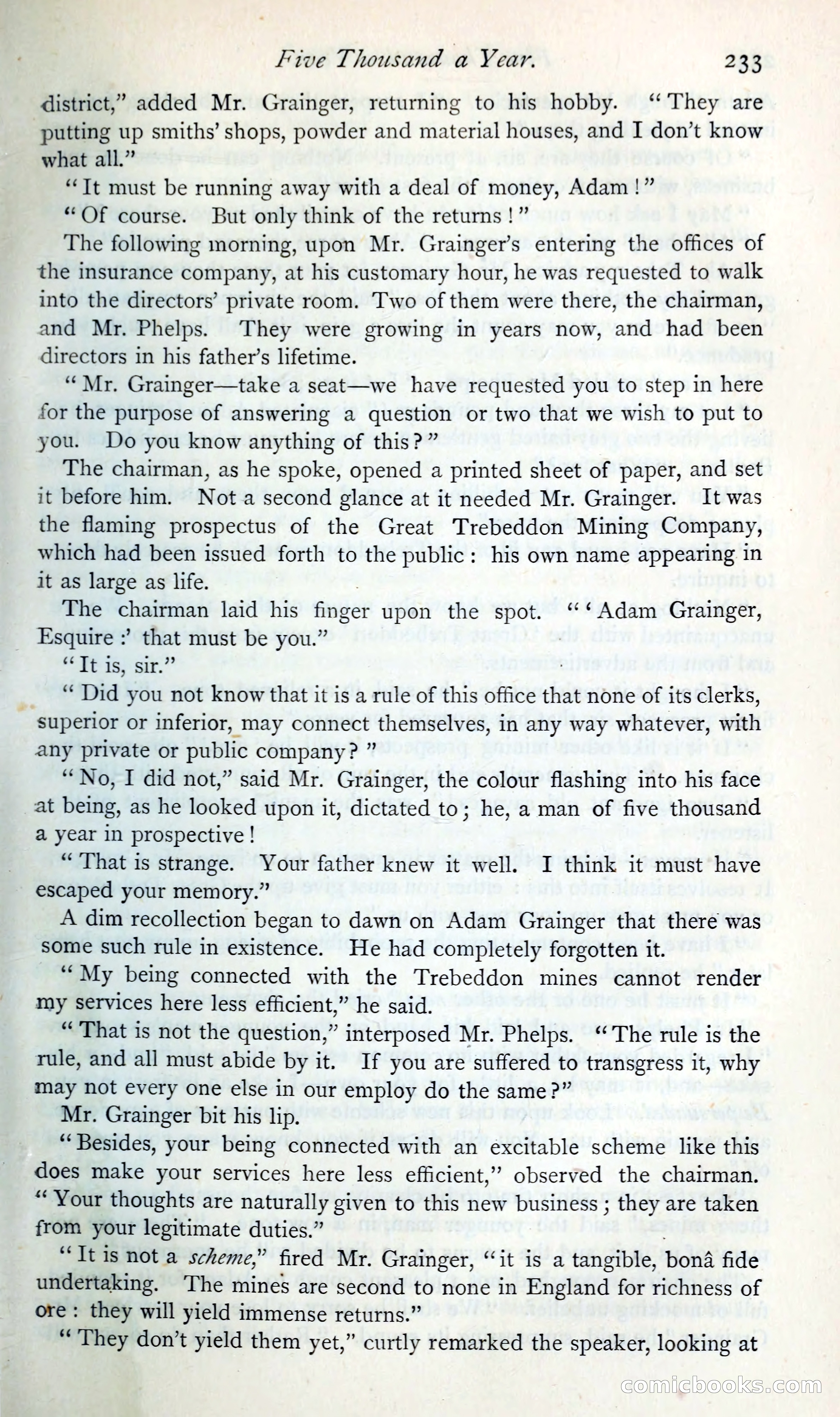
A restored page from Pulp Fiction, 1865. Page through the whole issue in the reader above.
📄 Transcribed text from this page (OCR, searchable)
Machine-transcribed from the original scan — historical spelling and the odd misread are preserved.
Five Thousand a Year. 233 district,’ added Mr. Grainger, returning to his hobby. ‘‘ They are putting up smiths’ shops, powder and material houses, and I don’t know what all.” “Tt must be running away with a deal of money, Adam!” “Of course. But only think of the returns!” The following morning, upon Mr. Grainger’s entering the offices of the insurance company, at his customary hour, he was requested to walk into the directors’ private room. Two of them were there, the chairman, and Mr. Phelps. They were growing in years now, and had been directors in his father’s lifetime. ‘““Mr. Grainger—take a seat—we have requested you to step in here for the purpose of answering a question or two that we wish to put to you. Do you know anything of this?” The chairman, as he spoke, opened a printed sheet of paper, and set it before him. Nota second glance at it needed Mr. Grainger. It was the flaming prospectus of the Great Trebeddon Mining Company, which had been issued forth to the public: his own name appearing in it as large as life. The chairman laid his finger upon the spot. “ ‘Adam Grainger, Esquire :’ that must be you.” ae 1s) er.” “Did you not know that it is a rule of this office that none of its clerks, - superior or inferior, may connect themselves, in any way whatever, with any private or public company? ” ‘No, I did not,” said Mr. Grainger, the colour flashing into his face at being, as he looked upon it, dictated to; he, a man of five thousand a year In prospective! “That is strange. Your father knew it well. I think it must have escaped your memory.” A dim recollection began to dawn on Adam Grainger that there was some such rule in existence. He had completely forgotten it. “My being connected with the Trebeddon mines cannot render my services here less efficient,” he said. “That is not the question,” interposed Mr. Phelps. ‘The rule is the tule, and all must abide by it. If you are suffered to transgress it, why may not every one else in our employ do the same?” Mr. Grainger bit his lip. “Besides, your being connected with an excitable scheme like this does make your services here less efficient,” observed the chairman. “Your thoughts are naturally given to this new business ; they are taken from your legitimate duties.” “Tt is not a scheme,” fired Mr. Grainger, “it is a tangible, bona fide undertaking. The mines are second to none in England for richness of ore: they will yield immense returns.” “They don’t yield them yet,” curtly remarked the speaker, looking at GomiilGaooks (SO) im