
Pulp Fiction, 1865 · page 242 of 400
The Argosy — page 242: what you’re looking at
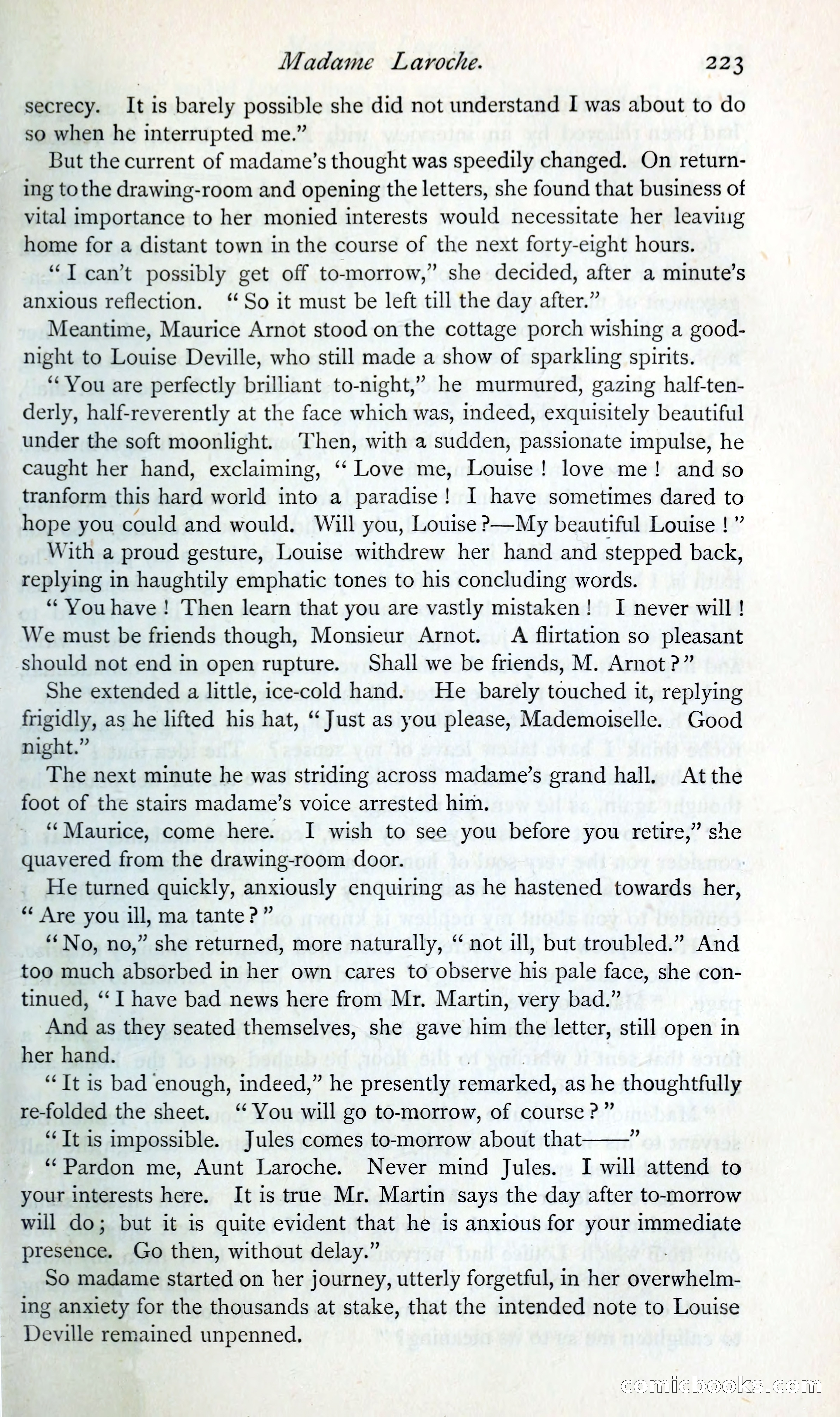
A restored page from Pulp Fiction, 1865. Page through the whole issue in the reader above.
📄 Transcribed text from this page (OCR, searchable)
Machine-transcribed from the original scan — historical spelling and the odd misread are preserved.
Madame Laroche. 223 secrecy. It is barely possible she did not understand I was about to do so when he interrupted me.” But the current of madame’s thought was speedily changed. On return- ing tothe drawing-room and opening the letters, she found that business of vital importance to her monied interests would necessitate her leaving home for a distant town in the course of the next forty-eight hours. “T can’t possibly get off to-morrow,” she decided, after a minute’s anxious reflection. ‘So it must be left till the day after.” Meantime, Maurice Arnot stood on the cottage porch wishing a good- night to Louise Deville, who still made a show of sparkling spirits. “You are perfectly brilliant to-night,” he murmured, gazing half-ten- derly, half-reverently at the face which was, indeed, exquisitely beautiful under the soft moonlight. ‘Then, with a sudden, passionate impulse, he caught her hand, exclaiming, ‘‘ Love me, Louise! love me! and so tranform this hard world into a paradise! I have sometimes dared to hope you could and would. Will you, Louise ?—My beautiful Louise !” With a proud gesture, Louise withdrew her hand and stepped back, replying in haughtily emphatic tones to his concluding words. “You have! Then learn that you are vastly mistaken! I never will! We must be friends though, Monsieur Arnot. A flirtation so pleasant should not end in open rupture. Shall we be friends, M. Arnot ?” She extended a little, ice-cold hand. He barely touched it, replying frigidly, as he lifted his hat, “‘ Just as you please, Mademoiselle. Good night.” The next minute he was striding across madame’s grand hall, Atthe foot of the stairs madame’s voice arrested him. ‘‘Maurice, come here. I wish to see you before you retire,” she quavered from the drawing-room door. He turned quickly, anxiously enquiring as he hastened towards her, * Are you ill, ma tante?” | ‘No, no,” she returned, more naturally, “ not ill, but troubled.” And too much absorbed in her own cares to observe his pale face, she con- tinued, ‘‘ I have bad news here from Mr. Martin, very bad.” And as they seated themselves, she gave him the letter, still open in her hand. | , “It is bad enough, indeed,” he presently remarked, as he thoughtfully re-folded the sheet. ‘‘ You will go to-morrow, of course ?” “Tt is impossible. Jules comes to-morrow about that ~ “Pardon me, Aunt Laroche. Never mind Jules. I will attend to your interests here. It is true Mr. Martin says the day after to-morrow will do; but it is quite evident that he is anxious for your immediate presence. Go then, without delay.” | So madame started on her journey, utterly forgetful, in her siisaieclom. ing anxiety for the thousands at stake, that the intended note to Louise Deville remained unpenned. 3 CORnlNuELOO© SS) (SO) im