
Pulp Fiction, 1865 · page 23 of 400
The Argosy — page 23: what you’re looking at
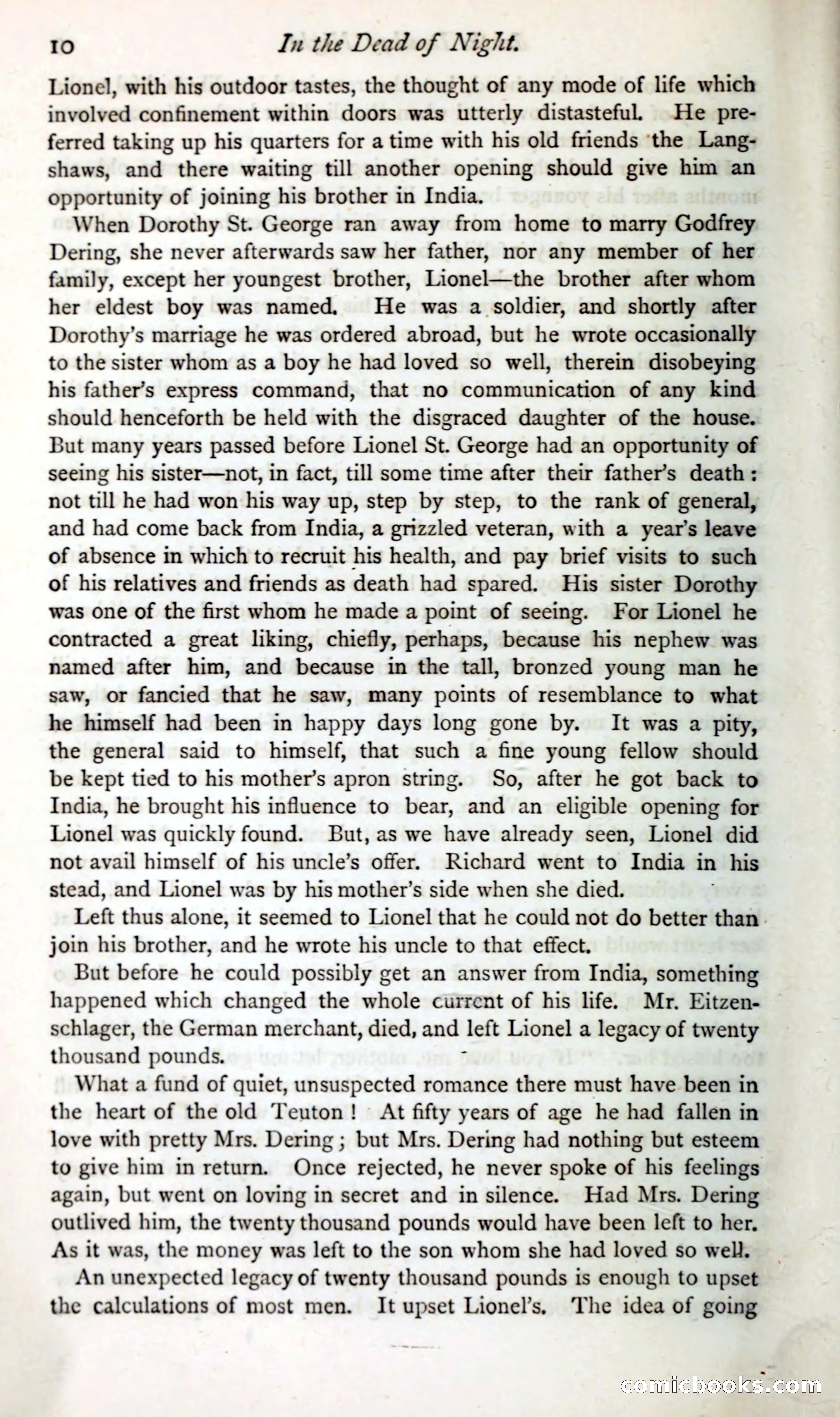
A restored page from Pulp Fiction, 1865. Page through the whole issue in the reader above.
📄 Transcribed text from this page (OCR, searchable)
Machine-transcribed from the original scan — historical spelling and the odd misread are preserved.
10 In the Dead of Night. Lionel, with his outdoor tastes, the thought of any mode of life which involved confinement within doors was utterly distasteful. He pre- ferred taking up his quarters for a time with his old friends ‘the Lang- shaws, and there waiting till another opening should give him an opportunity of joining his brother in India. When Dorothy St. George ran away from home to marry Godfrey Dering, she never afterwards saw her father, nor any member of her family, except her youngest brother, Lionel—the brother after whom her eldest boy was named, He was a soldier, and shortly after Dorothy’s marriage he was ordered abroad, but he wrote occasionally to the sister whom as a boy he had loved so well, therein disobeying his father’s express command, that no communication of any kind should henceforth be held with the disgraced daughter of the house. But many years passed before Lionel St. George had an opportunity of seeing his sister—not, in fact, till some time after their father’s death: not till he had won his way up, step by step, to the rank of general, and had come back from India, a grizzled veteran, with a year’s leave of absence in which to recruit his health, and pay brief visits to such of his relatives and friends as death had spared. His sister Dorothy was one of the first whom he made a point of seeing. For Lionel he contracted a great liking, chiefly, perhaps, because his nephew was named after him, and because in the tall, bronzed young man he saw, or fancied that he saw, many points of resemblance to what he himself had been in happy days long gone by. It was a pity, the general said to himself, that such a fine young fellow should be kept tied to his mother’s apron string. So, after he got back to India, he brought his influence to bear, and an eligible opening for Lionel was quickly found. But, as we have already seen, Lionel did not avail himself of his uncle’s offer. Richard went to India in his stead, and Lionel was by his mother’s side when she died. Left thus alone, it seemed to Lionel that he could not do better than. join his brother, and he wrote his uncle to that effect. But before he could possibly get an answer from India, something happened which changed the whole current of his life. Mr. Eitzen- © schlager, the German merchant, died, and left Lionel a legacy of twenty thousand pounds. , What a fund of quiet, unsuspected romance there must have been in the heart of the old Teuton! At fifty years of age he had fallen in love with pretty Mrs. Dering ; but Mrs. Dering had nothing but esteem to give him in return. Once rejected, he never spoke of his feelings again, but went on loving in secret and in silence. Had Mrs. Dering outlived him, the twenty thousand pounds would have been left to her. As it was, the money was left to the son whom she had loved so well. An unexpected legacy of twenty thousand pounds is enough to upset | the calculations of most men. It upset Lionel’s, The idea of going Gomicbooks (E(0) m