
Pulp Fiction, 1865 · page 21 of 400
The Argosy — page 21: what you’re looking at
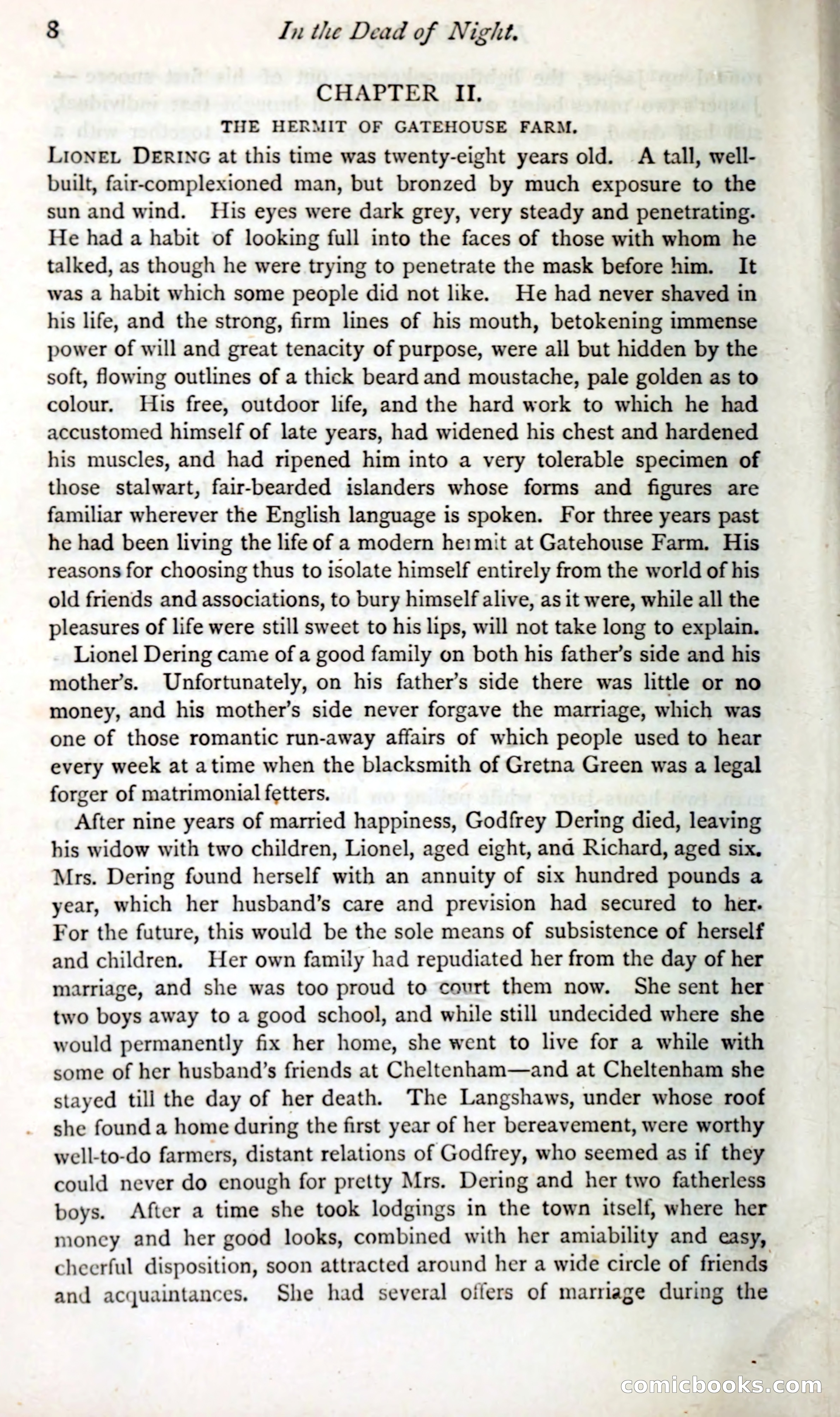
A restored page from Pulp Fiction, 1865. Page through the whole issue in the reader above.
📄 Transcribed text from this page (OCR, searchable)
Machine-transcribed from the original scan — historical spelling and the odd misread are preserved.
8 In the Dead of Night. CHAPTER II. THE HERMIT OF GATEHOUSE FARM. LIONEL DERING at this time was twenty-eight years old. A tall, well- built, fair-complexioned man, but bronzed by much exposure to the sun and wind. His eyes were dark grey, very steady and penetrating. He had a habit of looking full into the faces of those with whom he talked, as though he were trying to penetrate the mask before him. It was a habit which some people did not like. He had never shaved in his life, and the strong, firm lines of his mouth, betokening immense power of will and great tenacity of purpose, were all but hidden by the soft, flowing outlines of a thick beard and moustache, pale golden as to colour. His free, outdoor life, and the hard work to which he had accustomed himself of late years, had widened his chest and hardened his muscles, and had ripened him into a very tolerable specimen of those stalwart, fair-bearded islanders whose forms and figures are familiar wherever the English language is spoken. For three years past he had been living the life of a modern heimit at Gatehouse Farm. His reasons for choosing thus to isolate himself entirely from the world of his old friends and associations, to bury himself alive, as it were, while all the pleasures of life were still sweet to his lips, will not take long to explain. Lionel Dering came of a good family on both his father’s side and his mother’s. Unfortunately, on his father’s side there was little or no money, and his mother’s side never forgave the marriage, which was one of those romantic run-away affairs of which people used to hear every week at atime when the blacksmith of Gretna Green was a legal forger of matrimonial fetters. After nine years of married happiness, Godfrey Dering died, leaving his widow with two children, Lionel, aged eight, and Richard, aged six. Mrs. Dering found herself with an annuity of six hundred pounds a year, which her husband’s care and prevision had secured to her. For the future, this would be the sole means of subsistence of herself and children. Her own family had repudiated her from the day of her marriage, and she was too proud to court them now. She sent her two boys away to a good school, and while still undecided where she would permanently fix her home, she went to live for a while with some of her husband’s friends at Cheltenham—and at Cheltenham she stayed till the day of her death. The Langshaws, under whose roof she founda home during the first year of her bereavement, were worthy well-to-do farmers, distant relations of Godfrey, who seemed as if they could never do enough for pretty Mrs. Dering and her two fatherless boys. After a time she took lodgings in the town itself, where her money and her good looks, combined with her amiability and easy, cheerful disposition, soon attracted around her a wide circle of friends and acquaintances. She had several offers of marriage during the (E(0) m Gomilcbooks