
Pulp Fiction, 1922 · page 81 of 180
Argosy All-Story Weekly, 4 February 1922 — page 81: what you’re looking at
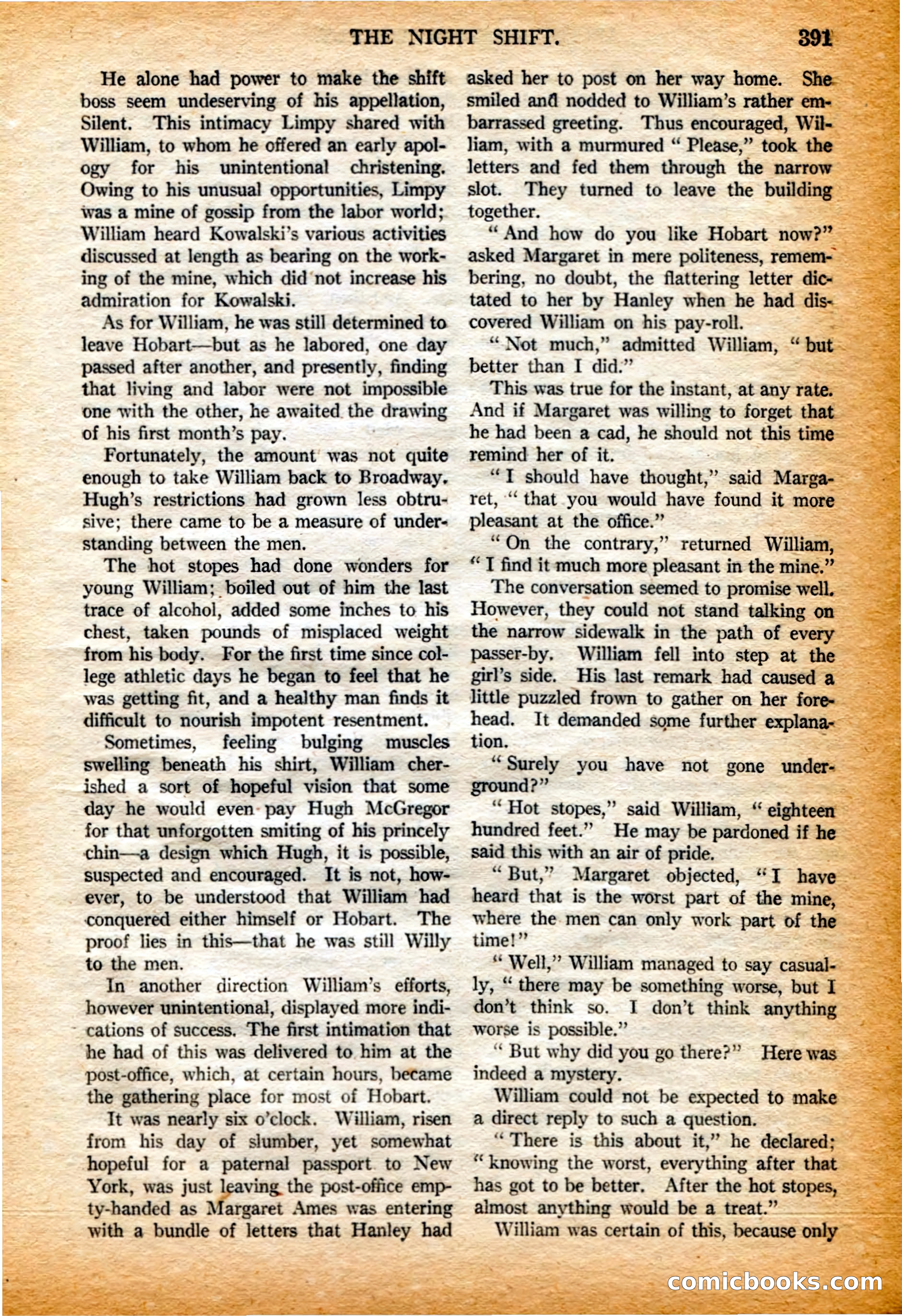
A restored page from Pulp Fiction, 1922. Page through the whole issue in the reader above.
📄 Transcribed text from this page (OCR, searchable)
Machine-transcribed from the original scan — historical spelling and the odd misread are preserved.
THE NIGHT SHIFT. He alone had power to make the shift boss seem undeserving of his appellation, Silent. This intimacy Limpy shared with William, to whom he offered an early apol- ogy for his unintentional christening. Owing to his unusual opportunities, Limpy was a mine of gossip from the labor world; William heard Kowalski’s various activities discussed at length as bearing on the work- ing of the mine, which did ‘not increase his admiration for Kowalski. As for William, he was still determined to leave Hobart—but as he labored, one day passed after another, and presently, finding that living and labor were not impossible one with the other, he awaited the drawing of his first month’s pay. Fortunately, the amount was not quite enough to take William back to Broadway. Hugh’s restrictions had grown less obtru- sive; there came to be a measure of under- standing between the men. The hot stopes had done wonders for young William; boiled out of him the last trace of alcohol, added some inches to his chest, taken pounds of misplaced weight from his body. For the first time since col- lege athletic days he began to feel that he was getting fit, and a healthy man finds it difficult to nourish impotent resentment. Sometimes, feeling bulging muscles swelling beneath his shirt, William cher- ished a sort of hopeful vision that some day he would even- pay Hugh McGregor for that unforgotten smiting of his princely chin—a design which Hugh, it is possible, suspected and encouraged. It is not, how- ever, to be understood that William had conquered either himself or Hobart. The proof lies in this—that he was still Willy to the men. In another direction William’s efforts, however unintentional, displayed more indi- - cations of success. The first intimation that he had of this was delivered to him at the post-office, which, at certain hours, became the gathering place for most of Hobart. It was nearly six o’clock. William, risen from his day of slumber, yet somewhat hopeful for a mabe passport. to New York, was just leaving the post-office emp- ty-handed as Margaret Ames was entering with a bundle of at letters that Hanley had asked her to post on her way home. barrassed greeting. Thus encouraged, Wil- liam, with a murmured “ Please,” took the letters and fed them through the narrow slot. They turned to leave the building together. e “i : ES ‘i ‘ t 4 > smiled anf nodded to William’s rather em- “And how do you like Hobart now?” — asked Margaret in mere politeness, remem- bering, no doubt, the flattering letter dic- tated to her by Hanley when he had dis- covered William on his pay-roll. “Not much,” admitted William, better than I did: “ This was true for the instant, at any rate. And if Margaret was willing to forget that. he had been a cad, he en not this time — remind her of it. “I should have thought,” said Marga-— ret, “that you would have found it more pleasant at the office.” “On the contrary,” returned William, **T find it much more pleasant in the mine.” The conversation seemed to promise well, However, they could not stand talking on the narrow sidewalk in the path of every passer-by, William fell into step at the girl’s side. His last remark had caused a little puzzled frown to gather on her fore~_ It demanded some further explana- head. tion. “Surely you have not gone wunder- ground?” “Hot stopes,”’ hundred feet.” He may be pardoned if he said this with an air of pride. “ But,” Margaret objected, time!” * Well,” William managed to say casual- said William, “ eighteen — “T have — | heard that is the worst part of the mine, — where the men can only work part of the = ly, “ there may be something worse, but I — eh - TU Os rh OVS WE t . ae Gy , i 4 : ’ : > bi ‘ { _ : «,* : Taser Ul vf . MTS * fi * ive Li ' é rt ° “ J 7 - ‘\ re v tie," ’ via . ne a hy AR ree ro Fn Ae stat 4 a Wi ’ nr) a? . “y Ss ty a 4 7, a ay : \ is f r a \ ° s,% > Te" ay re ¢ ade ; A 74 Pr 4 Jf ¥ S Vie ‘1HAe’ i nf hy 7, yy, Sebi shih ee M . Bonus ay Gat iv ¢ é i 7 Ve," ik keiths 6 - ,, . So) ma eS don’t think so. I don’t think anything worse is possible.” SS ‘‘ But why did you go there?” Herewas indeed a mystery. = 3 William could not be expected to make — a a direct reply to such a question. = “There is this about it,’ he declared; “knowing the worst, everything after that = has got to be better. After the hot stopes, almost anything would be a treat.” SS William was certain of this, because only nie ee ee see iebooks.com —