
Pulp Fiction, 1922 · page 67 of 180
Argosy All-Story Weekly, 4 February 1922 — page 67: what you’re looking at
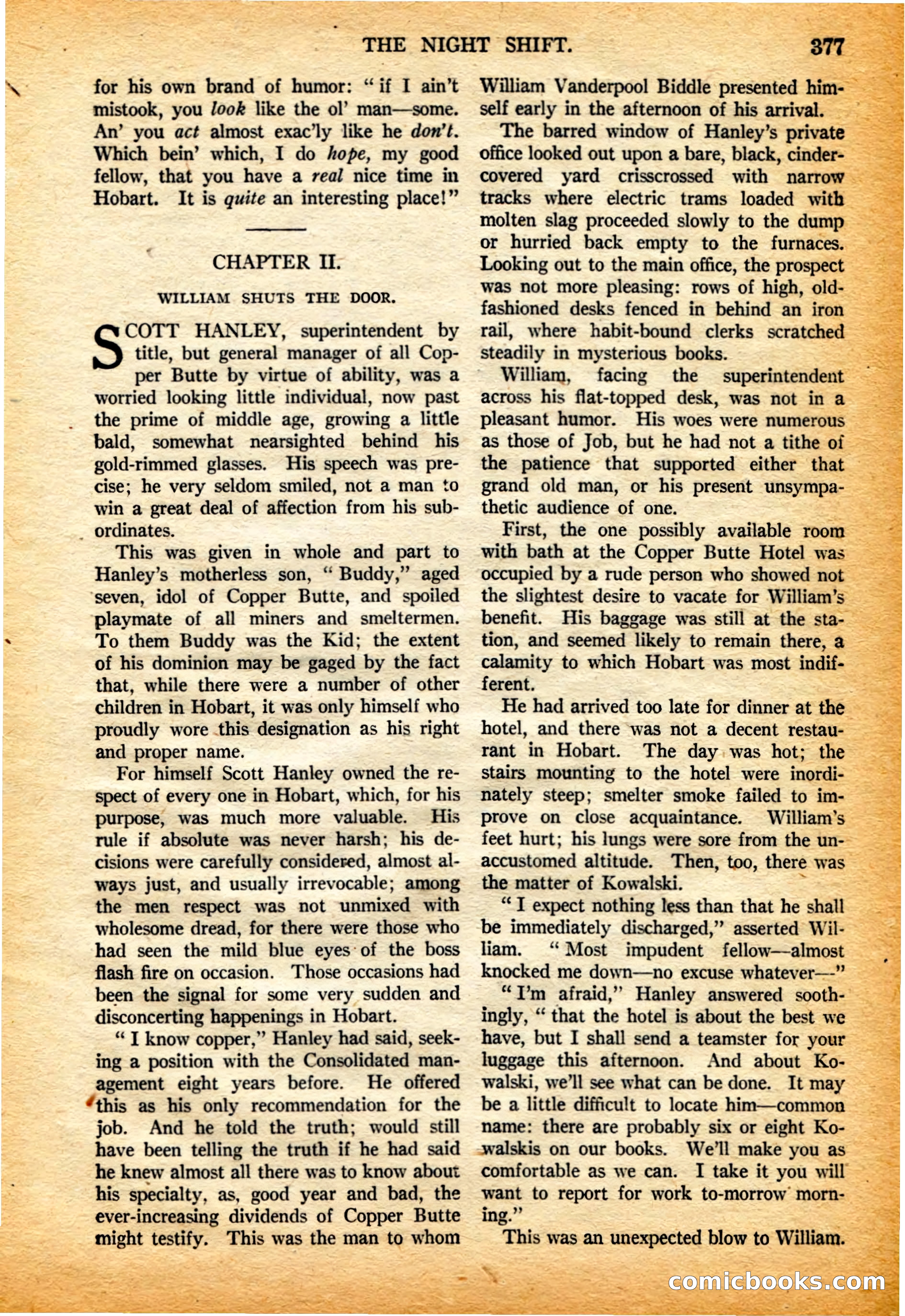
A restored page from Pulp Fiction, 1922. Page through the whole issue in the reader above.
📄 Transcribed text from this page (OCR, searchable)
Machine-transcribed from the original scan — historical spelling and the odd misread are preserved.
, > % Y | ne eS ~ a - Com a. : —_ Fs “ - = a —— % ee aS —— a 7 oa a —— Ae _— - . ae Se " ae, © * See ad =< © =A, Siow < PG ie ER Bes Serres Pe er oa ESS — IS <--* J a, “. —— Se ae - eee for his own brand of humor: “ if I ain’t mistook, you look like the ol’ man—some. An’ you act almost exac’ly like he don’t. Which bein’ which, I do hope, my good fellow, that you have a real nice time in Hobart. It is quite an interesting place!” CHAPTER II. WILLIAM SHUTS THE DOOR. COTT HANLEY, superintendent by title, but general manager of all Cop- per Butte by virtue of ability, was a worried looking little individual, now past the prime of middle age, growing a little bald, somewhat nearsighted behind his gold-rimmed glasses. His speech was pre- cise; he very seldom smiled, not a man to win a great deal of affection from his sub- _ ordinates. This was given in whole and part to Hanley’s motherless son, “ Buddy,” aged ‘seven, idol of Copper Butte, and spoiled playmate of all miners and smeltermen. To them Buddy was the Kid; the extent of his dominion may be gaged by the fact that, while there were a number of other children in Hobart, it was only himself who proudly wore this designation as his right and proper name. For himself Scott Hanley owned the re- spect of every one in Hobart, which, for his purpose, was much more valuable. His rule if absolute was never harsh; his de- cisions were carefully considered, almost al- ways just, and usually irrevocable; among the men respect was not unmixed with wholesome dread, for there were those who had seen the mild blue eyes of the boss flash fire on occasion. Those occasions had been the signal for some very sudden and disconcerting happenings in Hobart. “ IT know copper,”’ Hanley had said, seek- ing a position with the Consolidated man- PS ene eight years before. He offered “this as his only recommendation for the job. And he told the truth; would still have been telling the truth if he had said he knew almost all there was to know about his specialty, as, good year and bad, the ever-increasing dividends of Copper Butte Ee testify. This was the man nt9 a ~* wid - d >»* - ——_ — ’ ~~ Es = : Pace ——— Soe = ns cs a ; Y a a ee a ome * en CP re ee eae a A te Se ne ig Son William Vanderpool Biddle presented fi him- — self early in the afternoon of his sri Fe The barred window of Hanley’s private — office looked out upon a bare, black, cinder- — covered yard crisscrossed with narro vo : tracks where electric trams loaded with — molten slag proceeded slowly to the dump > or hurried back empty to the furnaces. ~ Looking out to the main office, the prospect _ BS was not more pleasing: rows of high, old- — fashioned desks fenced in behind an i — rail, where habit-bound clerks scratched steadily in mysterious books. ) William, facing the superintendet ent across his flat-topped desk, was not in = - pleasant humor. His woes were numerous ~ as those of Job, but he had not a tithe o = the patience that supported either that grand old man, or his present unsympa- = thetic audience of one. ees First, the one possibly available roor with bath at the Copper Butte Hotel was occupied by a rude person who showed not = = the slightest desire to vacate for William’s pee benefit. His baggage was still at the sta- tion, and seemed likely to remain there, = = calamity to which Hobart was most indif- = ferent. — = He had arrived too late for dinner at the hotel, and there was not a decent restau- rant in Hobart. The day was hot; the — stairs mounting to the hotel were inordi- — nately steep; smelter smoke failed to im- prove on close acquaintance. William’s 3 feet hurt; his lungs were sore from the un-— accustomed altitude. Then, too, there was” the matter of Kowalski. = “I expect nothing less than that he shall be immediately discharged,” asserted Wil- liam. ‘“ Most impudent fellow—almost knocked me down—no excuse whatever— “I’m afraid,” Hanley answered sooth- a ingly, “that the hotel is about the best we have, but I shall send a teamster for your — = luggage this afternoon. And about Ko- — walski, we'll see what can be done. It may — be a little difficult to locate hia nai ale | name: there are probably six or eight Ko- _ wwalskis on our books. We'll make you as = comfortable as we can. I take it you will want to report for work to-morrow morn- : ing. ” &, ee . This was an unexpected blow ney villi iar m. ~_— eo Sj - 3 oe ree me Si ee Sa — ~ ms oe “ss _ @ Ns a ee a ». ~ 2 ~ comic CE Poin = ~ i re —= ; “ a * = = aS -_—