
Pulp Fiction, 1922 · page 148 of 180
Argosy All-Story Weekly, 4 February 1922 — page 148: what you’re looking at
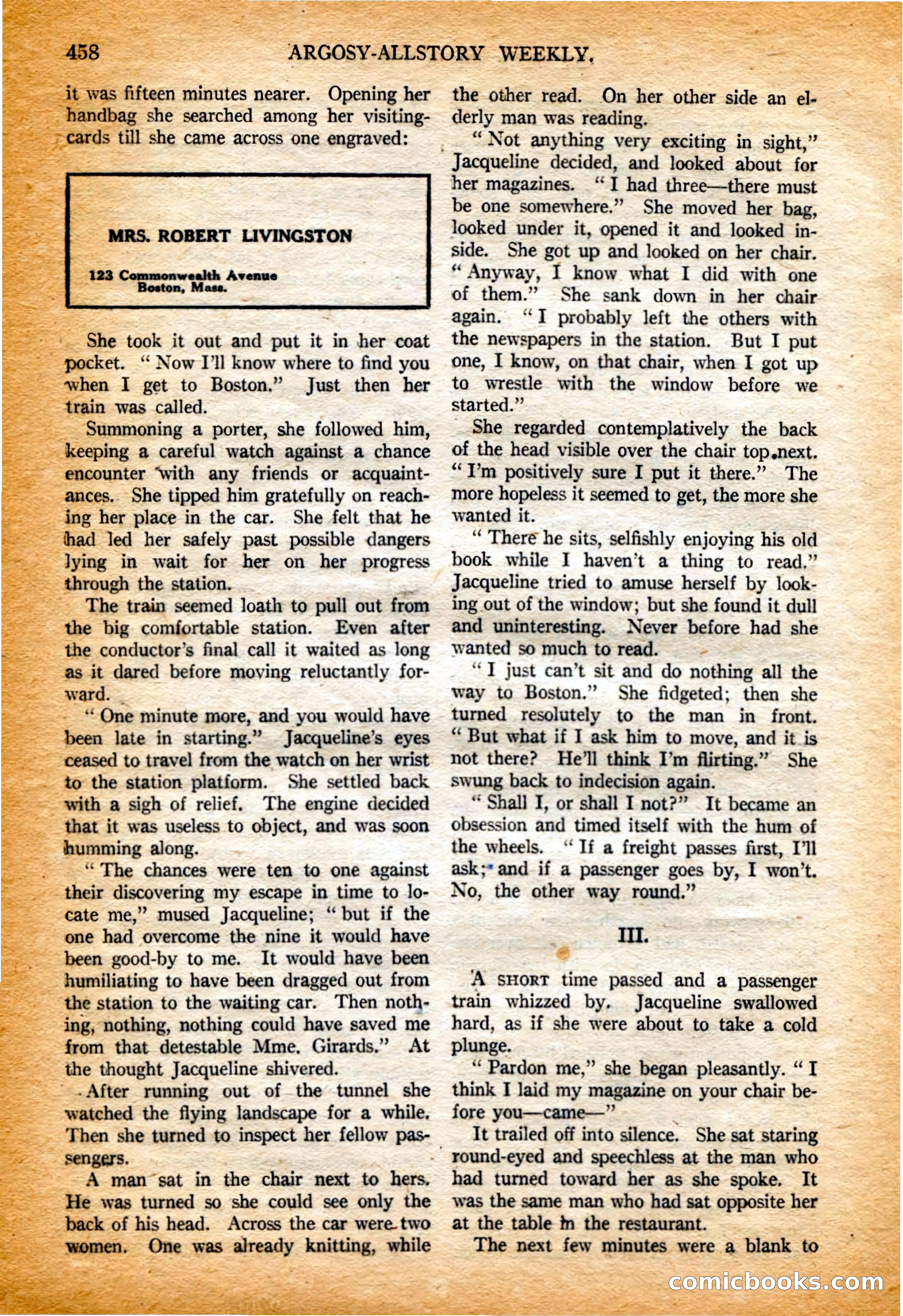
A restored page from Pulp Fiction, 1922. Page through the whole issue in the reader above.
📄 Transcribed text from this page (OCR, searchable)
Machine-transcribed from the original scan — historical spelling and the odd misread are preserved.
it was fifteen minutes nearer. Opening her _- handbag she searched among her visiting- "cards till she came across one engraved: eine MRS. ROBERT LIVINGSTON Boston, Mass. _- _«. She took it out and put it in her coat pocket. “ Now I'll know where to find you when I get to Boston.” Just then her train was called. Summoning a porter, she followed him, keeping a careful watch against a chance encounter “with any friends or acquaint- ances.. She tipped him gratefully on reach- ing her place in the car. She felt that he - had Jed her safely past possible dangers '- Jying in wait for her on her progress through the station. = The train seemed loath to pull out from the big comfortable station. Even after the conductor’s final call it waited as long as it dared before moving reluctantly for- ward. | ‘““One minute more, and you would have | been late in starting.” Jacqueline’s eyes ceased to travel from the watch on her wrist | to the station platform. She settled back with a sigh of relief. The engine decided that it was useless to object, and was soon humming along. “The chances were ten to one against their discovering my escape in time to lo- cate me,” mused Jacqueline; “ but if the one had overcome the nine it would have _. been good-by to me. It would have been = humiliating to have been dragged out from _. _ the station to the waiting car. Then noth- . ing, nothing, nothing could have saved me s from that detestable Mme, Girards,” At the thought Jacqueline shivered. -.After running out ofthe tunnel she watched the flying landscape for a while, Then she turned to inspect her fellow pas- =A man’ sat in the chair next to ner He was turned so she could see only the back of his head. Across the car were. two Sees: women. One was aizeasly knitting, while ARGOSY-ALLSTORY WEEKLY, = the other read. On her other side an el- derly man was reading. “Not anything very exciting in sight,” ; Jacqueline decided, and looked about for her magazines. “ I had three—there must be one somewhere.” She moved her bag, looked under it, opened it and looked in- side. She got up and looked on her chair. * Anyway, I know what I did with one of them.” She sank down in her chair again. “I probably left the others with the newspapers in the station. But I put one, I know, on that chair, when I got up to wrestle with the window before we started.” She regarded contemplatively the back of the head visible over the chair top.next. “I’m positively sure I put it there.” The more hopeless it seemed te get, the more she wanted it. ‘ Theré he sits, selfishly enjoying his old book while I haven’t a thing to read.” Jacqueline tried to amuse herself by look- ing out of the window; but she found it dull and uninteresting. Never before had she wanted so much to read. “I just can’t sit and do nothing all the way to Boston.” She fidgeted; then she turned resolutely to the man in front. *‘ But what if I ask him to move, and it_is not there? He’ll think I’m flirting.” She swung back to indecision again. “ Shall I, or shall I not?” It became an obsession and timed itself with the hum of the wheels. “If a freight passes first, I'll ask; and if a passenger goes by, I won’t. No, the other way round.” III. A SHORT time passed and a passenger train whizzed by. Jacqueline swallowed hard, as if she were about to take a cold plunge. “Pardon me,” she began pleasantly. “TI think I laid my magazine on your chair be- fore you—came—”’ : It trailed off into silence. She sat staring round-eyed and speechless at the man who had turned toward her as she spoke. It was the same man who had sat opposite her at the table in the restaurant. The next few minutes were a blank to nicboo (E(0) “S