
Pulp Fiction, 1922 · page 127 of 180
Argosy All-Story Weekly, 4 February 1922 — page 127: what you’re looking at
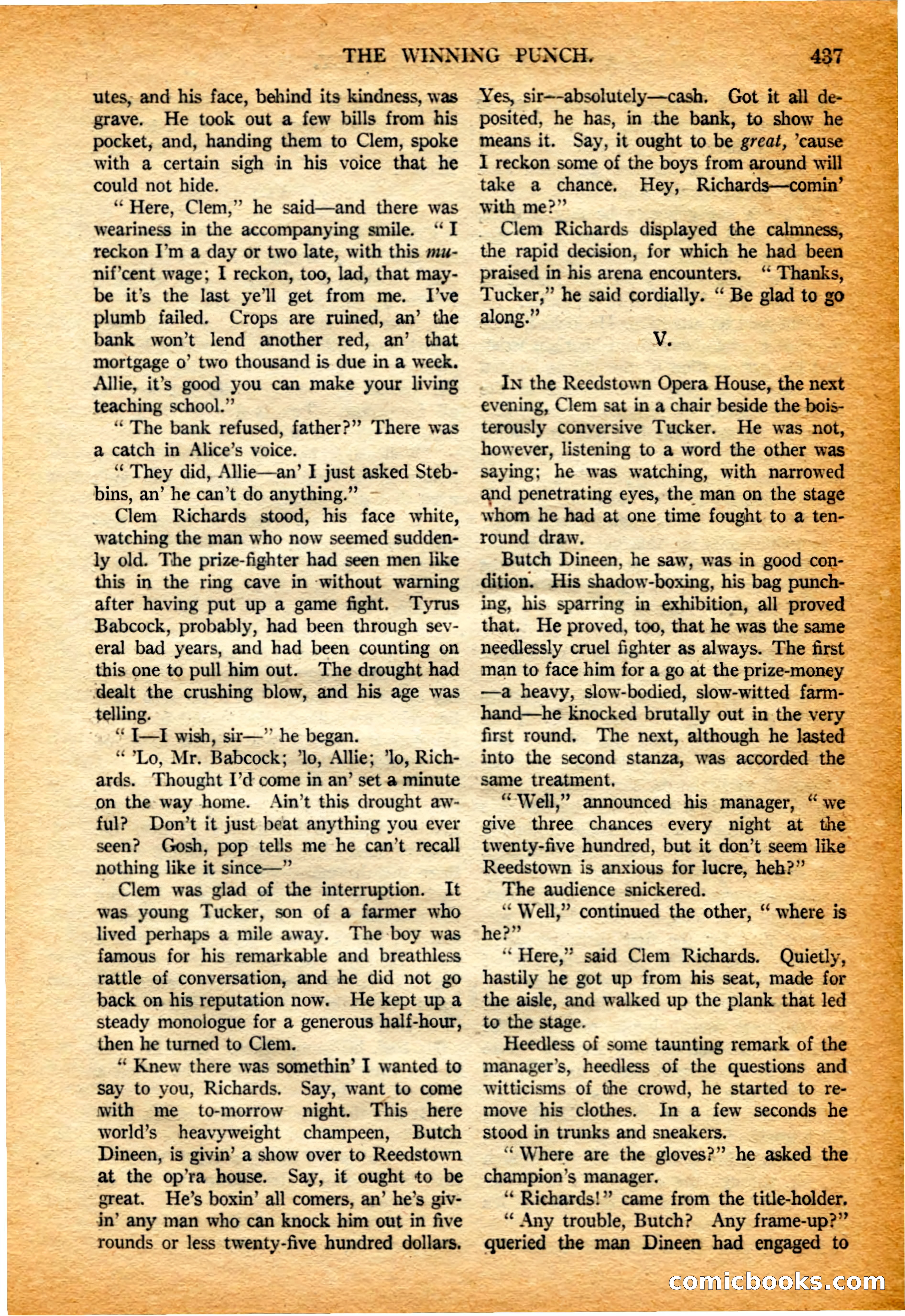
A restored page from Pulp Fiction, 1922. Page through the whole issue in the reader above.
📄 Transcribed text from this page (OCR, searchable)
Machine-transcribed from the original scan — historical spelling and the odd misread are preserved.
THE WINNENG -PUNCH. utes, and his face, behind its kindness, was grave. He took out a few bills from his pocket, and, handing them to Clem, spoke with a certain sigh in his voice that he could not hide. “ Here, Clem,” he said—and there was weariness in the accompanying smile. “I reckon I’m a day or two late, with this mu- nif’cent wage; I reckon, too, lad, that may- be it’s the last yell get from me. I’ve plumb failed. Crops are ruined, an’ the bank won’t lend another red, an’ that mortgage o’ two thousand is due in a week. Allie, it’s good you can make your living teaching school.” “The bank refused, father?” There was a catch in Alice’s voice. “They did, Allie—an’ I just asked Steb- bins, an’ he can’t do anything.” - Clem Richards stood, his face white, watching the man who now seemed sudden- ly old. The prize-fighter had seen men like this in the ring cave in without warning after having put up a game fight. Tyrus Babcock, probably, had been through sev- eral bad years, and had been counting on this one to pull him out. The drought had dealt the crushing blow, and his age was telling. ‘“‘ [—I wish, sir—’’ he began. “ °*Lo, Mr. Babcock; ’lo, Allie; ‘lo, Rich- ards. Thought I’d come in an’ set a minute on the way home. Ain’t this drought aw- ful? Don’t it just beat anything you ever seen? Gosh, pop tells me he can’t recall nothing like it since—” Clem was glad of the interruption. It was young Tucker, son of a farmer who lived perhaps a mile away. The-boy was famous for his remarkable and breathless rattle of conversation, and he did not go back on his reputation now. He kept upa steady monologue for a generous half-hour, then he turned to Clem. “ Knew there was somethin’ I wanted to say to you, Richards. Say, want to come with me to-morrow night. This here world’s heavyweight champeen, Butch Dineen, is givin’ a show over to Reedstown at the op’ra house. Say, it ought to be great. He’s boxin’ all comers, an’ he’s giv- in’ any man who can knock him out in five rounds or less twenty-five hundred dollars. Yes, sir--absolutely—cash, Got it all io 3 posited, he has, in the bank, to show he — means it. Say, it ought to be great, ‘cause I reckon some of the boys from around will take a chance, Hey, Richards—comin’ with me?”’ Clem Richards displayed the calmness“ the rapid decision, for which he had been praised in his arena encounters. “ Thanks, Tucker,” he said cordially. “ Be glad to go along. a V. In the Reedstown Opera House, the next evening, Clem sat in a chair beside the bois- — terously conversive Tucker. He was not, however, listening to a word the other was saying; he was watching, with narrowed and penetrating eyes, the man on the stage -~ whom he had at one time fought to a ten- round draw. Butch Dineen, he saw, was in good con- dition. His shadow- -boxing, his bag punch- ing, his sparring in exhibition, all proved — that. He proved, too, that he was the same needlessly cruel fighter as always. The first man to face him for a go at the prize-money —a heavy, slow-bodied, slow-witted farm- hand—he knocked brutally out in the very first round. The next, although he lasted into the second stanza, was accorded = Same treatment, “Well,” announced his manager, “we give three chances every night at the twenty-five hundred, but it don’t seem like ~ Reedstown is anxious for lucre, heh?” The audience snickered. : ‘“ Well,” continued the other, “ where is he?” ‘* Here,” said Clem Richards. Quietly, . hastily he got up from his seat, made for the aisle, and walked up the plank that led to the stage. , Heedless of some taunting remark of the manager’s, heedless of the questions and witticisms of the crowd, he started to re- move his clothes. In a few seconds he stood in trunks and sneakers. “Where are the gloves?” he asked the champion’s manager. ‘“‘ Richards!” came from the title-holder, “ Any trouble, Butch? Any frame-up?” queried the man Dineen had engaged to Lt com (E ) Vd boo . a” ie Le is 4 > J 7 » able dl y {> bad Piy se? AY ry oa u : o¥ ts’ eh a> sy + J ; vf Al} ~ (*, _ oy nN . 1-0 4 “s 5s 4 Rf; wale ree | ye : wy - ‘i . a Ly uh UA ais Vt Wh To tA be MAM aa ee oy 74 iver TT ae th, ae : eo SUA ERIN 1 K ~~ 4 * P , p ¥ BOM Fos Po ‘ } A Aa) adits) 2 BAA ; ‘ ' / os © eves WO Ne : com f A‘.