
Pulp Fiction, 1922 · page 118 of 180
Argosy All-Story Weekly, 4 February 1922 — page 118: what you’re looking at
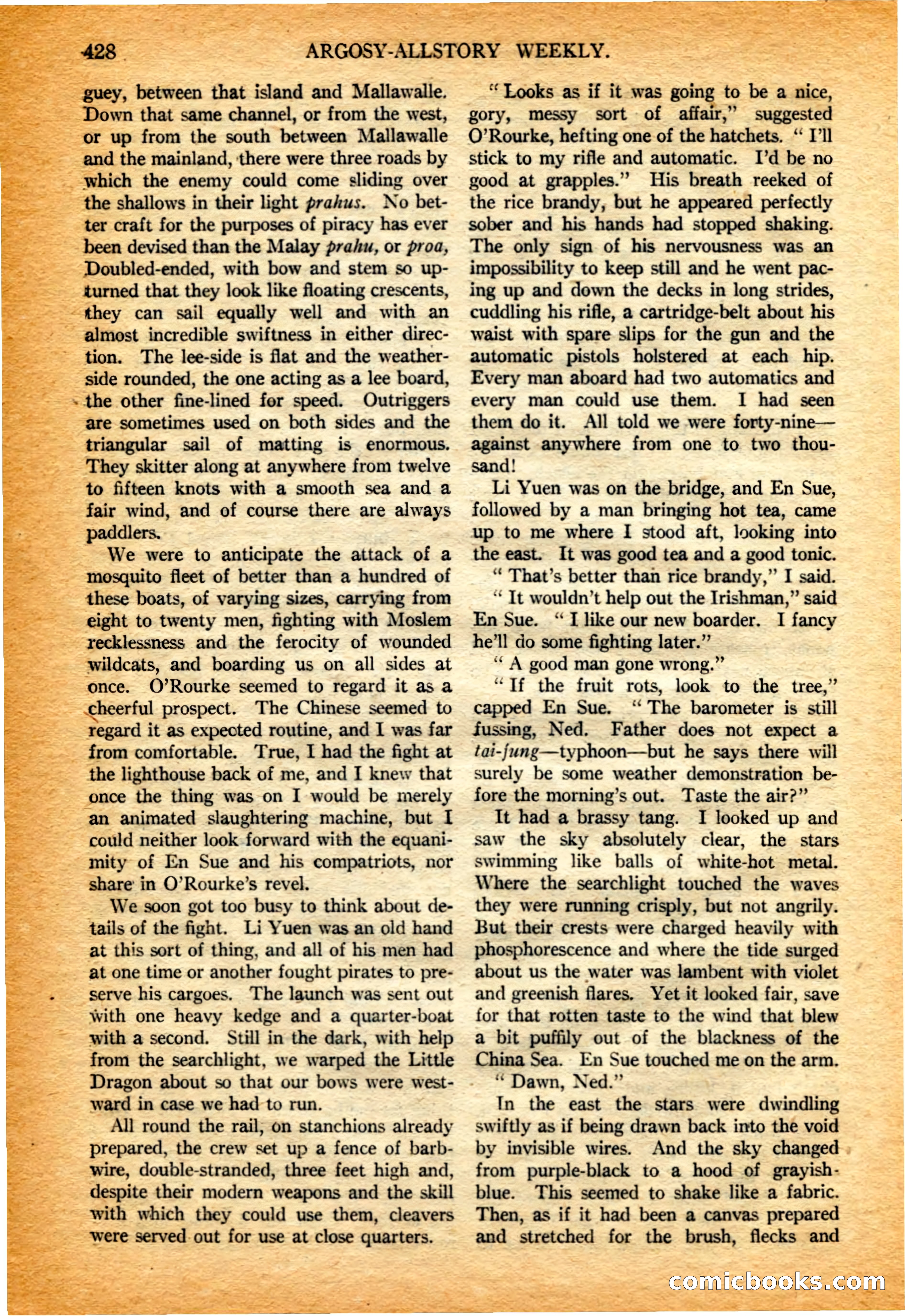
A restored page from Pulp Fiction, 1922. Page through the whole issue in the reader above.
📄 Transcribed text from this page (OCR, searchable)
Machine-transcribed from the original scan — historical spelling and the odd misread are preserved.
guey, between that island and Mallawalle. Down that same channel, or from the west, or up from the south between Mallawalle and the mainland, ‘there were three roads by which the enemy could come sliding over the shallows in their light prakus. No bet- ter craft for the purposes of piracy has ever been devised than the Malay prahu, or proa, Doubled-ended, with bow and stem so up- turned that they look like floating crescents, they can sail equally well and with an almost incredible swiftness in either direc- tion. The lee-side is flat and the weather- side rounded, the one acting as a lee board, - the other fine-lined for speed. Outriggers are sometimes used on both sides and the triangular sail of matting is enormous. They skitter along at anywhere from twelve to fifteen knots with a smooth sea and a fair wind, and of course there are always paddlers. We were to anticipate the attack of a mosquito fleet of better than a hundred of these boats, of varying sizes, carrying from eight to twenty men, fighting with Moslem recklessness and the ferocity of wounded wildcats, and boarding us on all sides at once. O’Rourke seemed to regard it as a cheerful prospect. The Chinese seemed to regard it as expected routine, and I was far from comfortable. True, I had the fight at the lighthouse back of me, and I knew that once the thing was on I would be merely an animated slaughtering machine, but I could neither look forward with the equani- mity of En Sue and his compatriots, nor share in O’Rourke’s revel. We soon got too busy to think about de- tails of the fight. Li Yuen was an old hand at this sort of thing, and all of his men had at one time or another fought pirates to pre- serve his cargoes. The launch was sent out with one heavy kedge and a quarter-boat with a second. Still in the dark, with help from the searchlight, we warped the Little Dragon about so that our bows were west- ward in case we had to run. All round the rail; on stanchions already prepared, the crew set up a fence of barb- wire, double-stranded, three feet high and, despite their modern weapons and the skill with which they could use them, cleavers were served out for use at close quarters. ~ ARGOSY-ALLSTORY WEEKLY. “Looks as if it was going to be a nice, gory, messy sort of affair,” suggested O’Rourke, hefting one of the hatchets. “ I'll stick to my rifle and automatic. I’d be no good at grapples.” His breath reeked of the rice brandy, but he appeared perfectly sober and his hands had stopped shaking. The only sign of his nervousness was an impossibility to keep still and he went pac- ing up and down the decks in long strides, cuddling his rifle, a cartridge-belt about his waist with spare slips for the gun and the automatic pistols holstered at each hip. Every man aboard had two automatics and every man could use them. I had seen them do it. All told we were forty-nine— against anywhere from one to two thou- sand! Li Yuen was on the bridge, and En Sue, followed by a man bringing hot tea, came up to me where I stood aft, looking into the east. It was good tea and a good tonic. “ That’s better than rice brandy,” I said. ‘* It wouldn’t help out the Irishman,” said En Sue. “I like our new boarder. I fancy he’ll do some fighting later.’’ ‘““ A good man gone wrong.” “Tf the fruit rots, look to the tree,” capped En Sue. “ The barometer is still fussing, Ned. Father does not expect a tai-fung—typhoon—but he says there will surely be some weather demonstration be- fore the morning’s out. Taste the air?” It had a brassy tang. I looked up and saw the sky absolutely clear, the stars swimming like balls of white-hot metal. Where the searchlight touched the waves they were running crisply, but not angrily. But their crests were charged heavily with phosphorescence and where the tide surged about us the water was lambent with violet and greenish flares. Yet it looked fair, save for that rotten taste to the wind that blew a bit puffily out of the blackness of the China Sea. En Sue touched me on the arm. “Dawn, Ned.” In the east the stars were dwindling swiftly as if being drawn back into the void by invisible wires. And the sky changed from purple-black to a hood of grayish- blue. This seemed to shake like a fabric. Then, as if it had been a canvas prepared and stretched for the brush, flecks and Lt Gomicbooks;com