
Pulp Fiction, 1922 · page 111 of 180
Argosy All-Story Weekly, 4 February 1922 — page 111: what you’re looking at
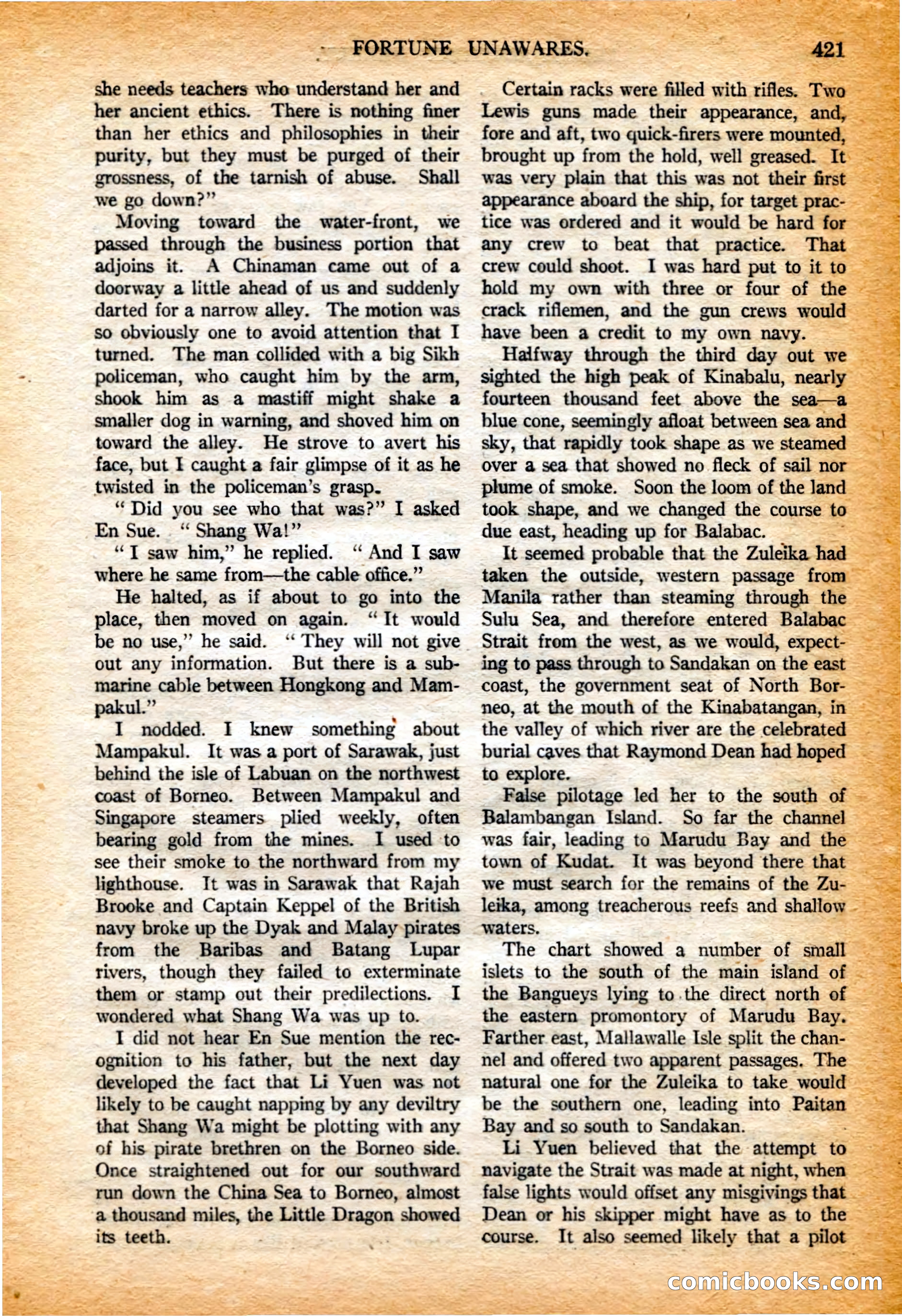
A restored page from Pulp Fiction, 1922. Page through the whole issue in the reader above.
📄 Transcribed text from this page (OCR, searchable)
Machine-transcribed from the original scan — historical spelling and the odd misread are preserved.
FORTUNE UNAWARES. she needs teachers who understand her and her ancient ethics. There is nothing finer than her ethics and philosophies in their purity, but they must be purged of their grossness, of the tarnish of abuse. Shall we go down?” Moving toward the water-front, we passed through the business portion that adjoins it. A Chinaman came out of a doorway a little ahead of us and suddenly darted for a narrow alley. The motion was so obviously one to avoid attention that I turned. The man collided with a big Sikh policeman, who caught him by the arm, shook him as a mastiff might shake a smaller dog in warning, and shoved him on toward the alley. He strove to avert his face, but I caught a fair glimpse of it as he twisted in the policeman’s grasp. “Did you see who that was?” I asked En Sue. ‘‘ Shang Wa!” ‘““T saw him,” he replied. ‘“ And I saw where he same from—the cable office.” He halted, as if about to go into the place, then moved on again. “It would be no use,’’ he said. ‘‘ They will not give out any information. But there is a sub- marine cable between Hongkong and Mam- pakul. b I nodded. I knew something about Mampakul. It was a port of Sarawak, just behind the isle of Labuan on the northwest coast of Borneo. Between Mampakul and Singapore steamers plied weekly, often bearing gold from the mines. I used to see their smoke to the northward from my lighthouse. It was in Sarawak that Rajah Brooke and Captain Keppel of the British navy broke up the Dyak and Malay pirates from the Baribas and Batang Lupar rivers, though they failed to exterminate them or stamp out their predilections. I wondered what Shang Wa was up to. I did not hear En Sue mention the rec- ognition to his father, but the next day developed the fact that Li Yuen was not likely to be caught napping by any deviltry that Shang Wa might be plotting with any of his pirate brethren on the Borneo side. Once straightened out for our southward run down the China Sea to Borneo, almost a thousand miles, the Little pHa showed its teeth. Certain racks were filled with rifles. Two Lewis guns made their appearance, and, — fore and aft, two quick-firers were mounted, brought up from the hold, well greased. It was very plain that this was not their first appearance aboard the ship, for target prac- tice was ordered and it would be hard for any crew to beat that practice. That crew could shoot. I was hard put to it to hold my own with three or four of the crack riflemen, and the gun crews would have been a credit to my own navy. Halfway through the third day out we sighted the high peak of Kinabalu, nearly fourteen thousand feet above the sea—a blue cone, seemingly afloat between sea and sky, that rapidly took shape as we steamed over a sea that showed no fleck of sail nor plume of smoke. Soon the loom of the Jand took shape, and we changed the course to due east, heading up for Balabac. It seemed probable that the Zuleika had taken the outside, western passage from Manila rather than steaming through the Sulu Sea, and therefore entered Balabac Strait from the west, as we would, expect- ing to pass through to Sandakan on the east coast, the government seat of North Bor- neo, at the mouth of the Kinabatangan, in the valley of which river are the celebrated burial caves that Raymond Dean had hoped =. to explore. False pilotage led her to the south of Balambangan Island. So far the channel was fair, leading to Marudu Bay and the town of Kudat. It was beyond there that we must search for the remains of the Zu- letka, among treacherous reefs and shallow - waters. The chart showed a number of small islets to the south of the main island of | the Bangueys lying to. the direct north of the eastern promontory of Marudu Bay. Farther east, Mallawalle Isle split the chan- nel and offered two apparent passages. The natural one for the Zuleika to take would be the southern one, leading into Paitan Bay and so south to Sandakan. Li Yuen believed that the attempt to navigate the Strait was made at night, when false lights would offset any misgivings that Dean or his skipper might have as to the course. It also seemed likely that a pilot Gomicbooks com -