
Pulp Fiction, 1922 · page 103 of 180
Argosy All-Story Weekly, 4 February 1922 — page 103: what you’re looking at
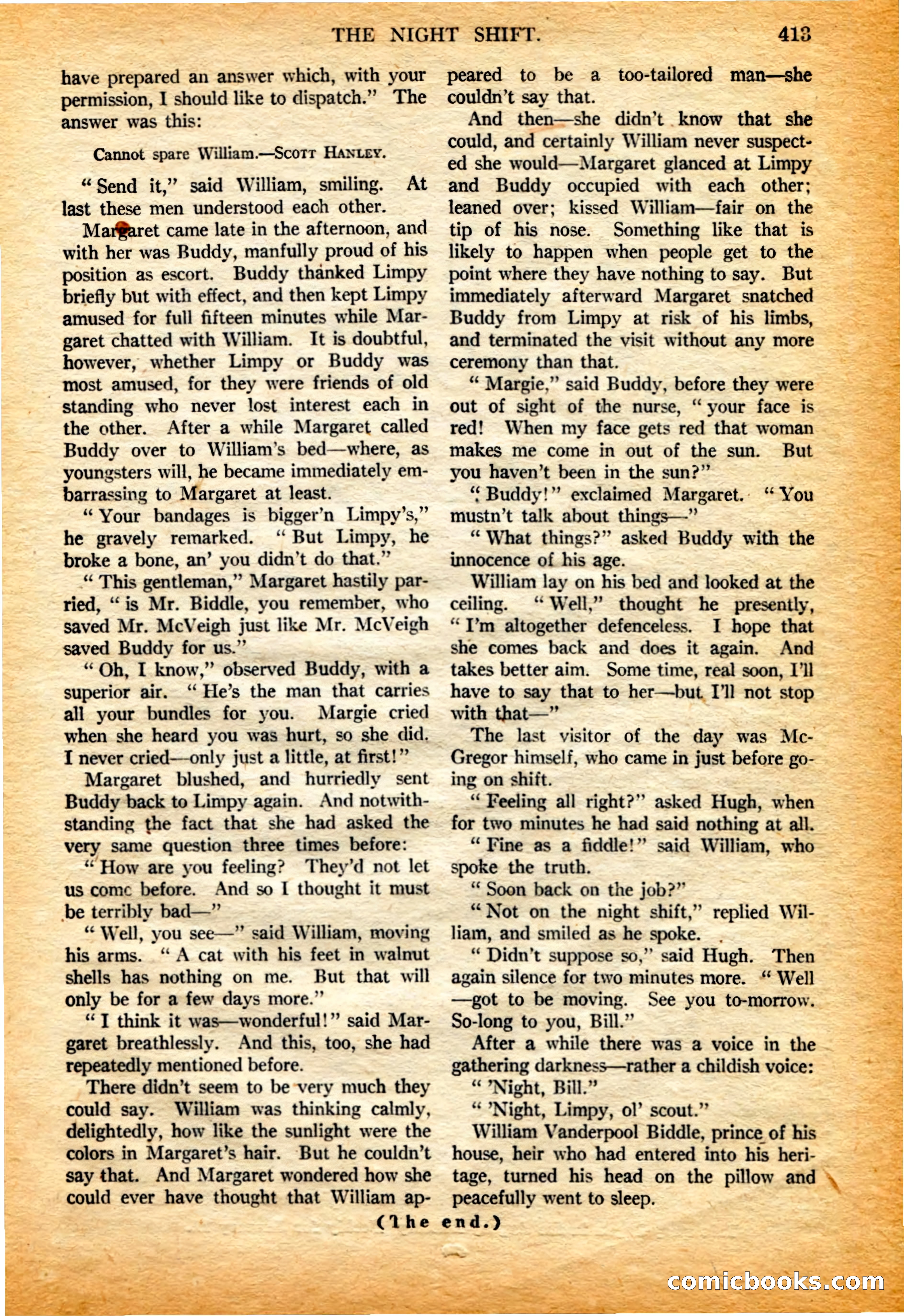
A restored page from Pulp Fiction, 1922. Page through the whole issue in the reader above.
📄 Transcribed text from this page (OCR, searchable)
Machine-transcribed from the original scan — historical spelling and the odd misread are preserved.
have prepared an answer which, with your permission, I should like to dispatch.” The answer was this: Cannot spare William.—Scotr HANLEvy. “Send it,’’ said William, smiling. At last these men understood each other. Mar@aret came late in the afternoon, and with her was Buddy, manfully proud of his position as escort. Buddy thanked Limpy briefly but with effect, and then kept Limpy amused for full fifteen minutes while Mar- garet chatted with William. It is doubtful, however, whether Limpy or Buddy was most amused, for they were friends of old standing who never lost interest each in the other. After a while Margaret called Buddy over to William’s bed—where, as youngsters will, he became immediately em- barrassing to Margaret at least. “Your bandages is bigger’n Limpy’s,” he gravely remarked. “ But Limpy, he broke a bone, an’ you didn’t do that.” “ This gentleman,” Margaret hastily par- ried, “is Mr. Biddle, you remember, who saved Mr. McVeigh just like Mr. McVeigh saved Buddy for us.” “ Oh, I know,” observed Buddy, with a superior air. ‘‘ He’s the man that carries all your bundles for you. Margie cried when she heard you was hurt, so she did. I never cried—only just a little, at first!” Margaret blushed, and hurriedly sent Buddy back to Limpy again. And notwith- standing the fact that she had asked the very same question three times before: “How are you feeling? They’d not let us come before. And so I thought it must be terribly bad—”’ “ Well, you see—”’ said William, moving his arms. “A cat with his feet in walnut shells has nothing on me. But that will only be for a few days more.” “T think it was—wonderful!” said Mar- garet breathlessly. And this, too, she had repeatedly mentioned before. There didn’t seem to be very much they could say. William was thinking calmly, delightedly, how like the sunlight were the colors in Margaret’s hair. But he couldn’t say that. And Margaret wondered how she could ever have thought that William ap- THE NIGHT SHIFT. 413 peared to be a_ too-tailored man—she couldn’t say that. And then—she didn’t know that she could, and certainly William never suspect- ed she would—Margaret glanced at Limpy and Buddy occupied with each other; leaned over; kissed William—fair on the tip of his nose. Something like that is likely to happen when people get to the point where they have nothing to say. But immediately afterward Margaret snatched Buddy from Limpy at risk of his limbs, and terminated the visit without any more ceremony than that. “ Margie,” said Buddy, before they were out of sight of the nurse, “ your face is red! When my face gets red that woman makes me come in out of the sun. But you haven’t been in the sun?” “* Buddy!” exclaimed Margaret.- “ You mustn’t talk about things—”’ “ What things?” asked Buddy with the innocence of his age. William lay on his bed and looked at the ceiling. “ Well,” thought he presenily, “T’m altogether defenceless. I hope that she comes back and does it again. And takes better aim. Some time, real soon, I'll have to say that to her—but I'll not stop with that—” The last visitor of the day was Mc- Gregor himself, who came in just before go- ing on shift. “ Feeling all right?” asked Hugh, when for two minutes he had said nothing at all. “Tine as a fiddle!” said William, who spoke the truth. “Soon back on the job?” “Not on the night shift,” replied Wil- liam, and smiled as he spoke. . “ Didn’t suppose so,” said Hugh. Then again silence for two minutes more. “ Well —got to be moving. See you to-morrow. So-long to you, Bill.” After a while there was a voice in the gathering darkness—rather a childish voice: “ *Night, Bill.” “Night, Limpy, ol’ scout.” William Vanderpool Biddle, prince of his house, heir who had entered into his heri- tage, turned his head on the pillow and \ peacefully went to sleep. (The end.) - —. comicbook CO