
Pulp Fiction, 1875 · page 395 of 400
The Argosy — page 395: what you’re looking at
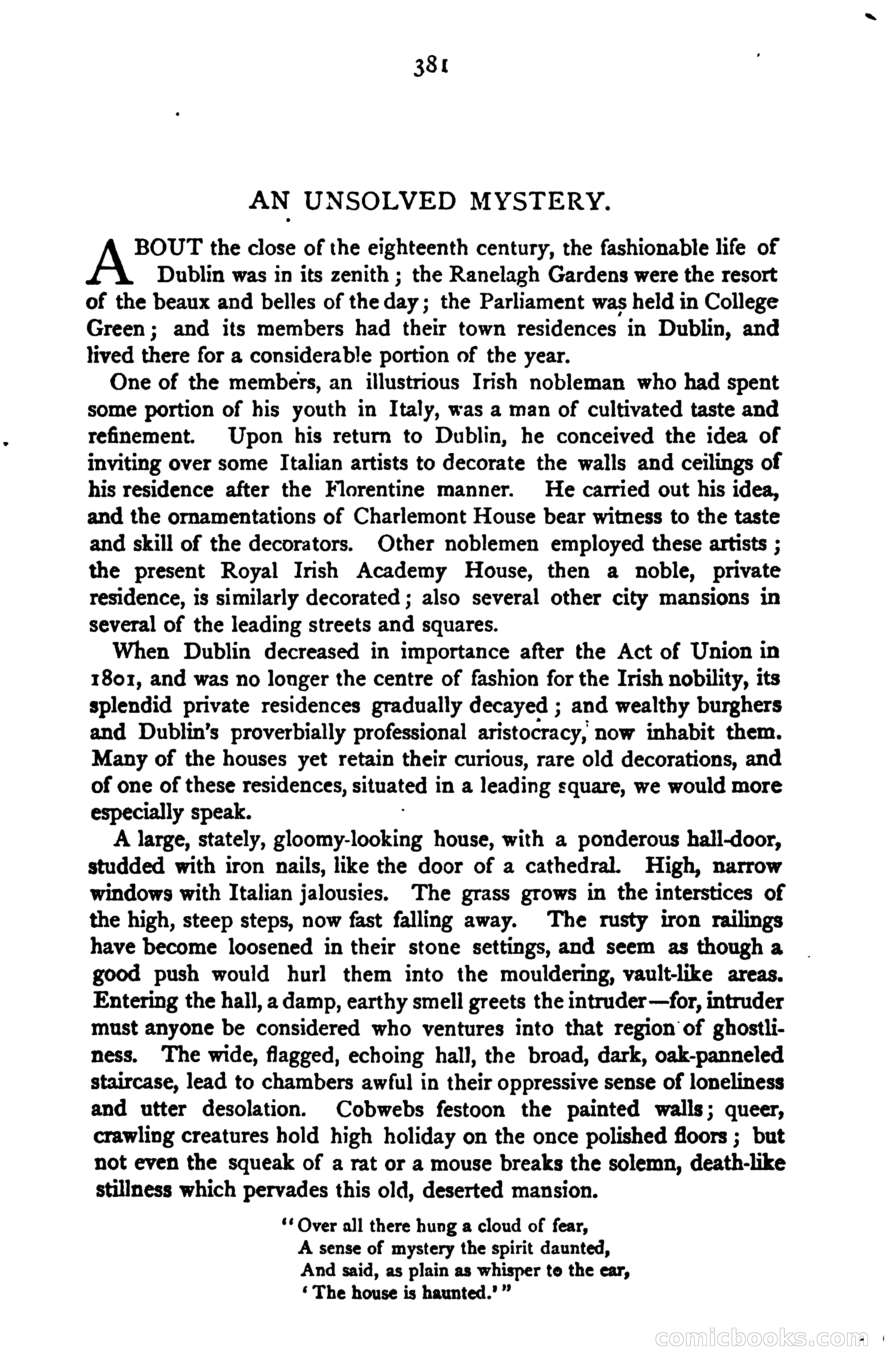
A restored page from Pulp Fiction, 1875. Page through the whole issue in the reader above.
📄 Transcribed text from this page (OCR, searchable)
Machine-transcribed from the original scan — historical spelling and the odd misread are preserved.
381 AN UNSOLVED MYSTERY. BOUT the close of the eighteenth century, the fashionable life of Dublin was in its zenith ; the Ranelagh Gardens were the resort of the beaux and belles of the day; the Parliament was held in College Green; and its members had their town residences in Dublin, and lived there for a considerable portion of the year. One of the members, an illustrious Irish nobleman who had spent some portion of his youth in Italy, was a man of cultivated taste and refinement. Upon his return to Dublin, he conceived the idea of inviting over some Italian artists to decorate the walls and ceilings of his residence after the Florentine manner. He carried out his idea, and the ornamentations of Charlemont House bear witness to the taste and skill of the decorators. Other noblemen employed these artists ; the present Royal Irish Academy House, then a noble, private residence, is similarly decorated ; also several other city mansions in several of the leading streets and squares. When Dublin decreased in importance after the Act of Union in 1801, and was no longer the centre of fashion for the Irish nobility, its splendid private residences gradually decayed ; and wealthy burghers and Dubhmn’s proverbially professional aristocracy, now inhabit them. Many of the houses yet retain their curious, rare old decorations, and of one of these residences, utunted in a leading square, we would more especially speak. A large, stately, gloomy-looking house, with a ponderous hall-door, studded with iron nails, like the door of a cathedral. High, narrow windows with Italian jalousies. The grass grows in the interstices of the high, steep steps, now fast falling away. The rusty iron railings have become loosened in their stone settings, and seem as though a good push would hurl them into the mouldering, vault-like areas. Entering the hall, a damp, earthy smell greets the intruder —for, intruder must anyone be considered who ventures into that region of ghostli- ness. The wide, flagged, echoing hall, the broad, dark, oak-panneled staircase, lead to chambers awful in their oppressive sense of loneliness and utter desolation. Cobwebs festoon the painted walls; queer, crawling creatures hold high holiday on the once polished floors ; but not even the squeak of a rat or a mouse breaks the solemn, death-like stillness which pervades this old, deserted mansion. ‘* Over all there hung a cloud of fear, A sense of mystery the spirit daunted, And said, as plain as whisper to the ear, ‘The house is haunted.’ ” COLMA a) NOOKS (CO)