
Pulp Fiction, 1875 · page 377 of 400
The Argosy — page 377: what you’re looking at
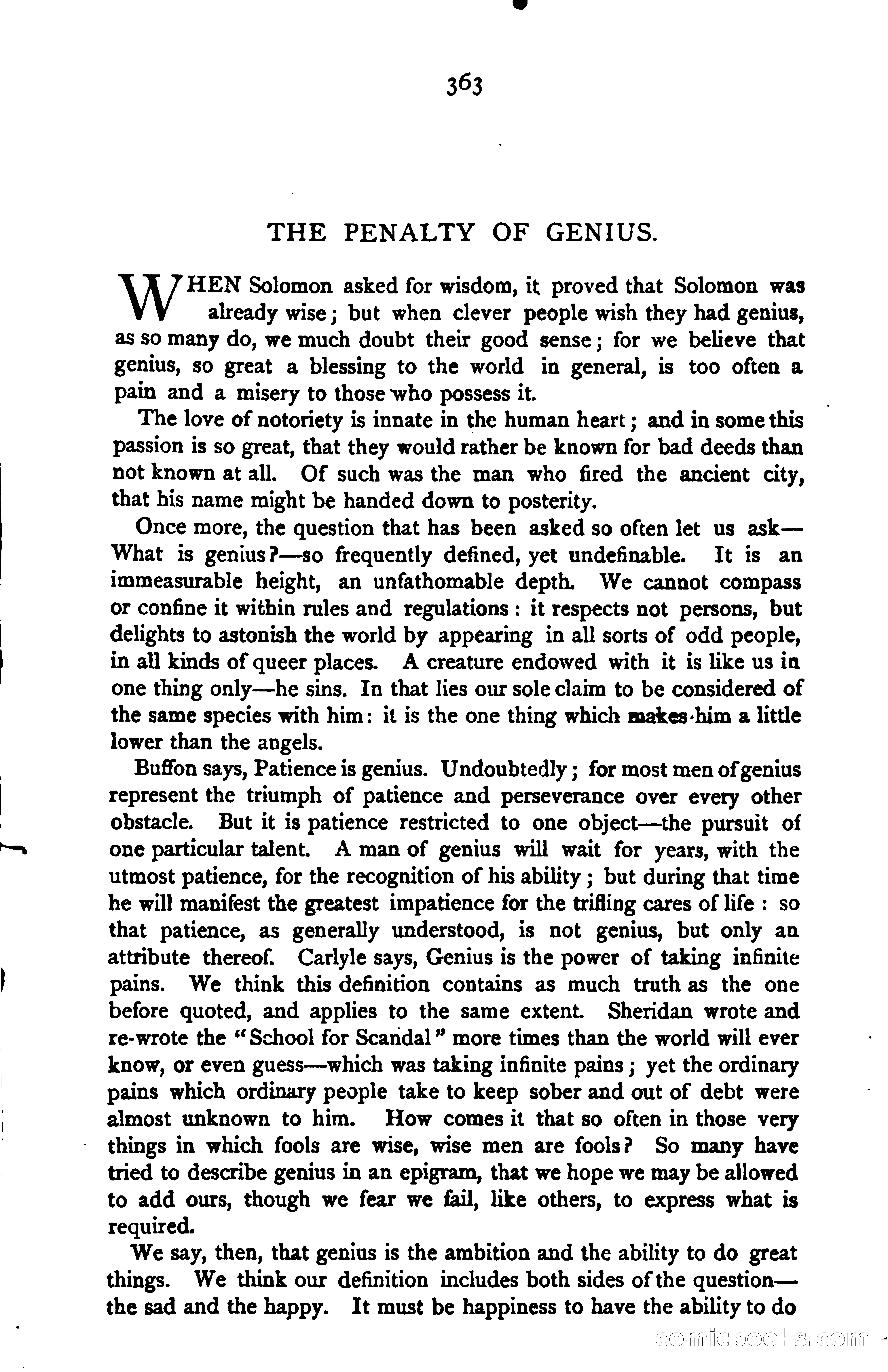
A restored page from Pulp Fiction, 1875. Page through the whole issue in the reader above.
📄 Transcribed text from this page (OCR, searchable)
Machine-transcribed from the original scan — historical spelling and the odd misread are preserved.
363 THE PENALTY OF GENIUS. HEN Solomon asked for wisdom, it proved that Solomon was already wise; but when clever people wish they had genius, as SO many do, we much doubt their good sense; for we believe that genius, so great a blessing to the world in general, is too often a pain and a misery to those who possess it. The love of notoriety is innate in the human heart ; and in some this passion is so great, that they would rather be known for bad deeds than not known at all. Of such was the man who fired the ancient city, that his name might be handed down to posterity. Once more, the question that has been asked so often let us ask— What is genius?—so frequently defined, yet undefinable. It is an immeasurable height, an unfathomable depth. We cannot compass or confine it within rules and regulations: it respects not persons, but delights to astonish the world by appearing in all sorts of odd people, in all kinds of queer places. A creature endowed with it is like us in one thing only—he sins. In that lies our sole claim to be considered of the same species with him: it is the one thing which makes-him a little lower than the angels. Buffon says, Patience is genius. Undoubtedly ; for most men of genius represent the triumph of patience and perseverance over every other obstacle. But it is patience restricted to one object—the pursuit of one particular talent. A man of genius will wait for years, with the utmost patience, for the recognition of his ability ; but during that time he will manifest the greatest impatience for the trifling cares of life: so that patience, as generally understood, is not genius, but only an attribute thereof. Carlyle says, Genius is the power of taking infinite pains. We think this definition contains as much truth as the one before quoted, and applies to the same extent. Sheridan wrote and re-wrote the “School for Scandal” more times than the world will ever know, or even guess—which was taking infinite pains ; yet the ordinary pains which ordinary people take to keep sober and out of debt were almost unknown to him. How comes it that so often in those very things in which fools are wise, wise men are fools? So many have tried to describe genius in an epigram, that we hope we may be allowed to add ours, though we fear we fail, like others, to express what is required. We say, then, that genius is the ambition and the ability to do great things. We think our definition includes both sides of the question— the sad and the happy. It must be happiness to have the ability to do CORnniclooolkks (CO)