
Pulp Fiction, 1875 · page 370 of 400
The Argosy — page 370: what you’re looking at
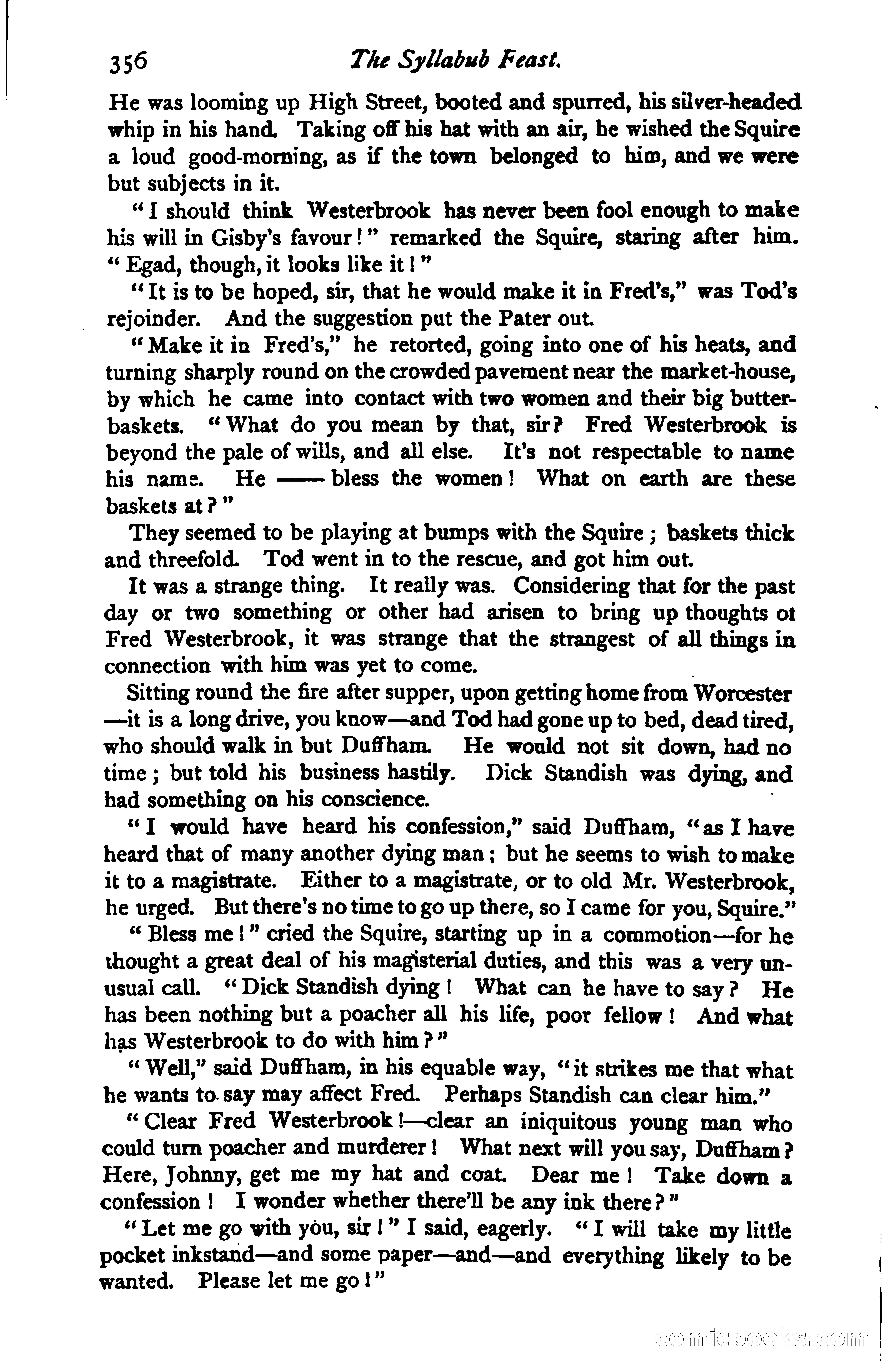
A restored page from Pulp Fiction, 1875. Page through the whole issue in the reader above.
📄 Transcribed text from this page (OCR, searchable)
Machine-transcribed from the original scan — historical spelling and the odd misread are preserved.
356 The Syllabub Feast. He was looming up High Street, booted and spurred, his silver-headed. whip in his hand. Taking off his hat with an air, he wished the Squire a loud good-morning, as if the town belonged to him, and we were but subjects in it. “T should think Westerbrook has never been fool enough to make his will in Gisby’s favour!” remarked the Squire, staring after him. ‘‘ Egad, though, it looks like it!” ‘It is to be hoped, sir, that he would make it in Fred’s,” was Tod’s rejoinder. And the suggestion put the Pater out. ‘¢ Make it in Fred’s,” he retorted, going into one of his heats, and turning sharply round on the crowded pavement near the market-house, by which he came into contact with two women and their big butter- baskets. ‘“‘ What do you mean by that, sir? Fred Westerbrook is beyond the pale of wills, and all else. It’s not respectable to name his name. He bless the women! What on earth are these baskets at?” They seemed to be playing at bumps with the Squire ; baskets thick and threefold. ‘Tod went in to the rescue, and got him out. It was a strange thing. It really was. Considering that for the past day or two something or other had arisen to bring up thoughts ot Fred Westerbrook, it was strange that the strangest of all things in connection with him was yet to come. | Sitting round the fire after supper, upon getting home from Worcester — it is a long drive, you know—and Tod had gone up to bed, dead tired, who should walk in but Duffham. He would not sit down, had no time ; but told his business hastily. Dick Standish was dying, and had something on his conscience. ‘I would have heard his confession,” said Duffham, “as I have heard that of many another dying man; but he seems to wish to make it to a magistrate. Either to a magistrate, or to old Mr. Westerbrook, he urged. But there’s no time to go up there, so I came for you, Squire.” ‘‘ Bless me!” cried the Squire, starting up in a commotion—for he thought a great deal of his magisterial duties, and this was a very un- usual call. ‘Dick Standish dying! What can he haveto say? He has been nothing but a poacher all his life, poor fellow! And what has Westerbrook to do with him ?” “Well,” said Duffham, in his equable way, “it strikes me that what he wants to.say may affect Fred. Perhaps Standish can clear him.” “ Clear Fred Westerbrook !—clear an iniquitous young man who could turn poacher and murderer! What next will yousay, Duffham? Here, Johnny, get me my hat and coat. Dear me! Take down a confession ! I wonder whether there’ll be any ink there?” “Let me go with you, sir!” I said, eagerly. ‘I will take my little pocket inkstand—and some paper—and—and everything likely to be wanted. Please let me go!” CORnniclooolkks (CO)