
Pulp Fiction, 1875 · page 320 of 400
The Argosy — page 320: what you’re looking at
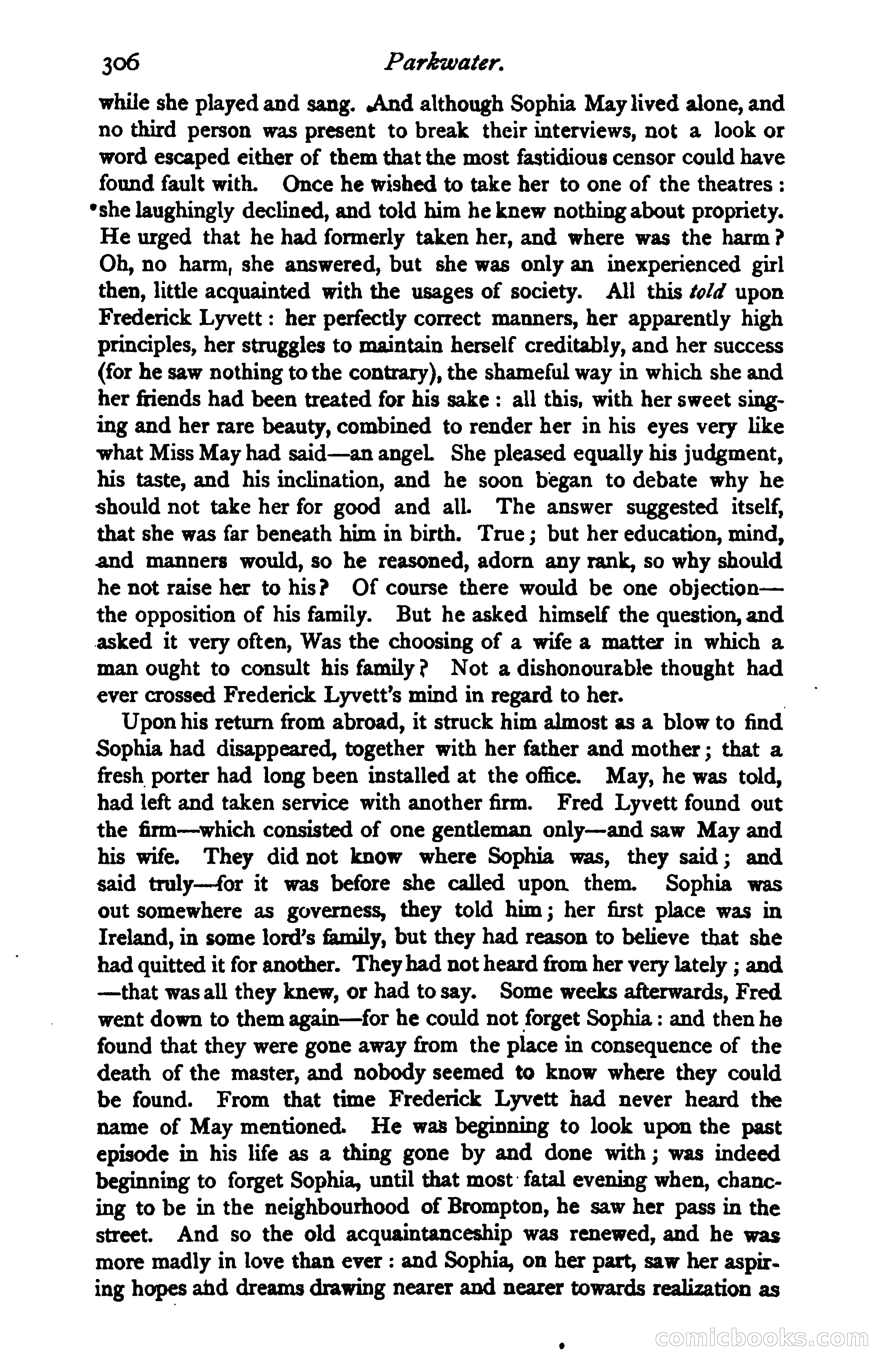
A restored page from Pulp Fiction, 1875. Page through the whole issue in the reader above.
📄 Transcribed text from this page (OCR, searchable)
Machine-transcribed from the original scan — historical spelling and the odd misread are preserved.
306 Parkwater. while she played and sang. And although Sophia May lived alone, and no third person was present to break their interviews, not a look or word escaped either of them that the most fastidious censor could have found fault with. Once he wished to take her to one of the theatres : *she laughingly declined, and told him he knew nothing about propriety. He urged that he had formerly taken her, and where was the harm? Oh, no harm, she answered, but she was only an inexperienced girl then, little acquainted with the usages of society. All this o/d upon Frederick Lyvett : her perfectly correct manners, her apparently high principles, her struggles to maintain herself creditably, and her success (for he saw nothing tothe contrary), the shameful way in which she and her friends had been treated for his sake: all this, with her sweet sing- ing and her rare beauty, combined to render her in his eyes very like what Miss May had said—an angel. She pleased equally his judgment, his taste, and his inclination, and he soon began to debate why he should not take her for good and all. The answer suggested itself, that she was far beneath him in birth. True; but her education, mind, and manners would, so he reasoned, adorn any rank, so why should he not raise her to his? Of course there would be one objection— the opposition of his family. But he asked himself the question, and asked it very often, Was the choosing of a wife a matter in which a man ought to consult his family? Not a dishonourable thought had ever crossed Frederick Lyvett’s mind in regard to her. Upon his return from abroad, it struck him almost as a blow to find Sophia had disappeared, together with her father and mother; that a fresh porter had long been installed at the office. May, he was told, had left and taken service with another firm. Fred Lyvett found out the firm—which consisted of one gentleman only—and saw May and his wife. They did not know where Sophia was, they said; and said truly—for it was before she called upon them. Sophia was out somewhere as governess, they told him; her first place was in Ireland, in some lord’s family, but they had reason to believe that she had quitted it for another. They had not heard from her very lately ; and —that was all they knew, or had tosay. Some weeks afterwards, Fred. went down to them again—for he could not forget Sophia : and then he found that they were gone away from the place in consequence of the death of the master, and nobody seemed to know where they could be found. From that time Frederick Lyvett had never heard the name of May mentioned. He was beginning to look upon the past episode in his life as a thing gone by and done with; was indeed beginning to forget Sophia, until that most: fatal evening when, chanc- ing to be in the neighbourhood of Brompton, he saw her pass in the street. And so the old acquaintanceship was renewed, and he was more madly in love than ever : and Sophia, on her part, saw her aspir- ing hopes ahd dreams drawing nearer and nearer towards realization as ; CONNICLO©© SS (CO)