
Pulp Fiction, 1875 · page 316 of 400
The Argosy — page 316: what you’re looking at
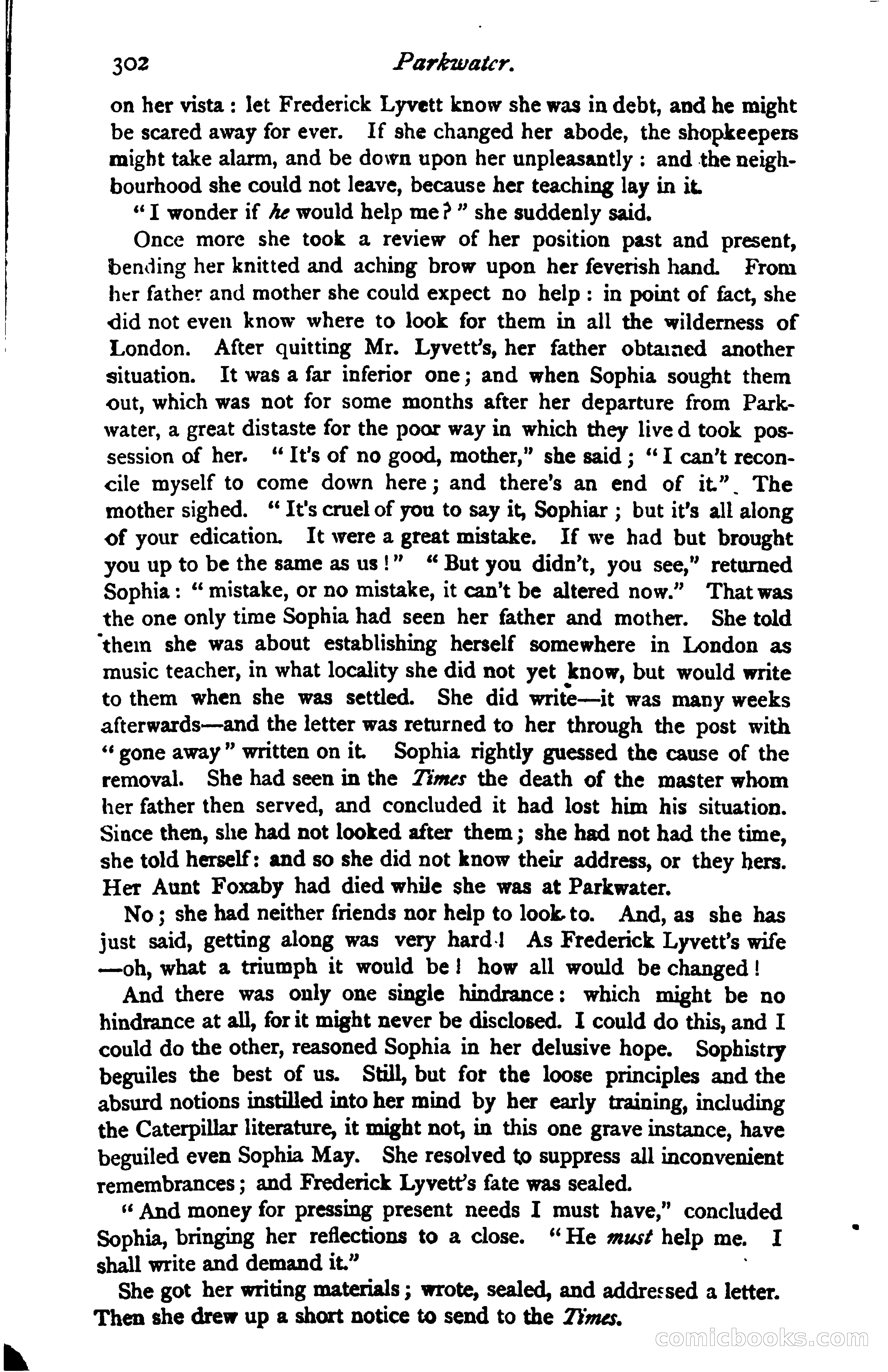
A restored page from Pulp Fiction, 1875. Page through the whole issue in the reader above.
📄 Transcribed text from this page (OCR, searchable)
Machine-transcribed from the original scan — historical spelling and the odd misread are preserved.
302 Parkwater. on her vista: let Frederick Lyvett know she was in debt, and he might be scared away for ever. If she changed her abode, the shopkeepers might take alarm, and be down upon her unpleasantly : and the neigh- bourhood she could not leave, because her teaching lay in it. ‘‘T wonder if Ae would help me?” she suddenly said. Once more she took a review of her position past and present, bending her knitted and aching brow upon her feverish hand. From her father and mother she could expect no help: in point of fact, she did not even know where to look for them in all the wilderness of London. After quitting Mr. Lyvett’s, her father obtained another situation. It was a far inferior one; and when Sophia sought them out, which was not for some months after her departure from Park- water, a great distaste for the poor way in which they lived took pos- session of her. “It’s of no good, mother,” she said ; “I can’t recon- cile myself to come down here; and there’s an end of it”. The mother sighed. “It's cruel of you to say it, Sophiar ; but it’s all along of your edication. It were a great mistake. If we had but brought you up to be the same as us!” “ But you didn’t, you see,” returned Sophia: “ mistake, or no mistake, it can’t be altered now.” That was the one only time Sophia had seen her father and mother. She told ‘them she was about establishing herself somewhere in London as music teacher, in what locality she did not yet know, but would write to them when she was settled. She did write—it was many weeks afterwards—and the letter was returned to her through the post with ‘¢ gone away” written on it. Sophia rightly guessed the cause of the removal. She had seen in the Zimes the death of the master whom her father then served, and concluded it had lost him his situation. Since then, she had not looked after them; she had not had the time, she told herself: and so she did not know their address, or they hers. Her Aunt Foxaby had died while she was at Parkwater. No; she had neither friends nor help to look-to. And, as she has just said, getting along was very hard-! As Frederick Lyvett’s wife —oh, what a triumph it would be! how all would be changed ! And there was only one single hindrance: which might be no hindrance at all, for it might never be disclosed. I could do this, and I could do the other, reasoned Sophia in her delusive hope. Sophistry beguiles the best of us. Stil, but for the loose principles and the absurd notions instilled into her mind by her early training, including the Caterpillar literature, it might not, in this one grave instance, have beguiled even Sophia May. She resolved to suppress all inconvenient remembrances; and Frederick Lyvett’s fate was sealed. ‘© And money for pressing present needs I must have,” concluded Sophia, bringing her reflections to a close. “He must help me. I shall write and demand it.” She got her writing materials ; wrote, sealed, and addressed a letter. Then she drew up a short notice to send to the Z}mes. GONMGIOO SS (CO)