
Pulp Fiction, 1875 · page 310 of 400
The Argosy — page 310: what you’re looking at
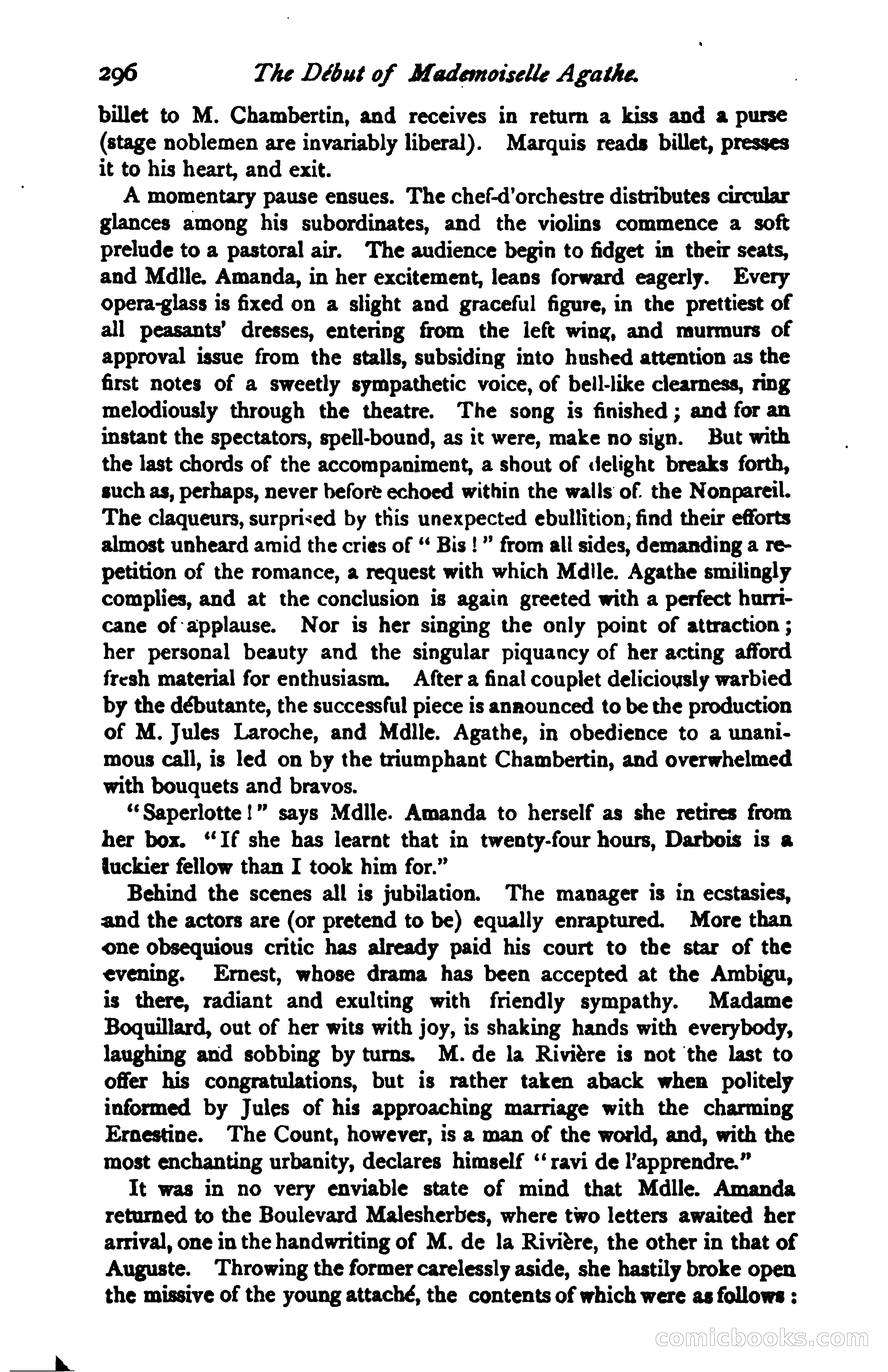
A restored page from Pulp Fiction, 1875. Page through the whole issue in the reader above.
📄 Transcribed text from this page (OCR, searchable)
Machine-transcribed from the original scan — historical spelling and the odd misread are preserved.
296 The Début of Mademoiselle Agathe. billet to M. Chambertin, and receives in return a kiss and a purse (stage noblemen are invariably liberal). Marquis reads billet, presses it to his heart, and exit. A momentary pause ensues. The chef-d’orchestre distributes circular glances among his subordinates, and the violins commence a soft prelude to a pastoral air. The audience begin to fidget in therr seats, and Mdlle. Amanda, in her excitement, leans forward eagerly. Every opera-giass is fixed on a slight and graceful figure, in the prettiest of all peasants’ dresses, entering from the ieft wing, and murmurs of approval issue from the stalls, subsiding into hushed attention as the first notes of a sweetly sympathetic voice, of bell-like clearness, ring melodiously through the theatre. The song is finished ; and for an instant the spectators, spell-bound, as it were, make no sign. But with the last chords of the accompaniment, a shout of delight breaks forth, such as, perhaps, never before echoed within the walls of. the Nonpareil. The claqueurs, surprised by this unexpected ebullition; find their efforts almost unheard amid the cries of “‘ Bis!” from all sides, demanding a re- petition of the romance, a request with which Mdile. Agathe smuilingly complies, and at the conclusion is again greeted with a perfect hurri- cane of applause. Nor is her singing the only point of attraction ; her personal beauty and the singular piquancy of her acting afford fresh material for enthusiasm. After a final couplet deliciously warbied by the débutante, the successful piece is announced to be the production of M. Jules Laroche, and Mdlle. Agathe, in obedience to a unani- mous call, is led on by the triumphant Chambertin, and overwhelmed with bouquets and bravos. ‘“‘Saperlotte!” says Mdlle. Amanda to herself as she retires from her box. “If she has learnt that in twenty-four hours, Darbois is a luckier fellow than I took him for.” Behind the scenes all is jubilation. The manager is tn ecstasies, and the actors are (or pretend to be) equally enraptured. More than one obsequious critic has already paid his court to the star of the evening. Ernest, whose drama has been accepted at the Ambigu, is there, radiant and exulting with friendly sympathy. Madame Boquillard, out of her wits with joy, is shaking hands with everybody, laughing and sobbing by turns. M. de la Rivitre is not the last to offer his congratulations, but is rather taken aback when politely informed by Jules of his approaching marriage with the charming Ernestine. The Count, however, is a man of the world, and, with the most enchanting urbanity, declares himself ‘‘ ravi de l’apprendre.” It was in no very enviable state of mind that Mdlle. Amanda returned to the Boulevard Malesherbes, where two letters awaited her arrival, one in the handwriting of M. de la Riviére, the other in that of Auguste. Throwing the former carelessly aside, she hastily broke open the missive of the young attaché, the contents of which were as follows : CORnniclooolkks (CO)