
Pulp Fiction, 1875 · page 306 of 400
The Argosy — page 306: what you’re looking at
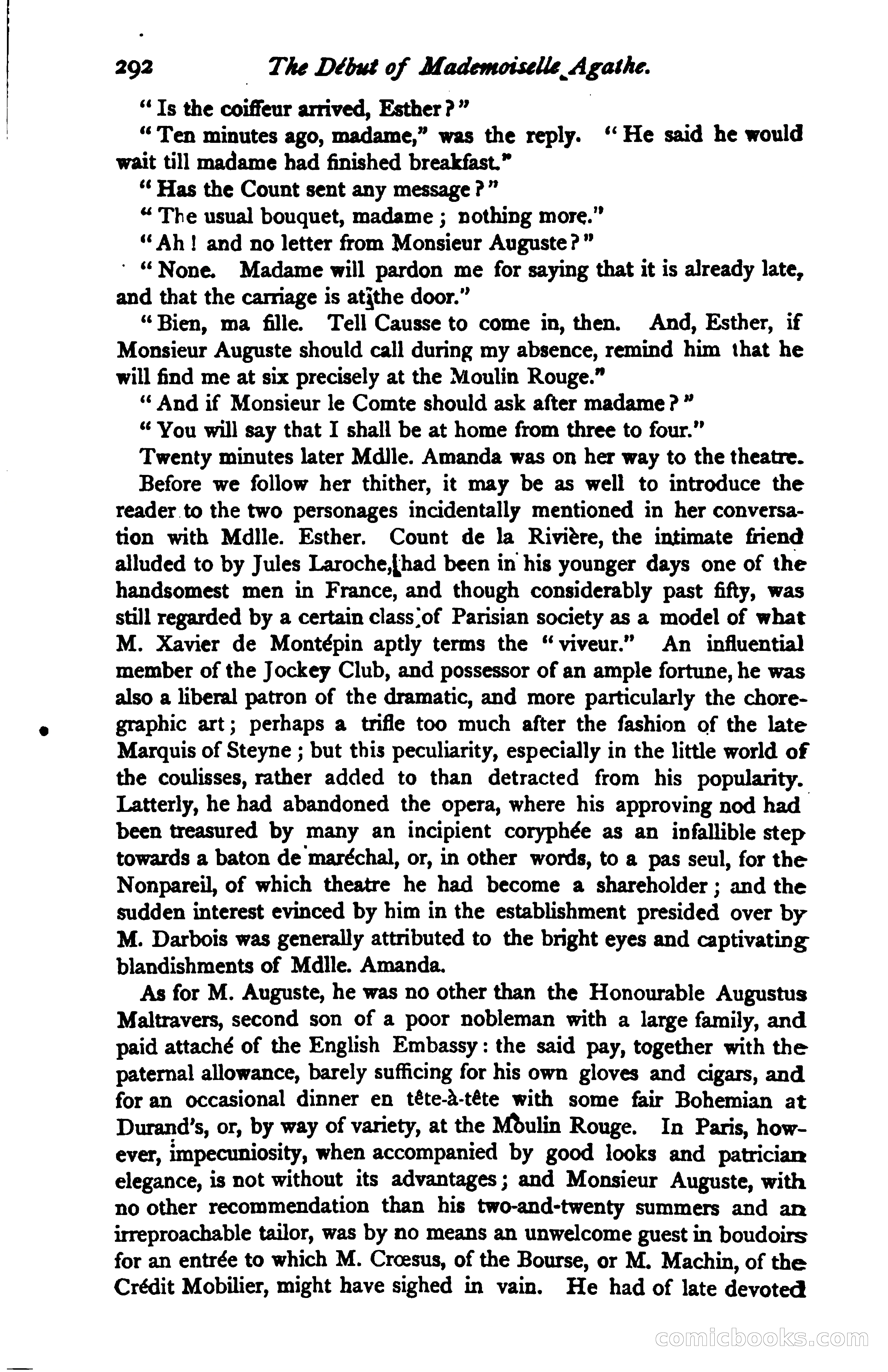
A restored page from Pulp Fiction, 1875. Page through the whole issue in the reader above.
📄 Transcribed text from this page (OCR, searchable)
Machine-transcribed from the original scan — historical spelling and the odd misread are preserved.
292 Ihe Début of Mademoiselle Agathe ‘Is the coiffeur arrived, Esther >” “Ten minutes ago, madame,” was the reply. ‘‘ He said he would wait till madame had finished breakfast.” ‘‘ Has the Count sent any message ?” “The usual bouquet, madame ; nothing more.” ‘Ah! and no letter from Monsieur Auguste ?” ' “None. Madame will pardon me for saying that it is already late, and that the carnage 1s atithe door.” “ Bien, ma fille. Tell Causse to come in, then. And, Esther, if Monsieur Auguste should call during my absence, remind him that he will find me at six precisely at the Moulin Rouge.” “And if Monsieur le Comte should ask after madame ? ” * You will say that I shall be at home from three to four.” Twenty minutes later Mdlle. Amanda was on her way to the theatre. Before we follow her thither, it may be as well to introduce the reader to the two personages incidentally mentioned in her conversa- tion with Mdlle. Esther. Count de Ja Riviere, the intimate frend alluded to by Jules Laroche,{had been in his younger days one of the handsomest men in France, and though considerably past fifty, was still regarded by a certain class.of Pansian society as a model of what M. Xavier de Montépin aptly terms the “viveur.” An _ influential member of the Jockey Club, and possessor of an ample fortune, he was also a liberal patron of the dramatic, and more particularly the chore- graphic art; perhaps a trifle too much after the fashion of the late Marquis of Steyne ; but this peculiarity, especially in the little world of the coulisses, rather added to than detracted from his popularity. Latterly, he had abandoned the opera, where his approving nod had been treasured by many an incipient coryphée as an infallible step towards a baton de maréchal, or, in other words, to a pas seul, for the Nonpareil, of which theatre he had become a shareholder ; and the sudden interest evinced by him in the establishment presided over by M. Darbois was generally attributed to the bright eyes and captivating blandishments of Mdlle. Amanda. As for M. Auguste, he was no other than the Honourable Augustus Maltravers, second son of a poor nobleman with a large family, and paid attaché of the English Embassy: the said pay, together with the paternal allowance, barely sufficing for his own gloves and cigars, and for an occasional dinner en téte-a-téte with some fair Bohemian at Durand’s, or, by way of variety, at the Moulin Rouge. In Paris, how- ever, impecuniosity, when accompanied by good looks and patrician elegance, is not without its advantages; and Monsieur Auguste, with no other recommendation than his two-and-twenty summers and an irreproachable tailor, was by no means an unwelcome guest in boudoirs for an entrée to which M. Croesus, of the Bourse, or M. Machin, of the Crédit Mobilier, might have sighed in vain. He had of late devoted CORnniclooolkks (CO)