
Pulp Fiction, 1875 · page 264 of 400
The Argosy — page 264: what you’re looking at
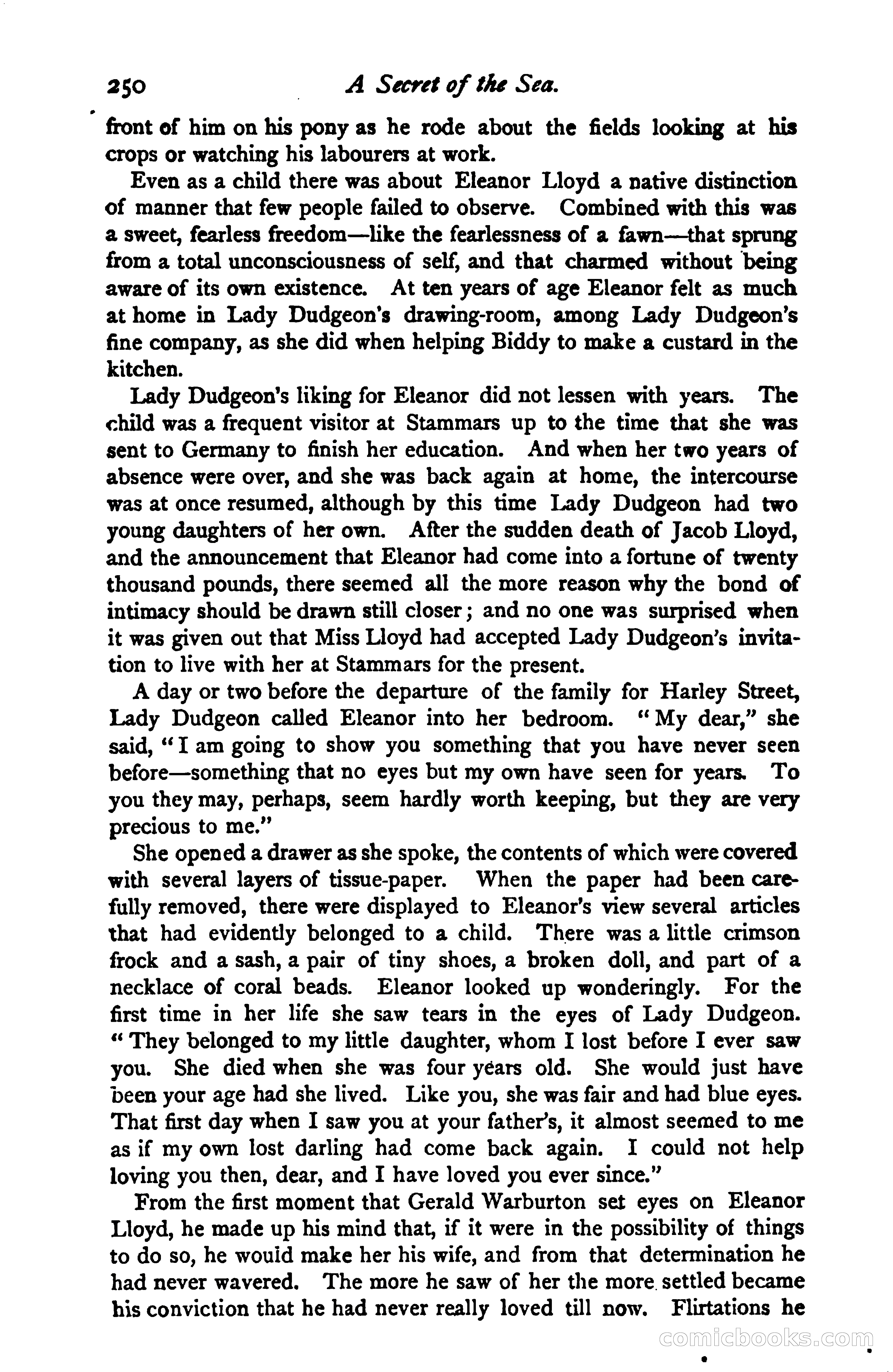
A restored page from Pulp Fiction, 1875. Page through the whole issue in the reader above.
📄 Transcribed text from this page (OCR, searchable)
Machine-transcribed from the original scan — historical spelling and the odd misread are preserved.
250 A Secret of the Sea. front of him on his pony as he rode about the fields looking at his crops or watching his labourers at work. Even as a child there was about Eleanor Lloyd a native distinction of manner that few people failed to observe. Combined with this was 2 sweet, fearless freedom—like the fearlessness of a fawn—that sprung from a total unconsciousness of self, and that charmed without being aware of its own existence. At ten years of age Eleanor felt as much at home in Lady Dudgeon’s drawing-room, among Lady Dudgeon’s fine company, as she did when helping Biddy to make a custard in the kitchen. Lady Dudgeon’s liking for Eleanor did not lessen with years. The child was a frequent visitor at Stammars up to the time that she was sent to Germany to finish her education. And when her two years of absence were over, and she was back again at home, the intercourse was at once resumed, although by this time Lady Dudgeon had two young daughters of her own. After the sudden death of Jacob Lloyd, and the announcement that Eleanor had come into a fortune of twenty thousand pounds, there seemed all the more reason why the bond of intimacy should be drawn still closer; and no one was surpnsed when it was given out that Miss Lloyd had accepted Lady Dudgeon’s invita- tion to live with her at Stammars for the present. A day or two before the departure of the family for Harley Street, Lady Dudgeon called Eleanor into her bedroom. ‘“ My dear,” she said, ‘““I am going to show you something that you have never seen before—something that no eyes but my own have seen for years. To you they may, perhaps, seem hardly worth keeping, but they are very precious to me.” She opened a drawer as she spoke, the contents of which were covered. with several layers of tissue-paper. When the paper had been care- fully removed, there were displayed to Eleanor’s view several articles that had evidently belonged to a child. There was a little crimson frock and a sash, a pair of tiny shoes, a broken doll, and part of a necklace of coral beads. Eleanor looked up wonderingly. For the first time in her life she saw tears in the eyes of Lady Dudgeon. “They belonged to my httle daughter, whom I lost before I ever saw you. She died when she was four yéars old. She would just have been your age had she lived. Like you, she was fair and had blue eyes. That first day when I saw you at your father’s, it almost seemed to me as if my own lost darling had come back again. I could not help loving you then, dear, and I have loved you ever since.” From the first moment that Gerald Warburton set eyes on Eleanor Lloyd, he made up his mind that, if it were in the possibility of things to do so, he would make her his wife, and from that determination he had never wavered. The more he saw of her the more settled became his conviction that he had never really loved till now. Flirtations he ecomniclooolkks _ (CO)