
Pulp Fiction, 1875 · page 234 of 400
The Argosy — page 234: what you’re looking at
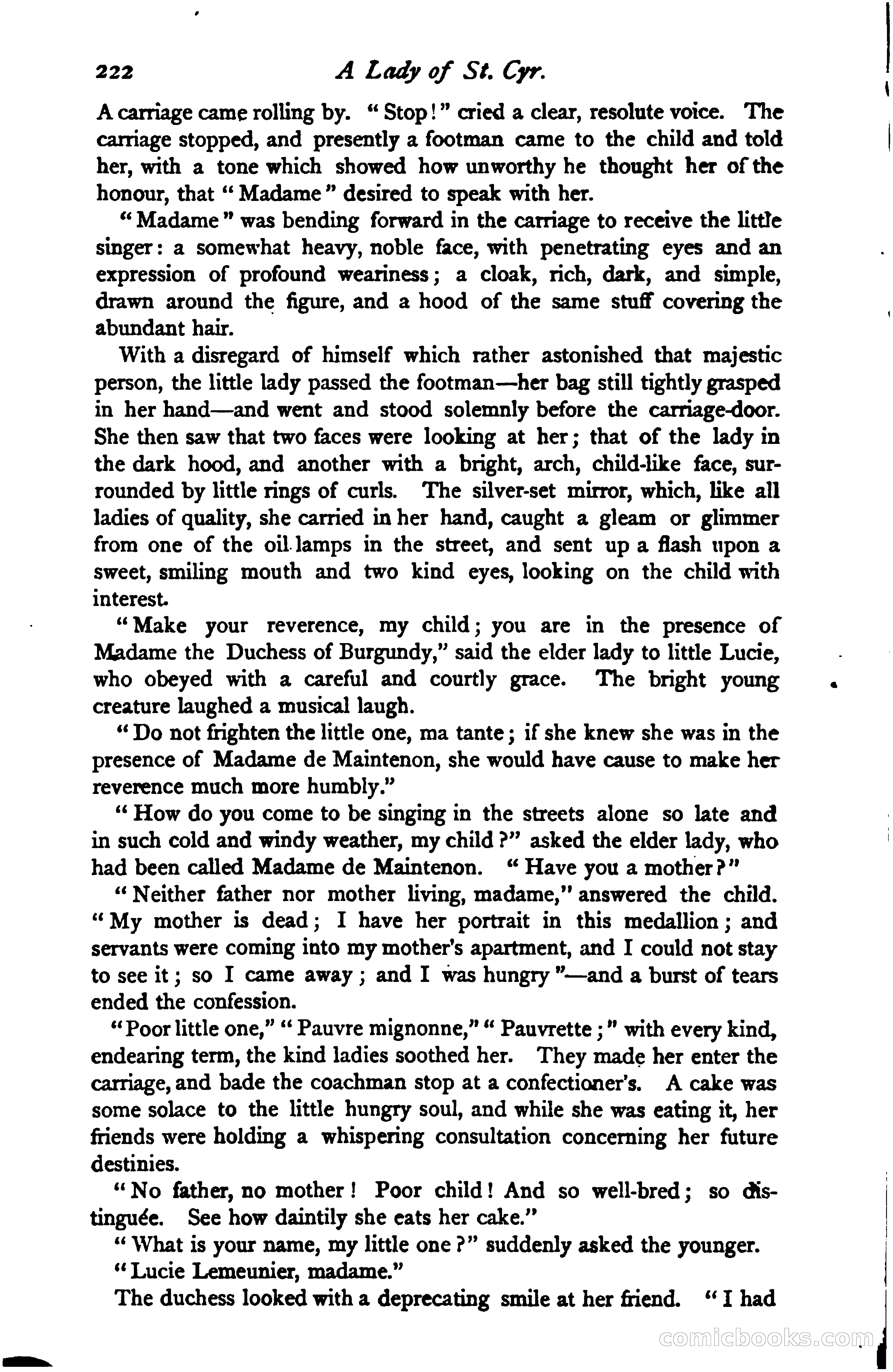
A restored page from Pulp Fiction, 1875. Page through the whole issue in the reader above.
📄 Transcribed text from this page (OCR, searchable)
Machine-transcribed from the original scan — historical spelling and the odd misread are preserved.
222 A Lady of St. Cyr. A carriage came rolling by. “ Stop!” cried a clear, resolute voice. The carriage stopped, and presently 2 footman came to the child and told her, with a tone which showed how unworthy he thought her of the honour, that ‘‘ Madame” desired to speak with her. “Madame” was bending forward in the carriage to receive the little singer: a somewhat heavy, noble face, with penetrating eyes and an expression of profound weariness; a cloak, rich, dark, and simple, drawn around the figure, and a hood of the same stuff covering the abundant hair. With a disregard of himself which rather astonished that majestic person, the little lady passed the footman—her bag still tightly grasped in her hand—and went and stood solemnly before the carnage-door. She then saw that two faces were looking at her; that of the lady m the dark hood, and another with a bright, arch, child-like face, sur- rounded by little rings of curls. The silver-set mirror, which, hke all ladies of quality, she carned in her hand, caught a gleam or glimmer from one of the oil Jamps in the street, and sent up a flash upon a sweet, smiling mouth and two kind eyes, looking on the child with interest. “Make your reverence, my child; you are in the presence of Madame the Duchess of Burgundy,” said the elder lady to little Lucie, who obeyed with a careful and courtly grace. The bnght young creature laughed a musical laugh. “Do not fnghten the little one, ma tante; 1f she knew she was in the presence of Madame de Maintenon, she would have cause to make her reverence much more humbly.” ‘‘ How do you come to be singing in the streets alone so late and in such cold and windy weather, my child ?” asked the elder lady, who had been called Madame de Maintenon. ‘“ Have you a mother?” ‘‘Neither father nor mother living, madame,’ answered the child. “My mother is dead; I have her portrait in this medallion ; and servants were coming into my mother’s apartment, and I could not stay to see it; so I came away ; and I was hungry "—and a burst of tears ended the confession. “Poor little one,” ‘‘ Pauvre mignonne,” “ Pauvrette ;” with every kind, endearing term, the kind ladies soothed her. They made her enter the carriage, and bade the coachman stop at a confectioner’s. A cake was some solace to the little hungry soul, and while she was eating it, her friends were holding a whispering consultation concerning her future destinies. ‘‘No father, no mother! Poor child! And so well-bred; so dis- tinguée. See how daintily she eats her cake.”’ ‘“‘ What is your name, my little one ?” suddenly asked the younger. ‘Lucie Lemeunier, madame.” The duchess looked with a deprecating smile at her friend. ‘I had EOMRniilElooe _ SS (CO)