
Pulp Fiction, 1875 · page 222 of 400
The Argosy — page 222: what you’re looking at
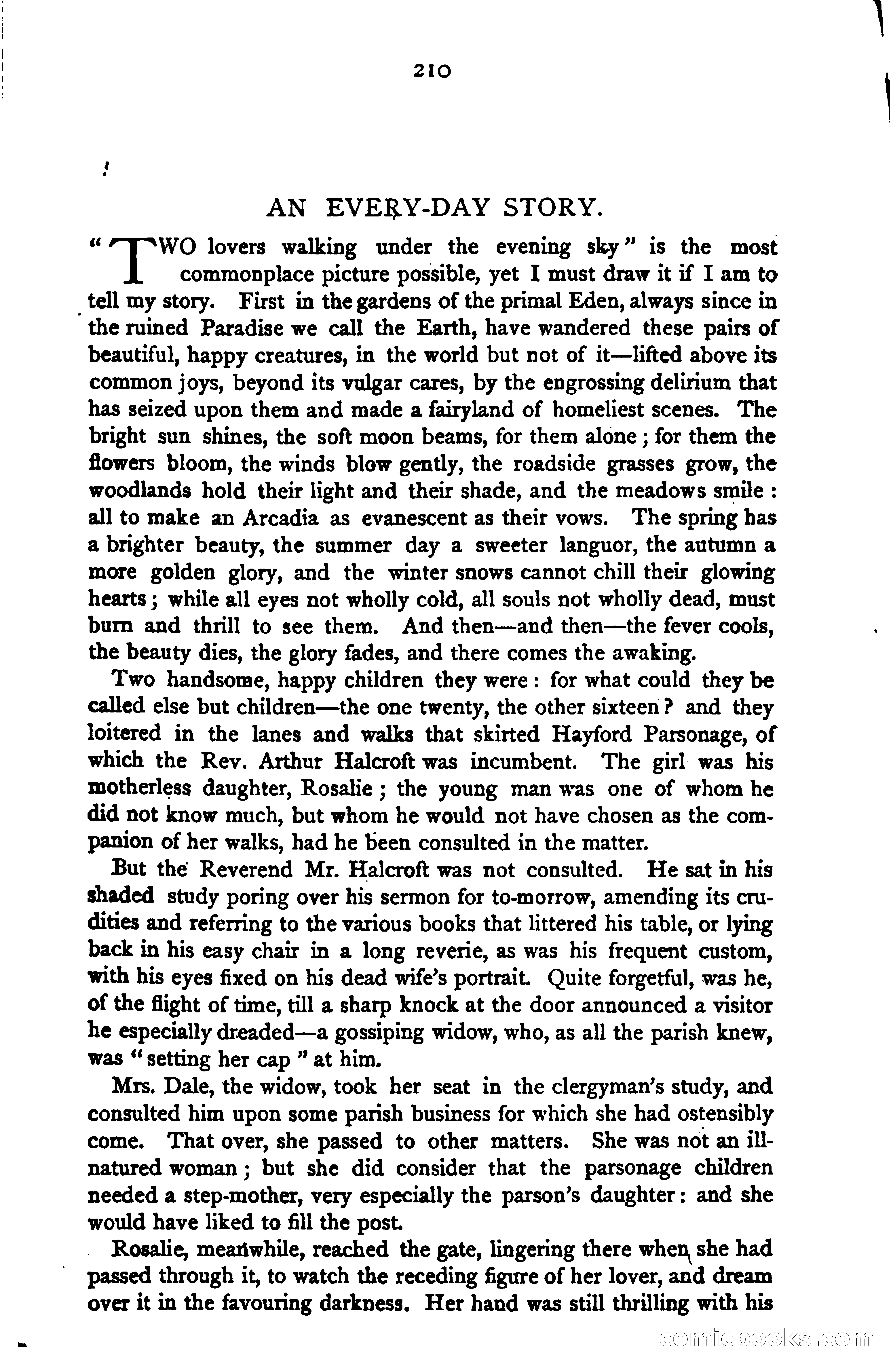
A restored page from Pulp Fiction, 1875. Page through the whole issue in the reader above.
📄 Transcribed text from this page (OCR, searchable)
Machine-transcribed from the original scan — historical spelling and the odd misread are preserved.
z1I0 AN EVERY-DAY STORY. a WO lovers walking under the evening sky” is the most commonplace picture possible, yet I must draw it if I am to tell my story. First in the gardens of the primal Eden, always since in the ruined Paradise we call the Earth, have wandered these pairs of beautiful, happy creatures, in the world but not of it—lifted above its common joys, beyond its vulgar cares, by the engrossing delinum that has seized upon them and made a fairyland of homeliest scenes. The bright sun shines, the soft moon beams, for them alone ; for them the flowers bloom, the winds blow gently, the roadside grasses grow, the woodlands hold their light and their shade, and the meadows smile : all to make an Arcadia as evanescent as their vows. The spring has a brighter beauty, the summer day a sweeter languor, the autumn a more golden glory, and the winter snows cannot chill their glowing hearts ; while all eyes not wholly cold, all souls not wholly dead, must burn and thrill to see them. And then—and then—the fever cools, the beauty dies, the glory fades, and there comes the awaking. Two handsome, happy children they were: for what could they be called else but children—the one twenty, the other sixteen? and they loitered in the lanes and walks that skirted Hayford Parsonage, of which the Rev. Arthur Halcroft was incumbent. The girl was his motherless daughter, Rosalie ; the young man was one of whom he did not know much, but whom he would not have chosen as the com- panion of her walks, had he been consulted in the matter. But the Reverend Mr. Halcroft was not consulted. He sat in his shaded study poring over his sermon for to-morrow, amending its cru- dities and referring to the various books that littered his table, or lying back in his easy chair in a long reverie, as was his frequent custom, with his eyes fixed on his dead wife’s portrait. Quite forgetful, was he, of the flight of time, till a sharp knock at the door announced a visitor he especially dreaded—a gossiping widow, who, as all the parish knew, was “setting her cap ” at him. Mrs. Dale, the widow, took her seat in the clergyman’s study, and consulted him upon some parish business for which she had ostensibly come. ‘That over, she passed to other matters. She was not an ill- natured woman ; but she did consider that the parsonage children needed a step-mother, very especially the parson’s daughter: and she would have liked to fill the post. Rosalie, meariwhile, reached the gate, lingering there when she had passed through it, to watch the receding figure of her lover, and dream over it in the favouring darkness. Her hand was still thrilling with his EOMRniilElooe SS (CO)