
Pulp Fiction, 1875 · page 132 of 400
The Argosy — page 132: what you’re looking at
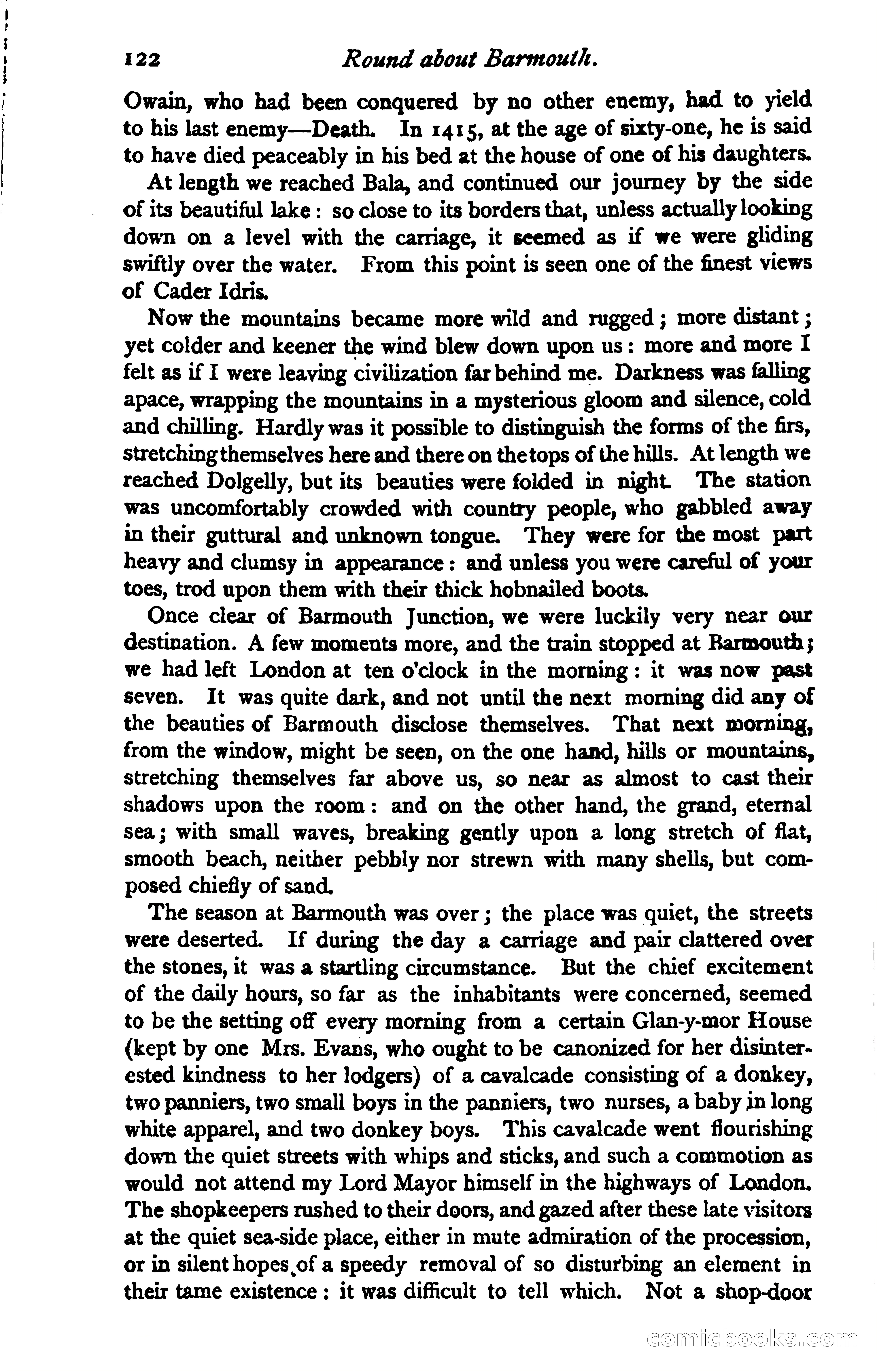
A restored page from Pulp Fiction, 1875. Page through the whole issue in the reader above.
📄 Transcribed text from this page (OCR, searchable)
Machine-transcribed from the original scan — historical spelling and the odd misread are preserved.
wien ey ssa i i ee 122 Round about Barmouth. Owain, who had been conquered by no other enemy, had to yield to his last enemy—Death. In 1415, at the age of sixty-one, he is said to have died peaceably in his bed at the house of one of his daughters. At length we reached Bala, and continued our journey by the side of its beautiful lake: so close to its borders that, unless actually looking down on a level with the carriage, it seemed as if we were gliding swiftly over the water. From this point is seen one of the finest views of Cader Idris. Now the mountains became more wild and rugged ; more distant ; yet colder and keener the wind blew down upon us: more and more I felt as if I were leaving civilization far behind me. Darkness was falling apace, wrapping the mountains in a mysterious gloom and silence, cold and chilling. Hardly was it possible to distinguish the forms of the firs, Stretching themselves here and there on thetops of the hills. At length we reached Dolgelly, but its beauties were folded in night. The station was uncomfortably crowded with country people, who gabbled away in their guttural and unknown tongue. They were for the most part heavy and clumsy in appearance: and unless you were careful of your toes, trod upon them with their thick hobnailed boots. Once clear of Barmouth Junction, we were luckily very near our destination. A few moments more, and the train stopped at Barmouth; we had left London at ten o'clock in the morning: it was now past seven. It was quite dark, and not until the next morning did any of the beauties of Barmouth disclose themselves. That next morning, from the window, might be seen, on the one hand, hills or mountains, stretching themselves far above us, so near as almost to cast their shadows upon the room: and on the other hand, the grand, eternal Sea; with small waves, breaking gently upon a long stretch of flat, smooth beach, neither pebbly nor strewn with many shells, but com- posed chiefly of sand. The season at Barmouth was over ; the place was quiet, the streets were deserted. If during the day a carriage and pair clattered over the stones, it was a startling circumstance. But the chief excitement of the daily hours, so far as the inhabitants were concerned, seemed to be the setting off every morning from a certain Glan-y-mor House (kept by one Mrs. Evans, who ought to be canonized for her disinter- ested kindness to her lodgers) of a cavalcade consisting of a donkey, two panniers, two small boys in the panniers, two nurses, a baby Jn long white apparel, and two donkey boys. This cavalcade went flourishing down the quiet streets with whips and sticks, and such a commotion as would not attend my Lord Mayor himself in the highways of London. The shopkeepers rushed to their doors, and gazed after these late visitors at the quiet sea-side place, either in mute admiration of the procession, or in silent hopes of a speedy removal of so disturbing an element in their tame existence ; it was difficult to tell which. Not a shop-door ECOMICOOOKS. CO