
Pulp Fiction, 1875 · page 124 of 400
The Argosy — page 124: what you’re looking at
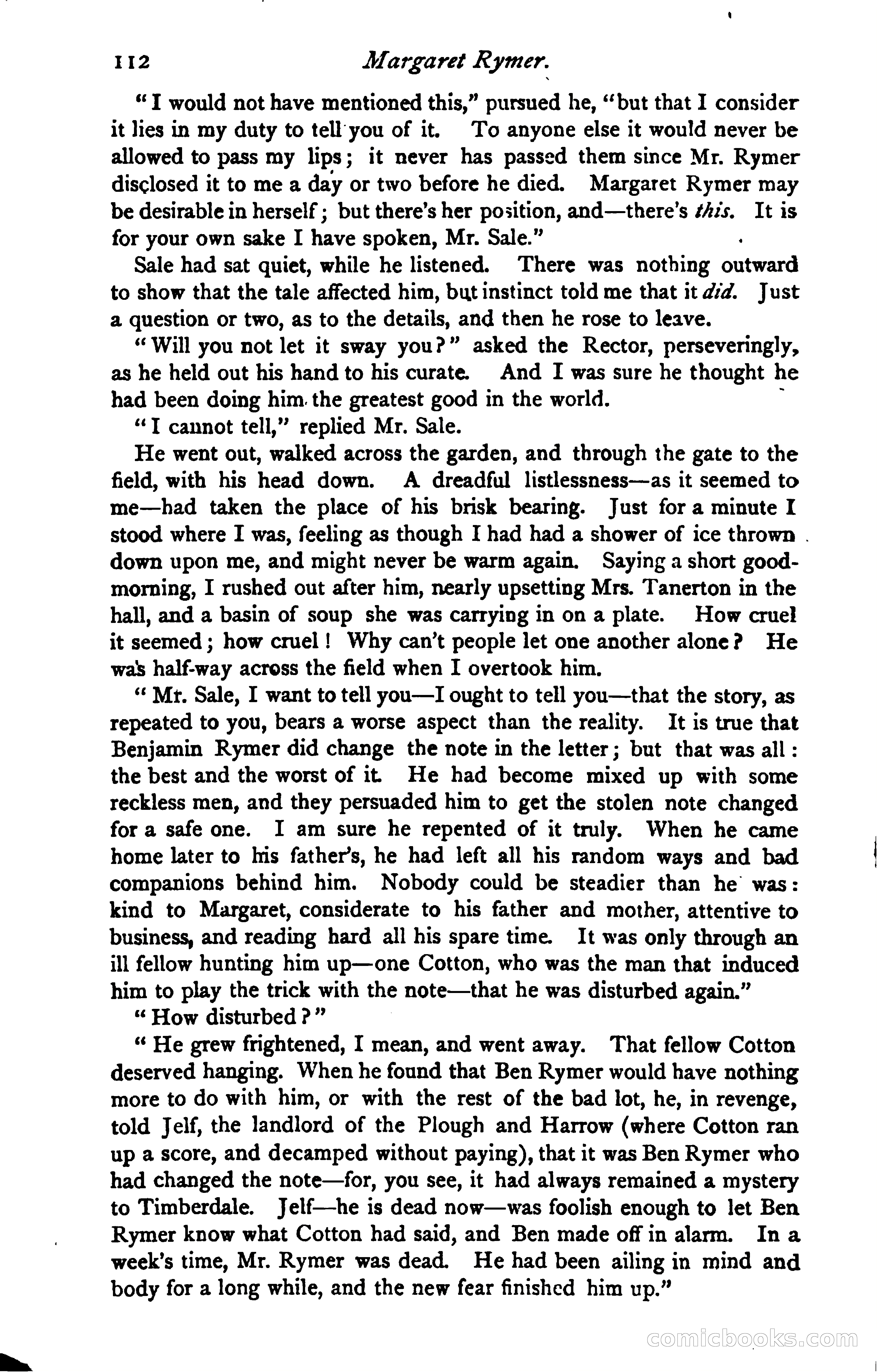
A restored page from Pulp Fiction, 1875. Page through the whole issue in the reader above.
📄 Transcribed text from this page (OCR, searchable)
Machine-transcribed from the original scan — historical spelling and the odd misread are preserved.
112 Margaret Rymer. “TI would not have mentioned this,” pursued he, “but that I consider it lies in my duty to tell'you of it. To anyone else it would never be allowed to pass my lips; it never has passed them since Mr. Rymer disclosed it to me a day or two before he died. Margaret Rymer may be desirable in herself ; but there’s her Destion, and—there’s ¢Azs. It is for your own sake I have spoken, Mr. Sale.” Sale had sat quiet, while he listened. There was nothing outward to show that the tale affected him, but instinct told me that it dd. Just a question or two, as to the details, and then he rose to leave. ‘Will you not let it sway you?” asked the Rector, perseveringly, as he held out his hand to his curate. And I was sure he thought he had been doing him. the greatest good in the world. ‘“‘T cannot tell,” replied Mr. Sale. He went out, walked across the garden, and through the gate to the field, with his head down. A dreadful listlessness—as it seemed to me—had taken the place of his brisk bearing. Just for a minute I stood where I was, feeling as though I had had a shower of ice thrown . down upon me, and might never be warm again. Saying a short good- morning, I rushed out after him, nearly upsetting Mrs. Tanerton in the hall, and a basin of soup she was carrying in on a plate. How cruel it seemed ; how cruel! Why can’t people let one another alone? He was half-way across the field when I overtook him. ‘“‘ Mr. Sale, I want to tell you—I ought to tell you—that the story, as repeated to you, bears a worse aspect than the reality. It is true that Benjamin Rymer did change the note in the letter; but that was all: the best and the worst of it He had become mixed up with some reckless men, and they persuaded him to get the stolen note changed for a safe one. I am sure he repented of it truly. When he came home later to Ins father’s, he had left all his random ways and bad companions behind him. Nobody could be steadier than he was: kind to Margaret, considerate to his father and mother, attentive to business, and reading hard all his spare time. It was only through an ill fellow hunting him up—one Cotton, who was the man that induced him to play the trick with the note—that he was disturbed again.” “ How disturbed ?” | “ He grew frightened, I mean, and went away. That fellow Cotton deserved hanging. When he found that Ben Rymer would have nothing more to do with him, or with the rest of the bad lot, he, in revenge, told Jelf, the landlord of the Plough and Harrow (where Cotton ran up a score, and decamped without paying), that it was Ben Rymer who had changed the note—for, you see, it had always remained a mystery to Timberdale. Jelf—he is dead now—was foolish enough to let Ben Rymer know what Cotton had said, and Ben made off in alarm. Ina week’s time, Mr. Rymer was dead. He had been ailing in mind and body for a long while, and the new fear finished him up.” COnnicboooks (GO)