
Pulp Fiction, 1875 · page 119 of 400
The Argosy — page 119: what you’re looking at
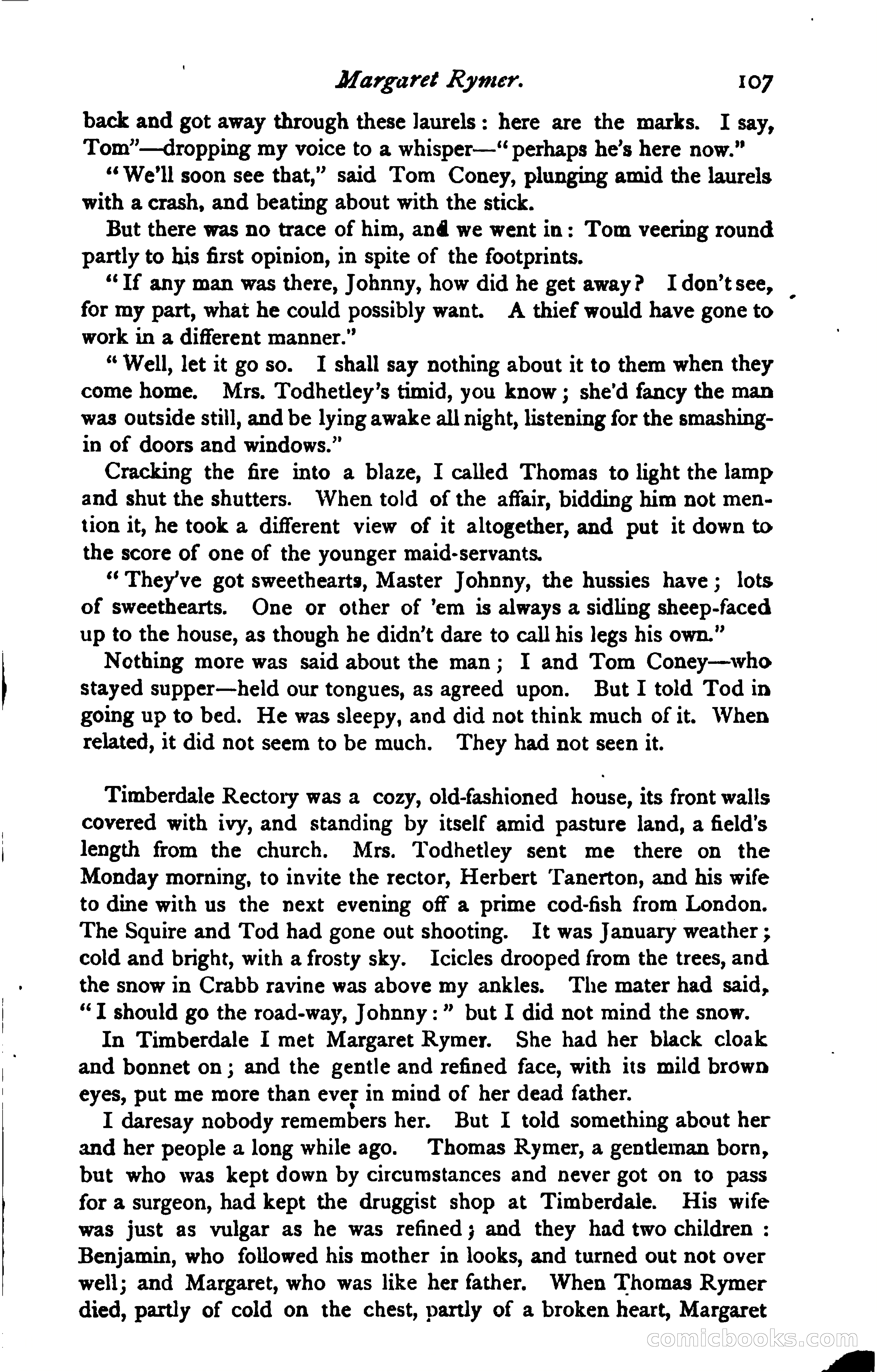
A restored page from Pulp Fiction, 1875. Page through the whole issue in the reader above.
📄 Transcribed text from this page (OCR, searchable)
Machine-transcribed from the original scan — historical spelling and the odd misread are preserved.
Margaret Rymer. 107 back and got away through these Jaurels: here are the marks. I say, Tom”—dropping my voice to a whisper—“ perhaps he’s here now.” ‘‘'We'll soon see that,” said Tom Coney, plunging amid the laurels with a crash, and beating about with the stick. But there was no trace of him, and we went in: Tom veering round partly to his first opinion, in spite of the footprints. ‘If any man was there, Johnny, how did he get away? Idon’tsee, for my part, what he could possibly want. A thief would have gone to work in a different manner.” “ Well, let it go so. I shall say nothing about it to them when they come home. Mrs. Todhetley’s timid, you know; she'd fancy the man was Outside still, and be lying awake all night, listening for the smashing- in of doors and windows.” Cracking the fire into a blaze, I called Thomas to light the lamp and shut the shutters. When told of the affair, bidding him not men- tion it, he took a different view of it altogether, and put it down to the score of one of the younger maid-servants. ‘‘ They've got sweethearts, Master Johnny, the hussies have; lots of sweethearts. One or other of ’em is always a sidling sheep-faced up to the house, as though he didn’t dare to call his legs his own.” Nething more was said about the man; I and Tom Coney—who stayed supper—held our tongues, as agreed upon. But I told Tod in going up to bed. He was sleepy, and did not think much of it. When related, it did not seem to be much. They had not seen it. Timberdale Rectory was a cozy, old-fashioned house, its front walls covered with ivy, and standing by itself amid pasture land, a field’s length from the church. Mrs. Todhetley sent me there on the Monday morning, to invite the rector, Herbert Tanerton, and his wife to dine with us the next evening off a prime cod-fish from London. The Squire and Tod had gone out shooting. It was January weather ; cold and brght, with a frosty sky. Icicles drooped from the trees, and the snow in Crabb ravine was above my ankles. The mater had said, “I should go the road-way, Johnny:” but I did not mind the snow. In Timberdale I met Margaret Rymer. She had her black cloak and bonnet on; and the gentle and refined face, with its mild brown eyes, put me more than ever in mind of her dead father. I daresay nobody remembers her. But I told something about her and her people a long while ago. Thomas Rymer, a gentleman born, but who was kept down by circumstances and never got on to pass for a surgeon, had kept the druggist shop at Timberdale. His wife was just as vulgar as he was refined; and they had two children : Benjamin, who followed his mother in looks, and turned out not over well; and Margaret, who was like her father. When Thomas Rymer died, partly of cold on the chest, partly of a broken heart, Margaret ECOMRRIC OOO Ss (GO)