
Pulp Fiction, 1865 · page 276 of 399
The Argosy — page 276: what you’re looking at
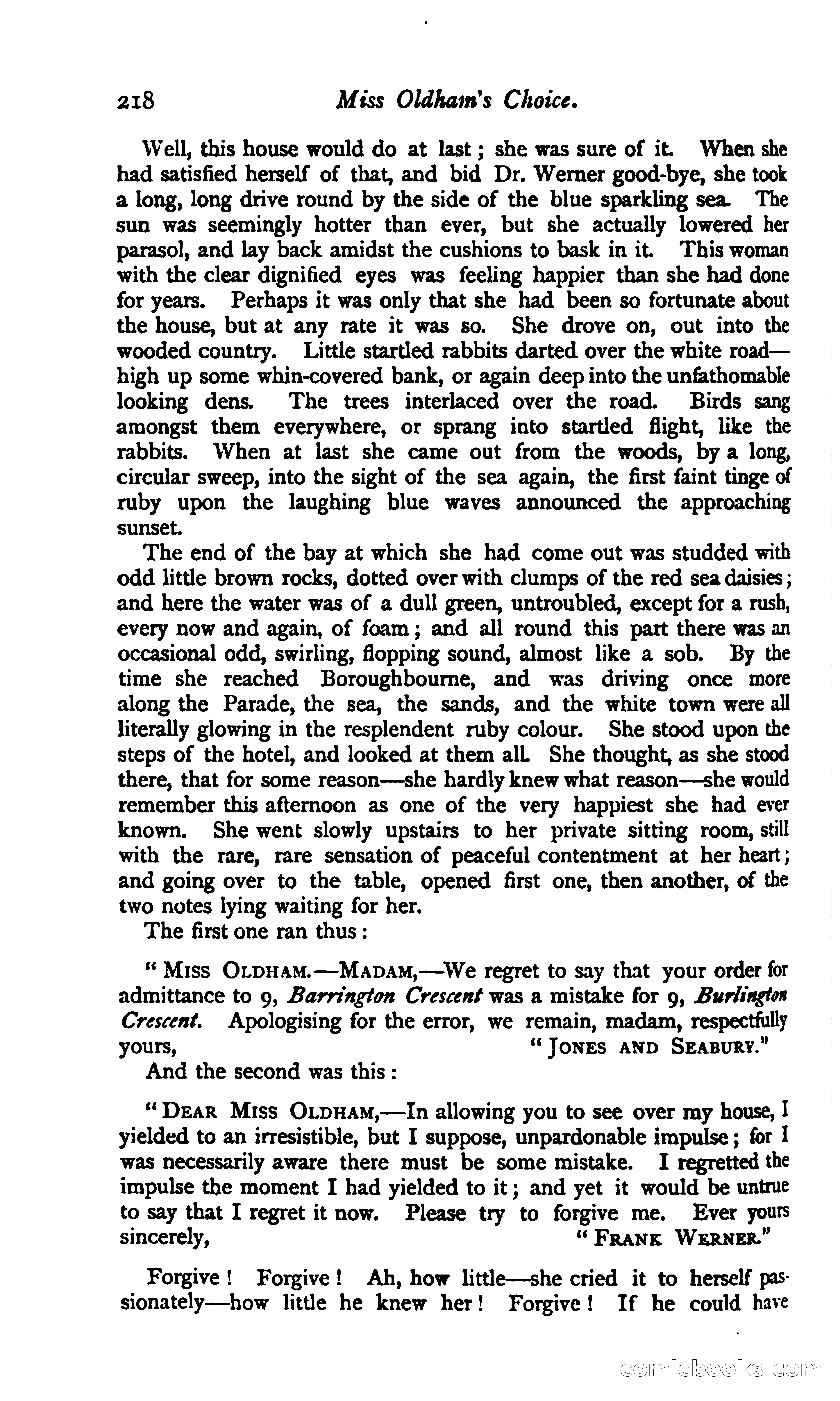
A restored page from Pulp Fiction, 1865. Page through the whole issue in the reader above.
📄 Transcribed text from this page (OCR, searchable)
Machine-transcribed from the original scan — historical spelling and the odd misread are preserved.
218 Miss Oldhaim's Choice. Well, this house would do at last; she was sure of it. When she had satisfied herself of that, and bid Dr. Werner good-bye, she took a long, long drive round by the side of the blue sparkling sea. The sun was seemingly hotter than ever, but she actually lowered her parasol, and lay back amidst the cushions to bask in it. This woman with the clear dignified eyes was feeling happier than she had done for years. Perhaps it was only that she had been so fortunate about the house, but at any rate it was so. She drove on, out into the wooded country. Little startled rabbits darted over the white road— high up some whin-covered bank, or again deep into the unfathomable looking dens. The trees interlaced over the road. Birds sang amongst them everywhere, or sprang into startled flight, like the rabbits. When at last she came out from the woods, by a long, circular sweep, into the sight of the sea again, the first faint tinge of ruby upon the laughing blue waves announced the approaching sunset. The end of the bay at which she had come out was studded with odd little brown rocks, dotted over with clumps of the red sea daisies ; and here the water was of a dull green, untroubled, except for a rush, every now and again, of foam; and all round this part there was an occasional odd, swirling, flopping sound, almost like a sob. By the time she reached SBoroughbourne, and was driving once more along the Parade, the sea, the sands, and the white town were all literally glowing in the resplendent ruby colour. She stood upon the steps of the hotel, and looked at them all. She thought, as she stood there, that for some reason—she hardly knew what reason—she would remember this afternoon as one of the very happiest she had ever known. She went slowly upstairs to her private sitting room, still with the rare, rare sensation of peaceful contentment at her heart; and going over to the table, opened first one, then another, of the two notes lying waiting for her. The first one ran thus: * Miss OLDHAM.—MADAM,—We regret to say that your order for admittance to 9, Barrington Crescent was a mistake for 9, Burlington Crescent. Apologising for the error, we remain, madam, respectfully yours, ‘JONES AND SEABURY.” And the second was this: “DEAR Miss OLDHAM,—In allowing you to see over my house, | yielded to an irresistible, but I suppose, unpardonable impulse; for ! was necessarily aware there must be some mistake. I regretted the impulse the moment I had yielded to it; and yet it would be untrue to say that I regret it now. Please try to forgive me. Ever yours sincerely, ‘“ FRANK WERNER.” Forgive! Forgive! Ah, how little—she cried it to herself pas- sionately—how little he knew her! Forgive! If he could have CONNEC MOOOKS.CO im