
Pulp Fiction, 1865 · page 400 of 399
The Argosy — page 400: what you’re looking at
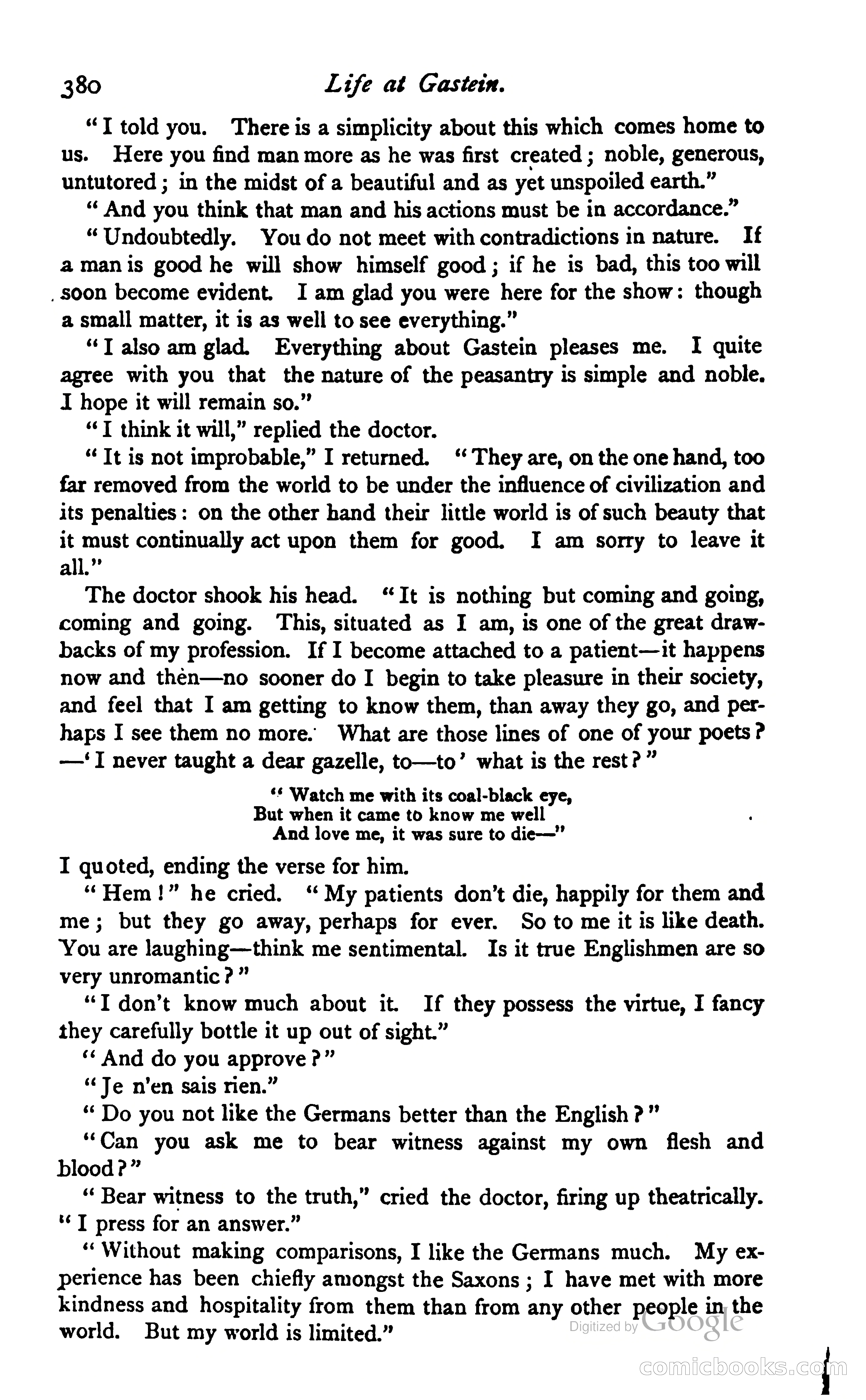
A restored page from Pulp Fiction, 1865. Page through the whole issue in the reader above.
📄 Transcribed text from this page (OCR, searchable)
Machine-transcribed from the original scan — historical spelling and the odd misread are preserved.
380 Life at Gastein. “T told you. There is a simplicity about this which comes home to us. Here you find man more as he was first created ; noble, generous, untutored ; in the midst of a beautiful and as yet unspoiled earth.” “ And you think that man and his actions must be in accordance.” “Undoubtedly. You do not meet with contradictions in nature. If a man is good he will show himself good; if he is bad, this too will _soon become evident. I am glad you were here for the show: though a small matter, it 1s as well to see everything.” ‘“T also am glad. Everything about Gastein pleases me. I quite agree with you that the nature of the peasantry is simple and noble. I hope it will remain so.” “T think it will,” replied the doctor. “ It is not improbable,” I returned. ‘‘ They are, on the one hand, too far removed from the world to be under the influence of civilization and its penalties : on the other hand their little world is of such beauty that it must continually act upon them for good. I am sorry to leave it all.” The doctor shook his head. “It is nothing but coming and going, coming and going. This, situated as I am, is one of the great draw- backs of my profession. If I become attached to a patient—1it happens now and then—no sooner do I begin to take pleasure in their society, and feel that I am getting to know them, than away they go, and per- haps I see them no more. What are those lines of one of your poets? —‘I never taught a dear gazelle, to—to’ what is the rest?” ‘f Watch me with its coal-black eye, But when it came to know me well And love me, it was sure to die—”’ I quoted, ending the verse for him. “Hem!” he cried. ‘ My patients don’t die, happily for them and me; but they go away, perhaps for ever. So to me it is like death. You are laughing—think me sentimental. Is it true Englishmen are so very unromantic ?” ‘“‘T don’t know much about it. If they possess the virtue, I fancy they carefully bottle it up out of sight.” ‘* And do you approve P” ‘Je n’en Sais rien.” “Do you not like the Germans better than the English ?” ‘‘Can you ask me to bear witness against my own flesh and blood ?” ‘‘ Bear witness to the truth,” cried the doctor, firing up theatrically. ** T press for an answer.” ‘‘ Without making comparisons, I like the Germans much. My ex- perience has been chiefly amongst the Saxons ; I have met with more kindness and hospitality from them than from any other people in, the world. But my world is limited.” ECORNICLOOO SS