
Pulp Fiction, 1865 · page 40 of 399
The Argosy — page 40: what you’re looking at
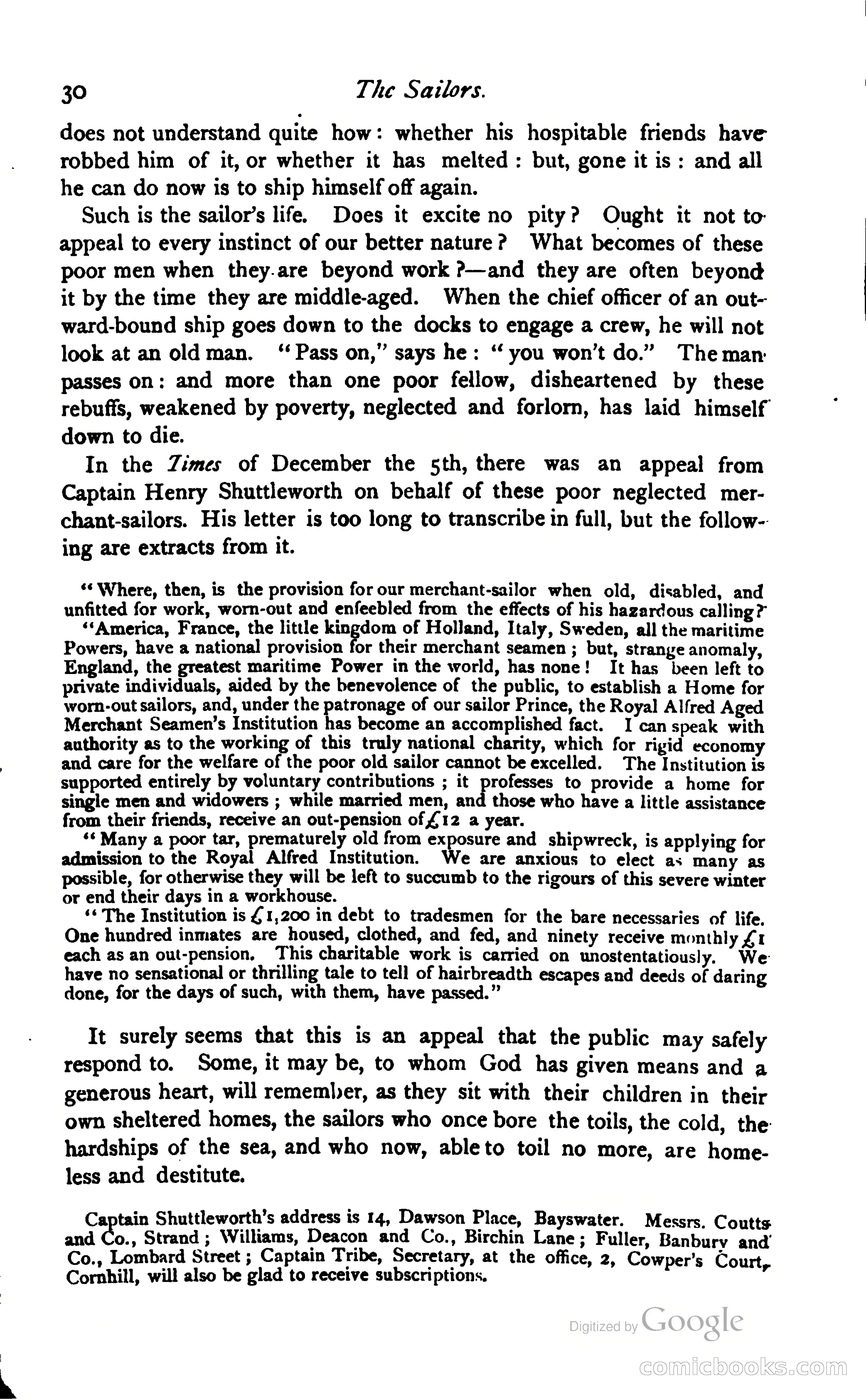
A restored page from Pulp Fiction, 1865. Page through the whole issue in the reader above.
📄 Transcribed text from this page (OCR, searchable)
Machine-transcribed from the original scan — historical spelling and the odd misread are preserved.
30 The Sailors. does not understand quite how: whether his hospitable friends have robbed him of it, or whether it has melted: but, gone it is: and all he can do now Is to ship himself off again. Such is the sailor’s life. Does it excite no pity? Ought it not to appeal to every instinct of our better nature? What becomes of these poor men when they.are beyond work ?—and they are often beyond it by the time they are middle-aged. When the chief officer of an out- ward-bound ship goes down to the docks to engage a crew, he will not look at an old man. ‘‘ Pass on,” says he: ‘‘ you won't do.” Theman passes on: and more than one poor fellow, disheartened by these rebuffs, weakened by poverty, neglected and forlorn, has laid himself down to die. In the Zimes of December the sth, there was an appeal from Captain Henry Shuttleworth on behalf of these poor neglected mer- chant-sailors. His letter is too long to transcribe in full, but the follow-- ing are extracts from it. ‘‘ Where, then, is the provision for our merchant-sailor when old, disabled, and unfitted for work, worn-out and enfeebled from the effects of his hazardous calling? ‘‘America, France, the little kingdom of Holland, Italy, Sweden, all the maritime Powers, have a national provision for their merchant seamen ; but, strange anomaly, England, the greatest maritime Power in the world, has none! It has been left to private individuals, aided by the benevolence of the public, to establish a Home for worn-out sailors, and, under the patronage of our sailor Prince, the Royal Alfred Aged Merchant Seamen’s Institution has become an accomplished fact. I can speak with authority as to the working of this truly national charity, which for rigid economy and care for the welfare of the poor old sailor cannot be excelled. The Institution is supported entirely by voluntary contributions ; it professes to provide a home for single men and widowers ; while married men, and those who have a little assistance from their friends, receive an out-pension of £12 a year. ‘* Many a poor tar, prematurely old from exposure and shipwreck, is applying for admission to the Royal Alfred Institution. We are anxious to elect as many as possible, for otherwise they will be left to succumb to the rigours of this severe winter or end their days in a workhouse. ‘¢ The Institution is £1,200 in debt to tradesmen for the bare necessaries of life. One hundred inmates are housed, clothed, and fed, and ninety receive monthly £1 each as an out-pension, This charitable work is carried on unostentatiously. We have no sensational or thrilling tale to tell of hairbreadth escapes and deeds of daring done, for the days of such, with them, have passed.” It surely seems that this is an appeal that the public may safely respond to. Some, it may be, to whom God has given means and a generous heart, will rememler, as they sit with their children in their own sheltered homes, the sailors who once bore the toils, the cold, the hardships of the sea, and who now, ableto toil no more, are home- less and destitute. Captain Shuttleworth’s address is 14, Dawson Place, Bayswater. Messrs. Coutts and Co., Strand ; Williams, Deacon and Co., Birchin Lane; Fuller, Banburv and’ Co., Lombard Street ; Captain Tribe, Secretary, at the office, 2, Cowper’s Court Cornhill, will also be glad to receive subscriptions. 4 COL @ NOOKS (C(O)