
Pulp Fiction, 1865 · page 398 of 399
The Argosy — page 398: what you’re looking at
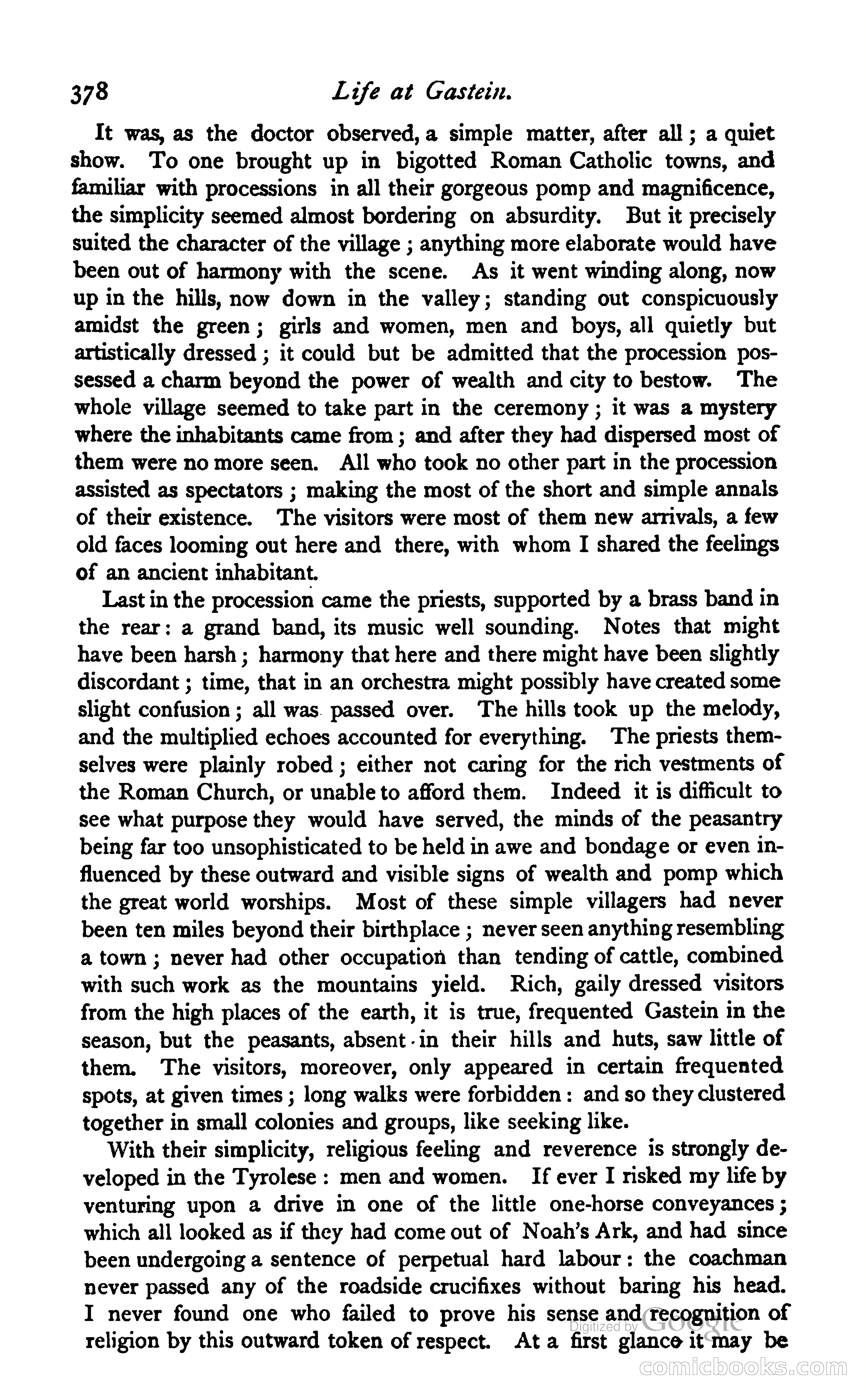
A restored page from Pulp Fiction, 1865. Page through the whole issue in the reader above.
📄 Transcribed text from this page (OCR, searchable)
Machine-transcribed from the original scan — historical spelling and the odd misread are preserved.
378 Life at Gastein. It was, as the doctor observed, a simple matter, after all ; a quiet show. To one brought up in bigotted Roman Catholic towns, and familiar with processions in all their gorgeous pomp and magnificence, the simplicity seemed almost bordering on absurdity. But it precisely suited the character of the village ; anything more elaborate would have been out of harmony with the scene. As it went winding along, now up in the hills, now down in the valley; standing out conspicuously amidst the green; girls and women, men and boys, all quietly but artistically dressed ; it could but be admitted that the procession pos- sessed a charm beyond the power of wealth and city to bestow. The whole village seemed to take part in the ceremony ; it was a mystery where the inhabitants came from ; and after they had dispersed most of them were no more seen. All who took no other part in the procession assisted as spectators ; making the most of the short and simple annals of their existence. The visitors were most of them new arrivals, a few old faces looming out here and there, with whom I shared the feelings of an ancient inhabitant. Last in the procession came the priests, supported by a brass band in the rear: a grand band, its music well sounding. Notes that might have been harsh; harmony that here and there might have been slightly discordant ; time, that in an orchestra might possibly have created some slight confusion ; all was. passed over. The hills took up the melody, and the multiplied echoes accounted for everything. The priests them- selves were plainly robed ; either not caring for the rich vestments of the Roman Church, or unable to afford them. Indeed it 1s difficult to see what purpose they would have served, the minds of the peasantry being far too unsophisticated to be held in awe and bondage or even in- fluenced by these outward and visible signs of wealth and pomp which the great world worships. Most of these simple villagers had never been ten miles beyond their birthplace ; never seen anything resembling a town ; never had other occupation than tending of cattle, combined with such work as the mountains yield. Rich, gaily dressed visitors from the high places of the earth, it is true, frequented Gastein in the season, but the peasants, absent-in their hills and huts, saw little of them. The visitors, moreover, only appeared in certain frequented spots, at given times ; long walks were forbidden: and so they clustered together in small colonies and groups, like seeking like. With their simplicity, religious feeling and reverence is strongly de- veloped in the Tyrolese : men and women. If ever I risked my life by venturing upon a drive in one of the little one-horse conveyances ; which all looked as if they had come out of Noah’s Ark, and had since been undergoing a sentence of perpetual hard labour: the coachman never passed any of the roadside crucifixes without baring his head. I never found one who failed to prove his sense and:recognition of religion by this outward token of respect. Ata first glance it'may be COMIC OOOKS. EO in —_)