
Pulp Fiction, 1865 · page 393 of 399
The Argosy — page 393: what you’re looking at
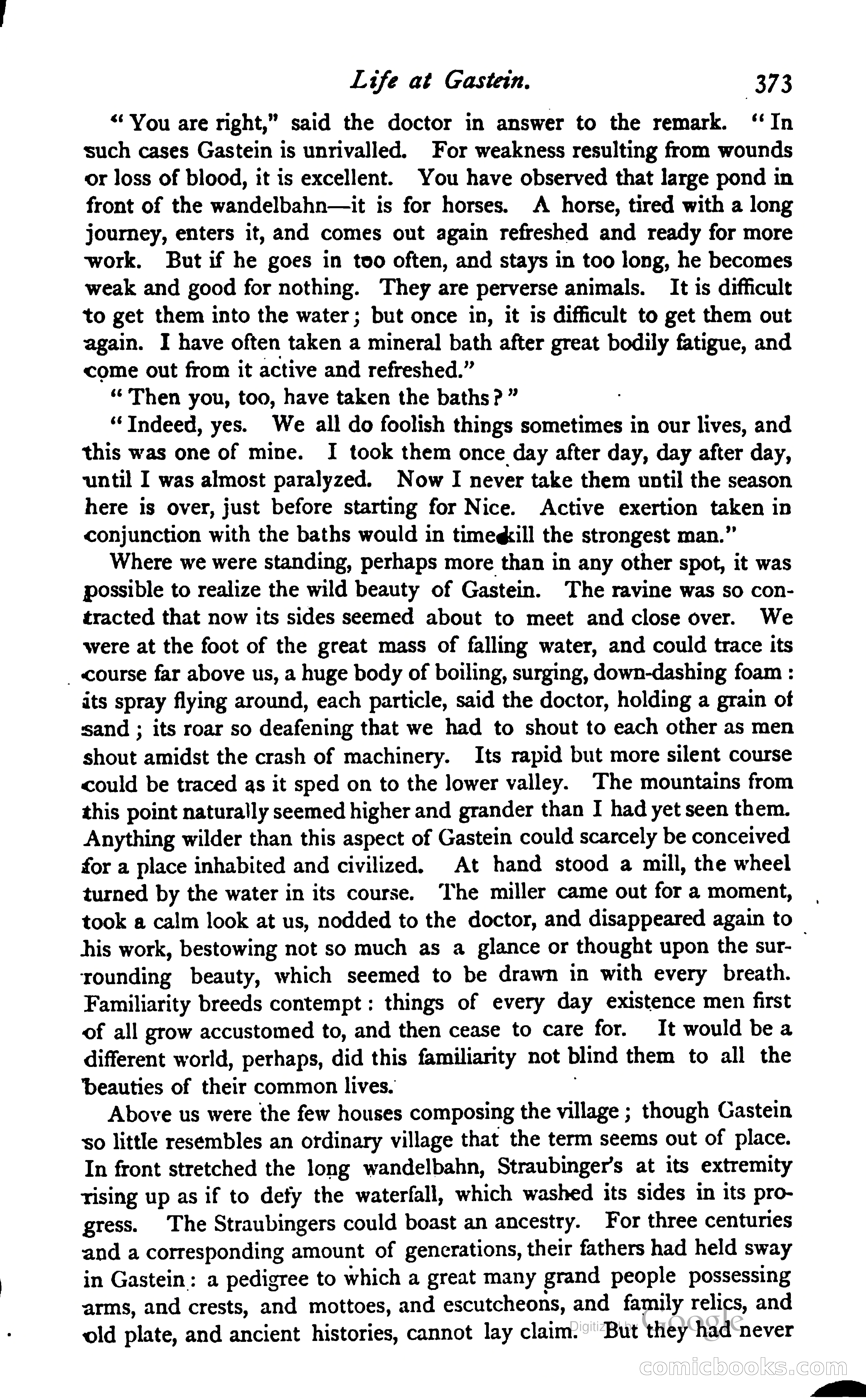
A restored page from Pulp Fiction, 1865. Page through the whole issue in the reader above.
📄 Transcribed text from this page (OCR, searchable)
Machine-transcribed from the original scan — historical spelling and the odd misread are preserved.
Life at Gastein. 373 “You are right,” said the doctor in answer to the remark. ‘In such cases Gastein is unrivalled. For weakness resulting from wounds or loss of blood, it is excellent. You have observed that large pond in front of the wandelbahn—it is for horses. A horse, tired with a long journey, enters it, and comes out again refreshed and ready for more work. But if he goes in too often, and stays in too long, he becomes weak and good for nothing. They are perverse animals. It 1s difficult to get them into the water; but once in, it 1s difficult to get them out again. I have often taken a mineral bath after great bodily fatigue, and come out from it active and refreshed.” “Then you, too, have taken the baths? ” “Indeed, yes. We all do foolish things sometimes in our lives, and this was one of mine. I took them once day after day, day after day, until I was almost paralyzed. Now I never take them until the season here is over, just before starting for Nice. Active exertion taken in conjunction with the baths would in timekill the strongest man.” Where we were standing, perhaps more than in any other spot, it was possible to realize the wild beauty of Gastein. The ravine was so con- tracted that now its sides seemed about to meet and close over. We were at the foot of the great mass of falling water, and could trace its _ course far above us, a huge body of boiling, surging, down-dashing foam : its spray flying around, each particle, said the doctor, holding a grain of sand ; its roar so deafening that we had to shout to each other as men shout amidst the crash of machinery. Its rapid but more silent course could be traced as it sped on to the lower valley. The mountains from this point naturally seemed higher and grander than I had yet seen them. Anything wilder than this aspect of Gastein could scarcely be conceived for a place inhabited and civilized. At hand stood a mill, the wheel turned by the water in its course. The miller came out for a moment, took a calm look at us, nodded to the doctor, and disappeared again to his work, bestowing not so much as a glance or thought upon the sur- } rounding beauty, which seemed to be drawn in with every breath. Familiarity breeds contempt: things of every day existence men first of all grow accustomed to, and then cease to care for. It would bea different world, perhaps, did this familiarity not blind them to all the ‘beauties of their common lives. Above us were the few houses composing the village ; though Gastein so little resembles an ordinary village that the term seems out of place. In front stretched the long wandelbahn, Straubinger’s at its extremity rising up as if to dety the waterfall, which washed its sides in its pro- gress. The Straubingers could boast an ancestry. For three centuries and a corresponding amount of gencrations, their fathers had held sway in Gastein: a pedigree to which a great many grand people possessing arms, and crests, and mottoes, and escutcheons, and family relics, and old plate, and ancient histories, cannot lay claim.” But they had‘never ECoOMmicloooks (C(O)