
Pulp Fiction, 1865 · page 323 of 399
The Argosy — page 323: what you’re looking at
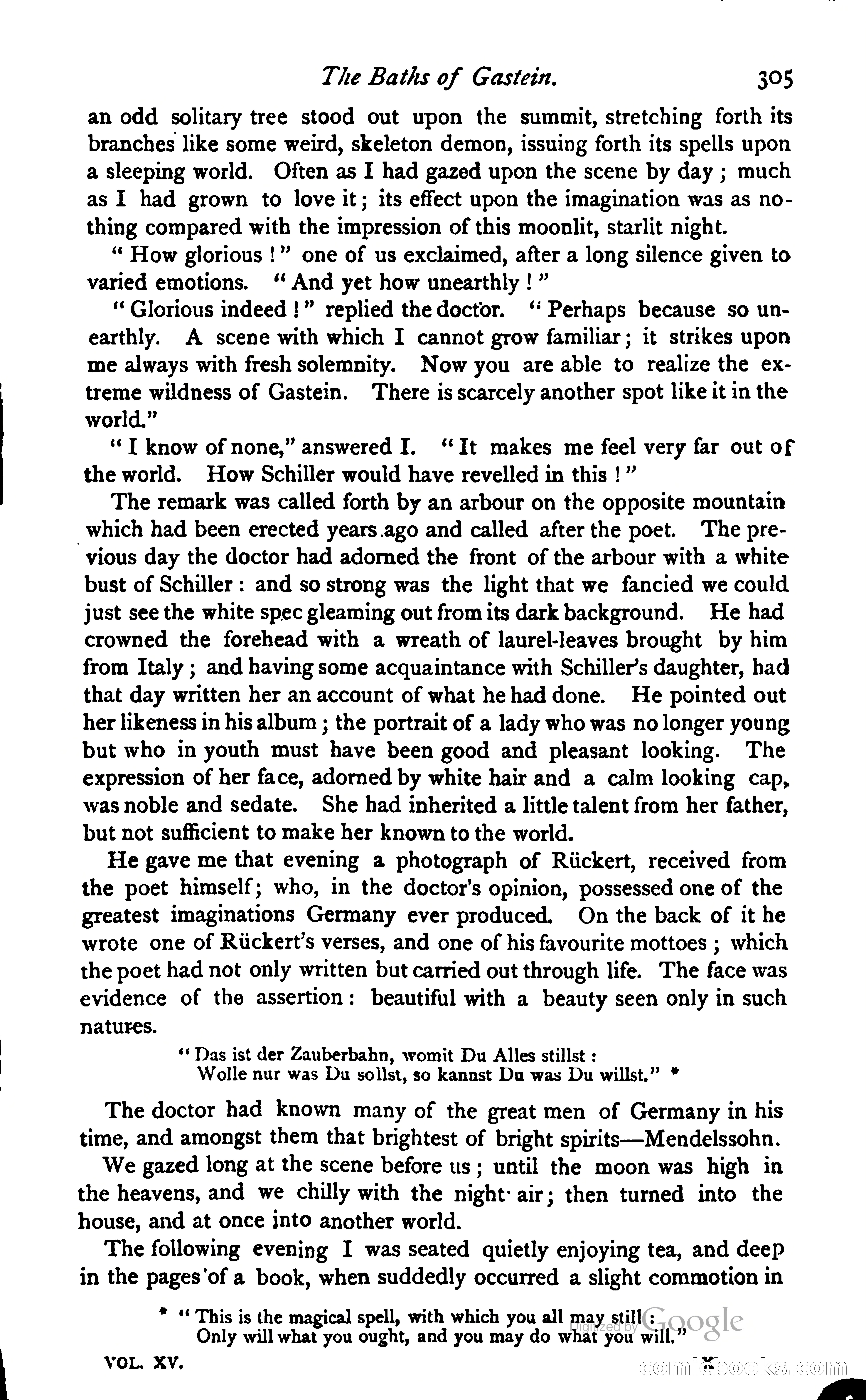
A restored page from Pulp Fiction, 1865. Page through the whole issue in the reader above.
📄 Transcribed text from this page (OCR, searchable)
Machine-transcribed from the original scan — historical spelling and the odd misread are preserved.
The Baths of Gastein. 305 an odd solitary tree stood out upon the summit, stretching forth its branches like some weird, skeleton demon, issuing forth its spells upon a sleeping world. Often as I had gazed upon the scene by day ; much as I had grown to love it; its effect upon the imagination was as no- thing compared with the impression of this moonlit, starlit night. “ How glorious!” one of us exclaimed, after a long silence given to varied emotions. ‘And yet how unearthly ! ” ‘Glorious indeed !” rephed the doctor. ‘‘ Perhaps because so un- earthly. A scene with which I cannot grow familiar; it strikes upon me always with fresh solemnity. Now you are able to realize the ex- treme wildness of Gastein. ‘There is scarcely another spot like it in the world.” ‘¢T know of none,” answered I. ‘It makes me feel very far out of the world. How Schiller would have revelled in this ! ” The remark was called forth by an arbour on the opposite mountain which had been erected years.ago and called after the poet. The pre- vious day the doctor had adomed the front of the arbour with a white bust of Schiller: and so strong was the light that we fancied we could just see the white spec gleaming out from its dark background. He had crowned the forehead with a wreath of laurel-leaves brought by him from Italy ; and having some acquaintance with Schiller’s daughter, had that day written her an account of what hehad done. He pointed out her likeness in his album ; the portrait of a lady who was no longer young but who in youth must have been good and pleasant looking. The expression of her face, adorned by white hair and a calm looking cap, was noble and sedate. She had inherited a little talent from her father, but not sufficient to make her known to the world. He gave me that evening a photograph of Riickert, received from the poet himself; who, in the doctor's opinion, possessed one of the greatest imaginations Germany ever produced. On the back of it he wrote one of Ruckert’s verses, and one of his favourite mottoes ; which the poet had not only written but carried out through life. The face was evidence of the assertion: beautiful with a beauty seen only in such natures. ‘‘ Das ist der Zauberbahn, womit Du Alles stillst : Wolle nur was Du sollst, so kannst Du was Du willst.” * The doctor had known many of the great men of Germany in his time, and amongst them that brightest of bright spirits—Mendelssohn. We gazed long at the scene before us; until the moon was high in the heavens, and we chilly with the night: air; then turned into the house, and at once into another world. The following evening I was seated quietly enjoying tea, and deep in the pages'of a book, when suddedly occurred a slight commotion in * “This is the magical spell, with which you all may still(: Only will what you ought, and you may do what you will.” | VOL. XV. cComieoooks.cO@ >