
Pulp Fiction, 1865 · page 265 of 399
The Argosy — page 265: what you’re looking at
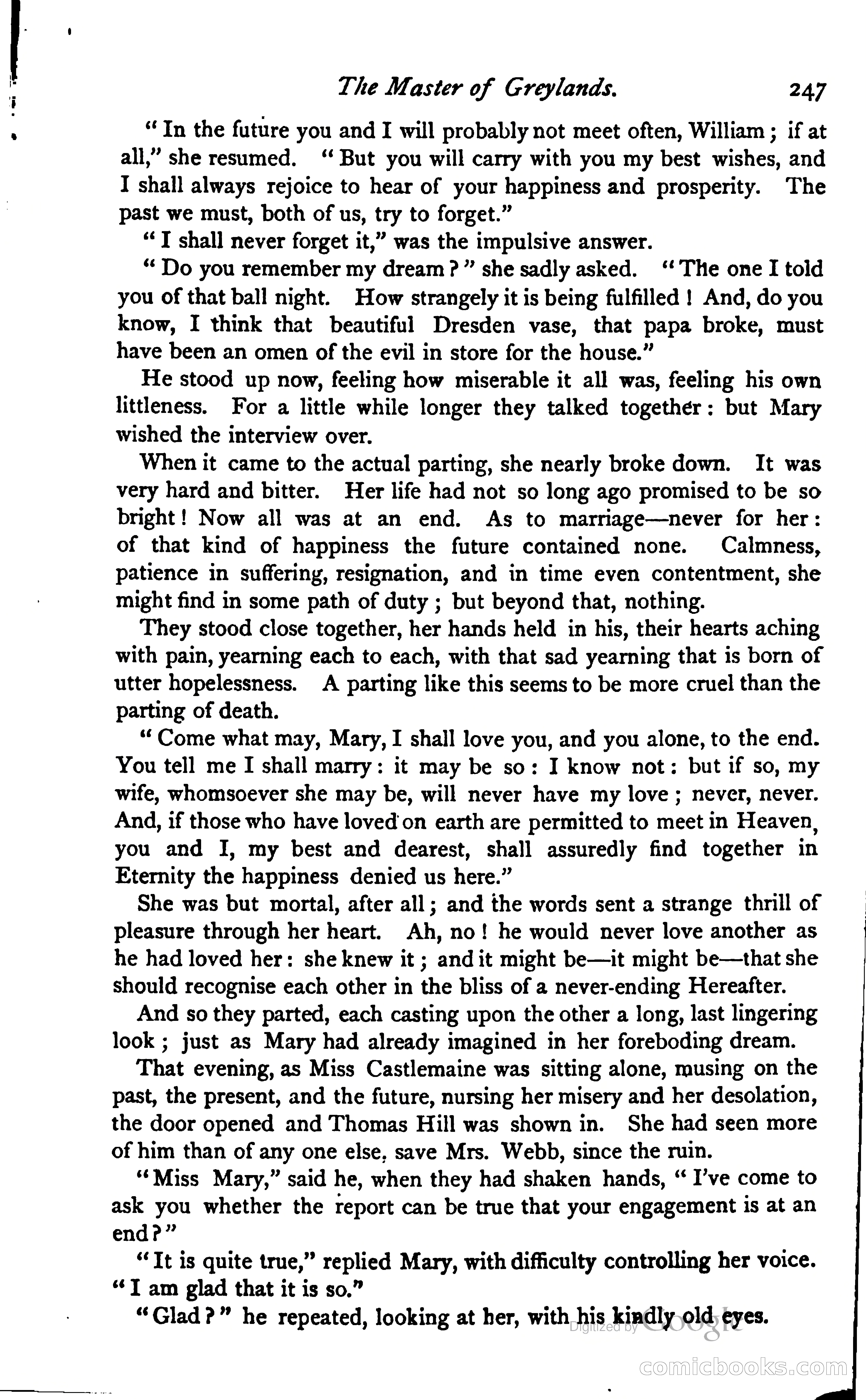
A restored page from Pulp Fiction, 1865. Page through the whole issue in the reader above.
📄 Transcribed text from this page (OCR, searchable)
Machine-transcribed from the original scan — historical spelling and the odd misread are preserved.
The Master of Greylands. 247 “In the future you and I will probably not meet often, William ; if at all,” she resumed. ‘But you will carry with you my best wishes, and I shall always rejoice to hear of your happiness and prosperity. The past we must, both of us, try to forget.” ““T shall never forget it,” was the impulsive answer. “Do you remember my dream?” she sadly asked. ‘‘ The one I told you of that ball night. How strangely it is being fulfilled ! And, do you know, I think that beautiful Dresden vase, that papa broke, must have been an omen of the evil in store for the house.” He stood up now, feeling how miserable it all was, feeling his own littleness. For a little while longer they talked together: but Mary wished the interview over. When it came to the actual parting, she nearly broke down. It was very hard and bitter. Her life had not so long ago promised to be so bright! Now all was at an end. As to marriage—never for her: of that kind of happiness the future contained none. Calmness, patience in suffering, resignation, and in time even contentment, she might find in some path of duty ; but beyond that, nothing. They stood close together, her hands held in his, their hearts aching with pain, yearning each to each, with that sad yearning that is born of utter hopelessness. A parting like this seems to be more cruel than the parting of death. “Come what may, Mary, I shall love you, and you alone, to the end. You tell me I shall marry: it may be so: I know not: but if so, my wife, whomsoever she may be, will never have my love ; never, never. And, 1f those who have loved on earth are permitted to meet in Heaven, you and J, my best and dearest, shall assuredly find together in Eternity the happiness denied us here.” She was but mortal, after all; and the words sent a strange thrill of pleasure through her heart. Ah, no! he would never love another as he had loved her: she knew it ; and it might be—it might be—that she Should recognise each other in the bliss of a never-ending Hereafter. And so they parted, each casting upon the other a long, last lingering look ; just as Mary had already imagined in her foreboding dream. That evening, as Miss Castlemaine was sitting alone, musing on the past, the present, and the future, nursing her misery and her desolation, the door opened and Thomas Hill was shown in. She had seen more of him than of any one else, save Mrs. Webb, since the ruin. ‘Miss Mary,” said he, when they had shaken hands, “ I’ve come to ask you whether the report can be true that your engagement is at an end?” “It is quite true,” replied Mary, with difficulty controlling her voice. ‘¢T am glad that it is so.” “Glad?” he repeated, looking at her, with his kindly old; eyes. ECOMicoOOKS.CoOm