
Pulp Fiction, 1865 · page 242 of 399
The Argosy — page 242: what you’re looking at
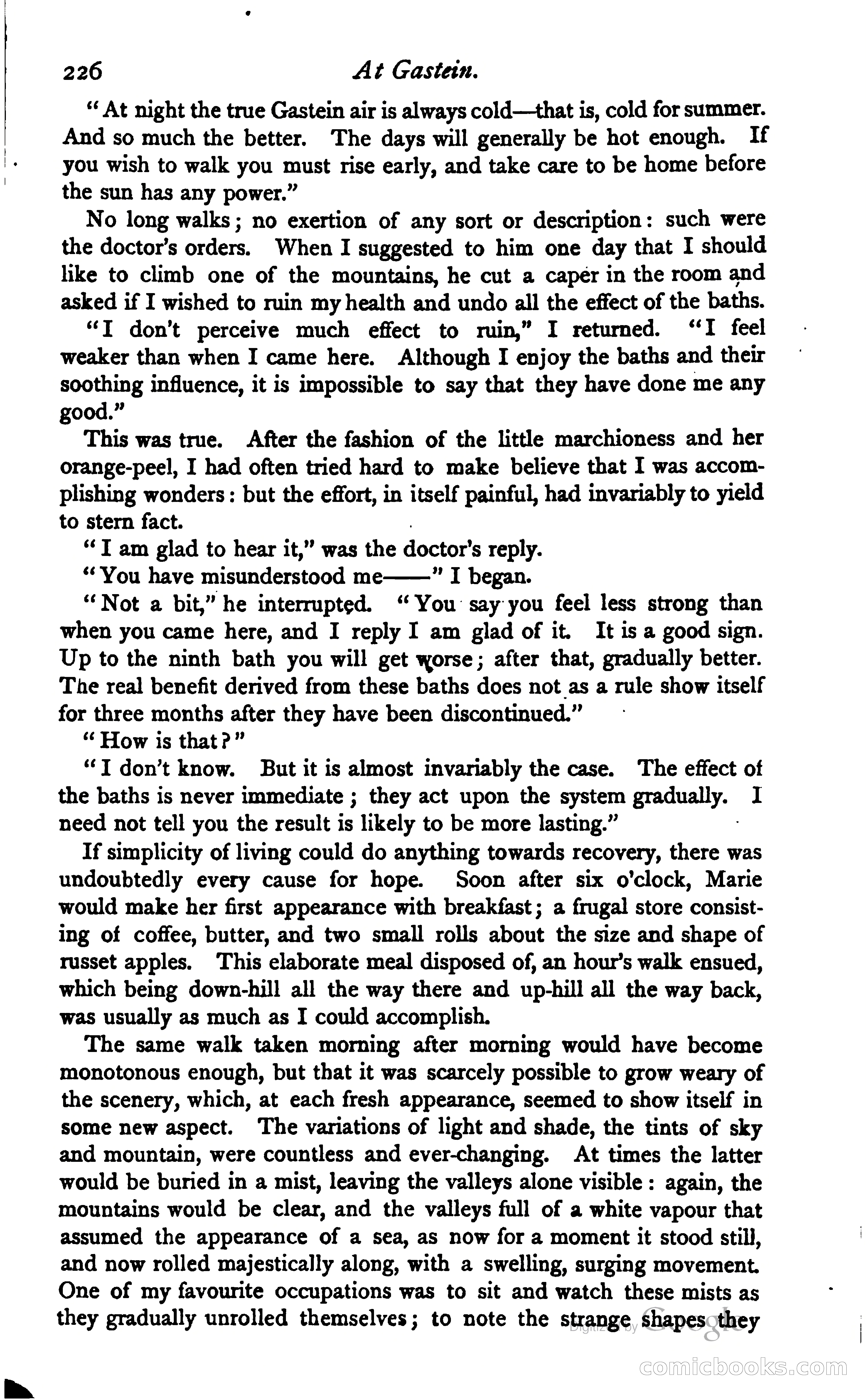
A restored page from Pulp Fiction, 1865. Page through the whole issue in the reader above.
📄 Transcribed text from this page (OCR, searchable)
Machine-transcribed from the original scan — historical spelling and the odd misread are preserved.
226 At Gastein. ‘At night the true Gastein air is always cold—that is, cold for summer. And so much the better. The days will generally be hot enough. If you wish to walk you must rise early, and take care to be home before the sun has any power.” No long walks; no exertion of any sort or description: such were the doctor’s orders. When I suggested to him one day that I should like to climb one of the mountains, he cut a caper in the room and asked if I wished to ruin my health and undo all the effect of the baths. “TIT don’t perceive much effect to ruin,” I returned. ‘I feel weaker than when I came here. Although I enjoy the baths and their soothing influence, it is impossible to say that they have done me any good.” This was true. After the fashion of the little marchioness and her orange-peel, I had often tried hard to make believe that I was accom- plishing wonders: but the effort, in itself painful, had invariably to yield to stern fact. ‘“‘T am glad to hear it,” was the doctor’ s reply. ‘“‘You have misunderstood me——” I began. ‘Not a bit,” he interrupted. ‘You say you feel less strong than when you came here, and I reply I am glad of it. It is a good sign. Up to the ninth bath you will get worse; after that, gradually better. The real benefit derived from these baths does not as a rule show itself for three months after they have been discontinued.” “ How is that?” “I don’t know. But it is almost invariably the case. The effect of the baths is never immediate ; they act upon the system gracmaly. I need not tell you the result is likely to be more lasting.” If simplicity of living could do anything towards recovery, there was undoubtedly every cause for hope. Soon after six o’clock, Marie would make her first appearance with breakfast; a frugal store consist- ing of coffee, butter, and two small rolls about the size and shape of russet apples. This elaborate meal disposed of, an hour’s walk ensued, which being down-hill all the way there and up-hill all the way back, was usually as much as I could accomplish. The same walk taken morning after morning would have become monotonous enough, but that it was scarcely possible to grow weary of the scenery, which, at each fresh appearance, seemed to show itself in some new aspect. The variations of light and shade, the tints of sky and mountain, were countless and ever-changing. At times the latter would be buried in a mist, leaving the valleys alone visible: again, the mountains would be clear, and the valleys full of a white vapour that assumed the appearance of a sea, as now for a moment it stood still, and now rolled majestically along, with a swelling, surging movement. One of my favourite occupations was to sit and watch these mists as they gradually unrolled themselves; to note the strange shapes they ECORNICLOOO SS (C(O) mn —_)