
Pulp Fiction, 1865 · page 234 of 399
The Argosy — page 234: what you’re looking at
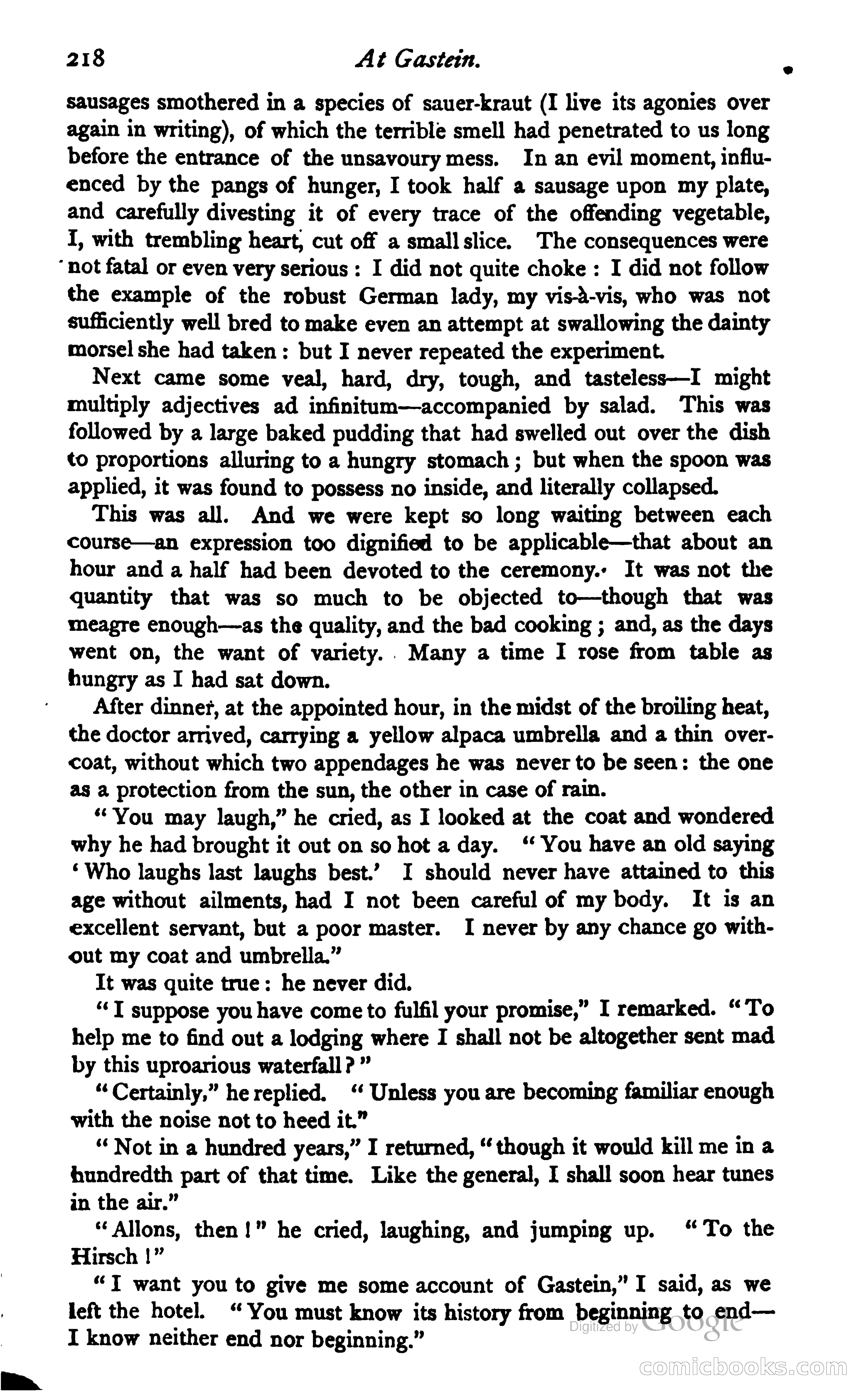
A restored page from Pulp Fiction, 1865. Page through the whole issue in the reader above.
📄 Transcribed text from this page (OCR, searchable)
Machine-transcribed from the original scan — historical spelling and the odd misread are preserved.
218 At Gastein. sausages smothered in a species of sauer-kraut (I live its agonies over again in writing), of which the terrible smell had penetrated to us long before the entrance of the unsavoury mess. In an evil moment, influ- enced by the pangs of hunger, I took half a sausage upon my plate, and carefully divesting it of every trace of the offending vegetable, I, with trembling heart, cut off a smallslice. The consequences were ‘not fatal or even very serious : I did not quite choke : I did not follow the example of the robust German lady, my vis-A-vis, who was not sufficiently well bred to make even an attempt at swallowing the dainty morsel she had taken: but I never repeated the experiment. Next came some veal, hard, dry, tough, and tasteless—I might multiply adjectives ad infinitum—accompanied by salad. This was followed by a large baked pudding that had swelled out over the dish ¢o proportions alluring to a hungry stomach ; but when the spoon was applied, it was found to possess no inside, and literally collapsed. This was all. And we were kept so long waiting between each course—an expression too dignified to be applicable—that about an hour and a half had been devoted to the ceremony.- It was not the quantity that was so much to be objected to—though that was meagre enough—as the quality, and the bad cooking ; and, as the days went on, the want of variety... Many a time I rose from table as hungry as I had sat down. : After dinner, at the appointed hour, in the midst of the broiling heat, the doctor arnved, carrying a yellow alpaca umbrella and a thin over- coat, without which two appendages he was never to be seen: the one as a protection from the sun, the other in case of rain. ‘You may laugh,” he cried, as I looked at the coat and wondered. why he had brought it out on so hot a day. ‘ You have an old saying ‘Who laughs last laughs best.’ I should never have attained to this age without ailments, had I not been careful of my body. It is an excellent servant, but a poor master. I never by any chance go with- out my coat and umbrella.” It was quite true: he never did. ‘“‘T suppose you have come to fulfil your promise,” I remarked. “To help me to find out a lodging where I shall not be altogether sent mad by this uproarious waterfall ? ” “Certainly,” he replied. ‘‘ Unless you are becoming familiar enough with the noise not to heed it.” ‘Not in a hundred years,” I returned, “though it would kill me in a hundredth part of that time. Like the general, I shall soon hear tunes in the air.” ‘ Allons, then!” he cried, laughing, and jumping up. “To the Hirsch !” “I want you to give me some account of Gastein,” I said, as we left the hotel. “ You must know its history from beginning to end— I know neither end nor beginning.” ECoOMmicloooks (C(O)