
Pulp Fiction, 1865 · page 217 of 399
The Argosy — page 217: what you’re looking at
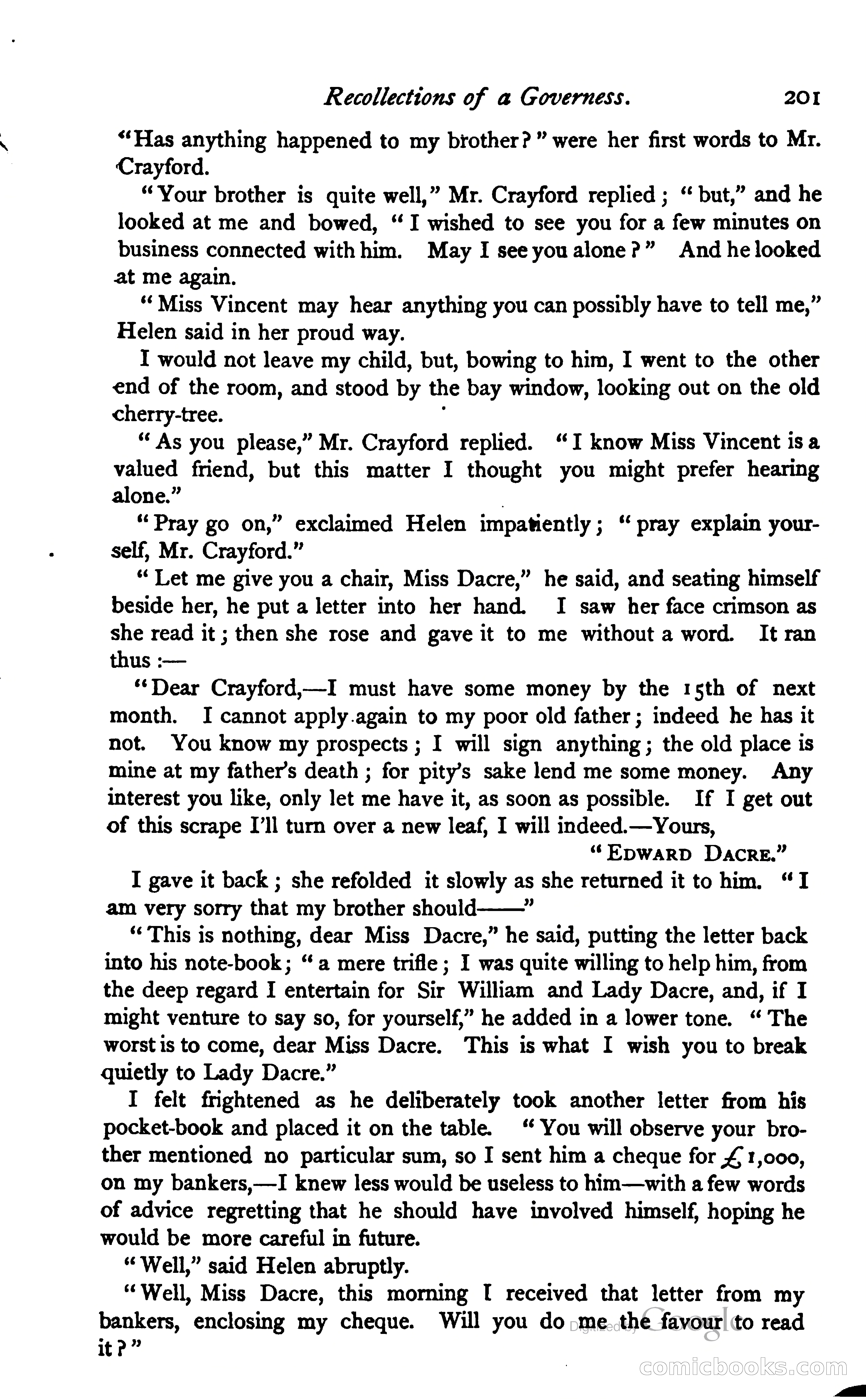
A restored page from Pulp Fiction, 1865. Page through the whole issue in the reader above.
📄 Transcribed text from this page (OCR, searchable)
Machine-transcribed from the original scan — historical spelling and the odd misread are preserved.
Recollections of a Governess. 201 **Has anything happened to my brother? ” were her first words to Mr. Crayford. “Your brother is quite well,” Mr. Crayford replied ; “ but,” and he looked at me and bowed, “I wished to see you for a few minutes on business connected withhim. May I seeyoualone?” And he looked at me again. ‘Miss Vincent may hear anything you can possibly have to tell me,” Helen said in her proud way. I would not leave my child, but, bowing to him, I went to the other end of the room, and stood by the bay window, looking out on the old cherry-tree. “As you please,” Mr. Crayford replied. “I know Miss Vincent is a valued friend, but this matter I thought you might prefer hearing alone.” “Pray go on,” exclaimed Helen impatiently; ‘ pray explain your- self, Mr. Crayford.” “Let me give you a chair, Miss Dacre,” he said, and seating himself beside her, he put a letter into her hand. I saw her face crimson as she read it ; then she rose and gave it to me without a word. It ran thus :— **Dear Crayford,—I must have some money by the rsth of next month. I cannot apply.again to my poor old father; indeed he has it not. You know my prospects ; I will sign anything; the old place is mine at my father’s death ; for pity’s sake lend me some money. Any interest you like, only let me have it, as soon as possible. If I get out of this scrape I’ll turn over a new leaf, I will indeed.—Yours, “EDWARD DACRE.” I gave it back ; she refolded it slowly as she returned it to him. “I am very sorry that my brother should : ‘This is nothing, dear Miss Dacre,” he said, putting the letter back into his note-book; “a mere trifle ; I was quite willing to help him, from the deep regard I entertain for Sir William and Lady Dacre, and, if I might venture to say so, for yourself,” he added in a lower tone. “ The worst is to come, dear Miss Dacre. This is what I wish you to break quietly to Lady Dacre.” I felt fmghtened as he deliberately took another letter from his pocket-book and placed it on the table. ‘“* You will observe your bro- ther mentioned no particular sum, so I sent him a cheque for £ 1,000, on my bankers,—I knew less would be useless to him—with a few words of advice regretting that he should have involved himself, hoping he would be more careful in future. “Well,” said Helen abruptly. “Well, Miss Dacre, this morning [ received that letter from my bankers, enclosing my cheque. Will you do.me..the favour ‘to read it?” COMIC OOOKS. EO \