
Pulp Fiction, 1865 · page 211 of 399
The Argosy — page 211: what you’re looking at
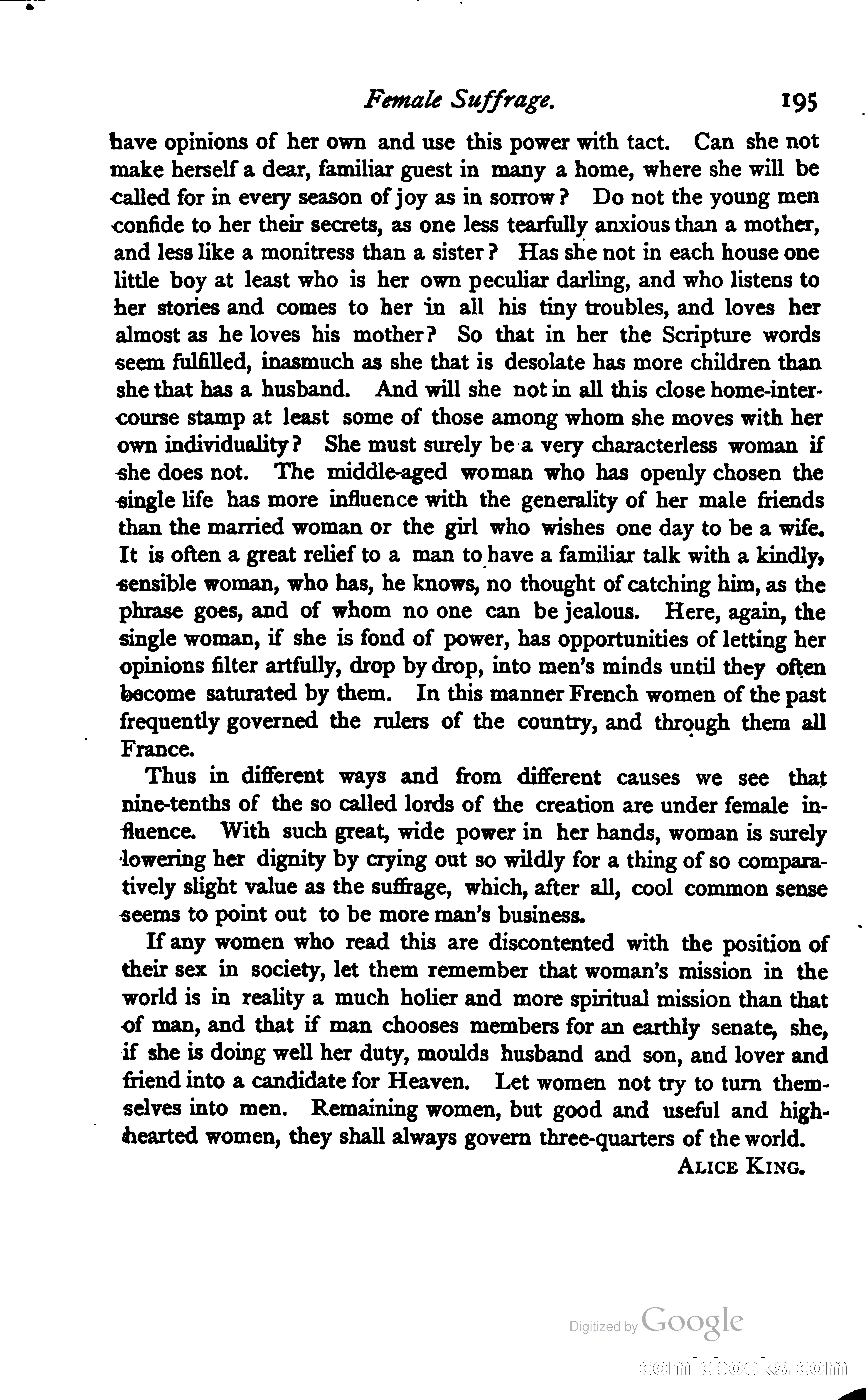
A restored page from Pulp Fiction, 1865. Page through the whole issue in the reader above.
📄 Transcribed text from this page (OCR, searchable)
Machine-transcribed from the original scan — historical spelling and the odd misread are preserved.
Female Suffrage. 195 have opinions of her own and use this power with tact. Can she not make herself a dear, familiar guest in many a home, where she will be called for in every season of joy as in sorrow? Do not the young men confide to her their secrets, as one less tearfully anxious than a mother, and less like a monitress than a sister? Has she not in each house one little boy at least who is her own peculiar darling, and who listens to her stories and comes to her in all his tiny troubles, and loves her almost as he loves his mother? So that in her the Scripture words seem fulfilled, inasmuch as she that is desolate has more children than she that has a husband. And will she notin all this close home-inter- course stamp at least some of those among whom she moves with her own individuality? She must surely be:a very characterless woman if she does not. The middle-aged woman who has openly chosen the single life has more influence with the generality of her male friends than the married woman or the girl who wishes one day to be a wife. It is often a great relief to a man to have a familiar talk with a kindly, sensible woman, who has, he knows, no thought of catching him, as the phrase goes, and of whom no one can be jealous. Here, again, the single woman, if she is fond of power, has opportunities of letting her opinions filter artfully, drop by drop, into men’s minds until they often become saturated by them. In this manner French women of the past frequently governed the rulers of the country, and through them all France. Thus in different ways and from different causes we see that nine-tenths of the so called lords of the creation are under female in- fluence. With such great, wide power in her hands, woman is surely lowering her dignity by crying out so wildly for a thing of so compara- tively slight value as the suffrage, which, after all, cool common sense seems to point out to be more man’s business. If any women who read this are discontented with the position of their sex in society, let them remember that woman’s mission in the world is in reality a much holier and more spiritual mission than that of man, and that if man chooses members for an earthly senate, she, if she is doing well her duty, moulds husband and son, and lover and friend into a candidate for Heaven. Let women not try to turn them- selves into men. Remaining women, but good and useful and high- hearted women, they shall always govern three-quarters of the world. ALICE KING, ECOMicoOOKS.CoOm