
Pulp Fiction, 1865 · page 169 of 399
The Argosy — page 169: what you’re looking at
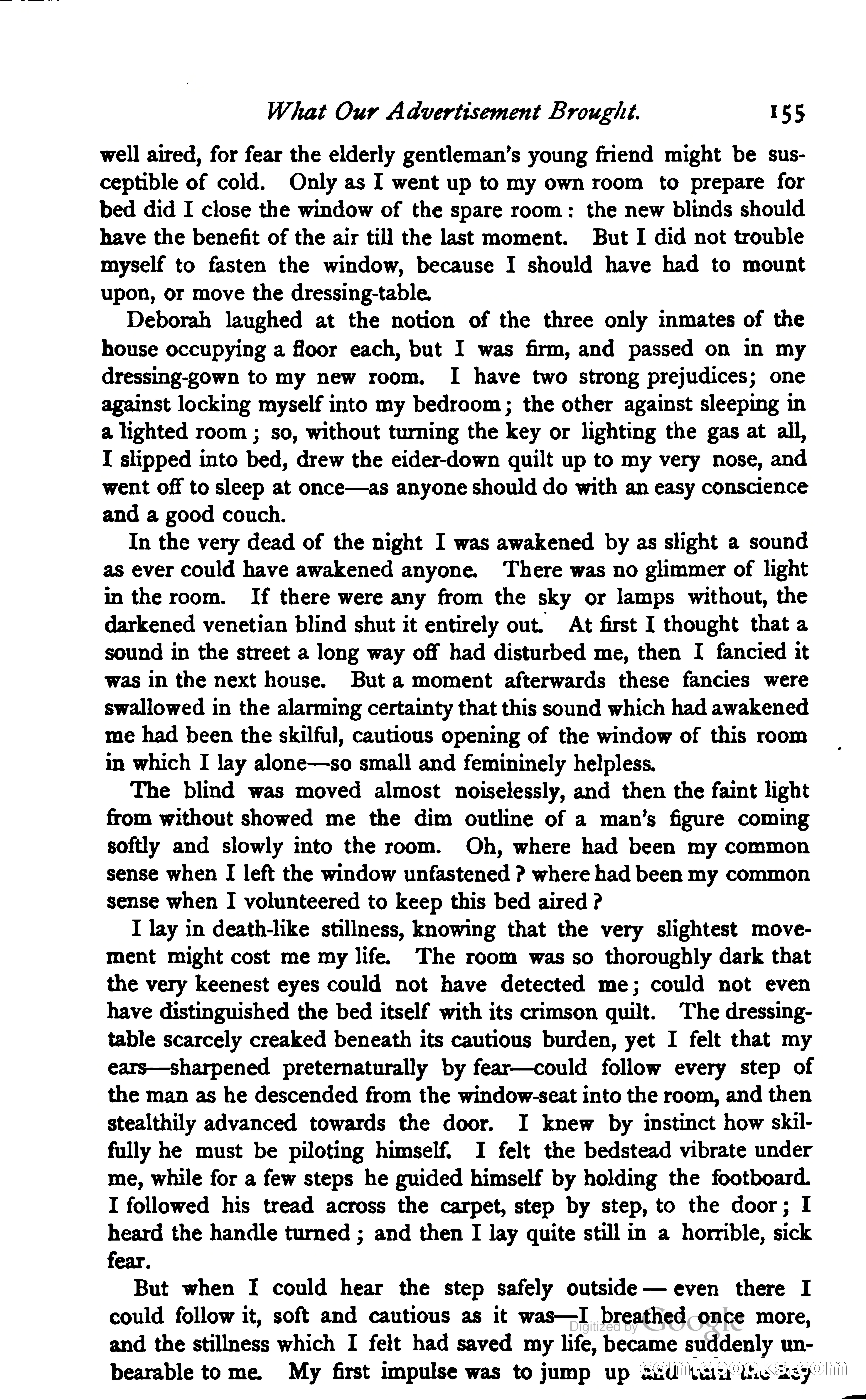
A restored page from Pulp Fiction, 1865. Page through the whole issue in the reader above.
📄 Transcribed text from this page (OCR, searchable)
Machine-transcribed from the original scan — historical spelling and the odd misread are preserved.
What Our Advertisement Brought. 155 well aired, for fear the elderly gentleman’s young friend might be sus- ceptible of cold. Only as I went up to my own room to prepare for bed did I close the window of the spare room: the new blinds should have the benefit of the air till the last moment. But I did not trouble myself to fasten the window, because I should have had to mount upon, or move the dressing-table. Deborah laughed at the notion of the three only inmates of the house occupying a floor each, but I was firm, and passed on in my dressing-gown to my new room. I have two strong prejudices; one against locking myself into my bedroom; the other against sleeping in a lighted room ; so, without turning the key or lighting the gas at all, I slipped into bed, drew the eider-down quilt up to my very nose, and went off to sleep at once—as anyone should do with an easy conscience and a good couch. In the very dead of the night I was awakened by as slight a sound as ever could have awakened anyone. There was no glimmer of light in the room. If there were any from the sky or lamps without, the darkened venetian blind shut it entirely out. At first I thought that a sound in the street a long way off had disturbed me, then I fancied it was in the next house. But a moment afterwards these fancies were swallowed in the alarming certainty that this sound which had awakened me had been the skilful, cautious opening of the window of this room in which I lay alone—so small and femininely helpless. The blind was moved almost noiselessly, and then the faint light from without showed me the dim outline of a man’s figure coming softly and slowly into the room. Oh, where had been my common sense when I left the window unfastened ? where had been my common sense when I volunteered to keep this bed aired ? I lay in death-like stillness, knowing that the very slightest move- ment might cost me my life. The room was so thoroughly dark that the very keenest eyes could not have detected me; could not even have distinguished the bed itself with its crimson quilt. The dressing- table scarcely creaked beneath its cautious burden, yet I felt that my ears—sharpened preternaturally by fear—could follow every step of the man as he descended from the window-seat into the room, and then stealthily advanced towards the door. I knew by instinct how skil- fully he must be piloting himself. I felt the bedstead vibrate under me, while for a few steps he guided himself by holding the footboard. I followed his tread across the carpet, step by step, to the door; I heard the handle turned ; and then I lay quite still in a hornble, sick fear. But when I could hear the step safely outside — even there I could follow it, soft and cautious as it was—I_ breathed, once more, and the stillness which I felt had saved my life, became suddenly un- bearable to me. My first impulse was to jump up end tenn the key”