
Pulp Fiction, 1887 · page 79 of 399
The Argosy — page 79: what you’re looking at
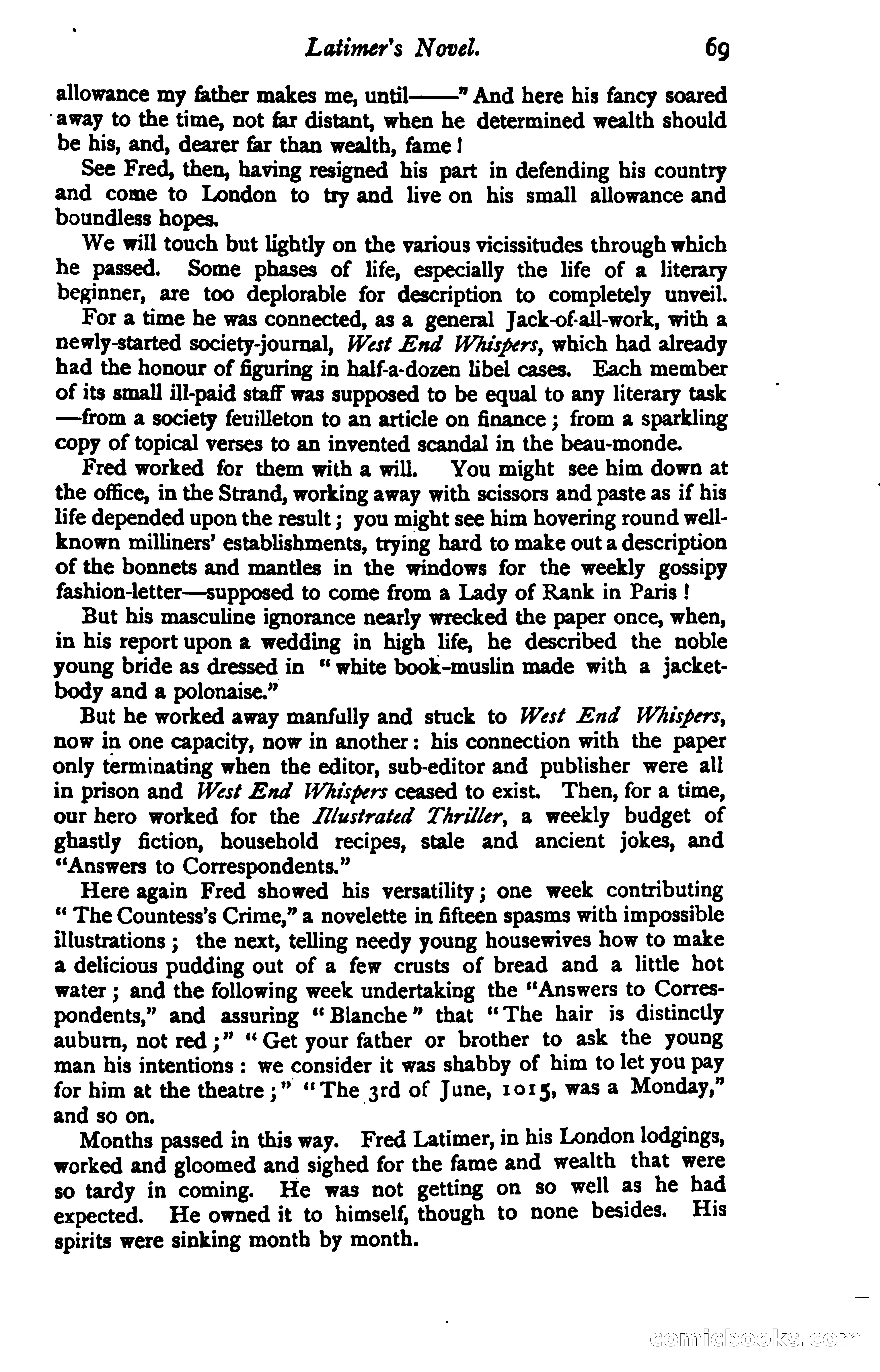
A restored page from Pulp Fiction, 1887. Page through the whole issue in the reader above.
📄 Transcribed text from this page (OCR, searchable)
Machine-transcribed from the original scan — historical spelling and the odd misread are preserved.
Latimer's Novel. 69 allowance my father makes me, until ” And here his fancy soared ‘away to the time, not far distant, when he determined wealth should be his, and, dearer far than wealth, fame! See Fred, then, having resigned his part in defending his country and come to London to try and live on his small allowance and boundless hopes. We will touch but lightly on the various vicissitudes through which he passed. Some phases of life, especially the life of a literary beginner, are too deplorable for description to completely unveil. For a time he was connected, as a general Jack-of-all-work, with a newly-started society-journal, West End Whispers, which had already had the honour of figuring in half-a-dozen libel cases. Each member of its small ill-paid staff was supposed to be equal to any literary task —from a society feuilleton to an article on finance ; from a sparkling copy of topical verses to an invented scandal in the beau-monde. Fred worked for them with a will, You might see him down at the office, in the Strand, working away with scissors and paste as if his life depended upon the result ; you might see him hovering round well- known milliners’ establishments, trying hard to make out a description of the bonnets and mantles in the windows for the weekly gossipy fashion-letter—supposed to come from a Lady of Rank in Paris! But his masculine ignorance nearly wrecked the paper once, when, in his report upon a wedding in high life, he described the noble young bride as dressed in “ white book-muslin made with a jacket- body and a polonaise.” But he worked away manfully and stuck to West End Whispers, now in one capacity, now in another: his connection with the paper only terminating when the editor, sub-editor and publisher were all in prison and West End Whispers ceased to exist. Then, for a time, our hero worked for the J//ustrated Thriller, a weekly budget of ghastly fiction, household recipes, stale and ancient jokes, and “Answers to Correspondents,” Here again Fred showed his versatility; one week contributing * The Countess’s Crime,” a novelette in fifteen spasms with impossible illustrations ; the next, telling needy young housewives how to make a delicious pudding out of a few crusts of bread and a little hot water ; and the following week undertaking the “Answers to Corres- pondents,” and assuring “ Blanche” that “The hair is distinctly auburn, not red ;” ‘Get your father or brother to ask the young man his intentions : we consider it was shabby of him to let you pay for him at the theatre ;” “‘The 3rd of June, 1015, was a Monday,” and so on. Months passed in this way. Fred Latimer, in his London lodgings, worked and glcomed and sighed for the fame and wealth that were so tardy in coming. He was not getting on so well as he had expected. He owned it to himself, though to none besides. His spirits were sinking month by month. CONMUG NOOO SS CO