
Pulp Fiction, 1887 · page 69 of 399
The Argosy — page 69: what you’re looking at
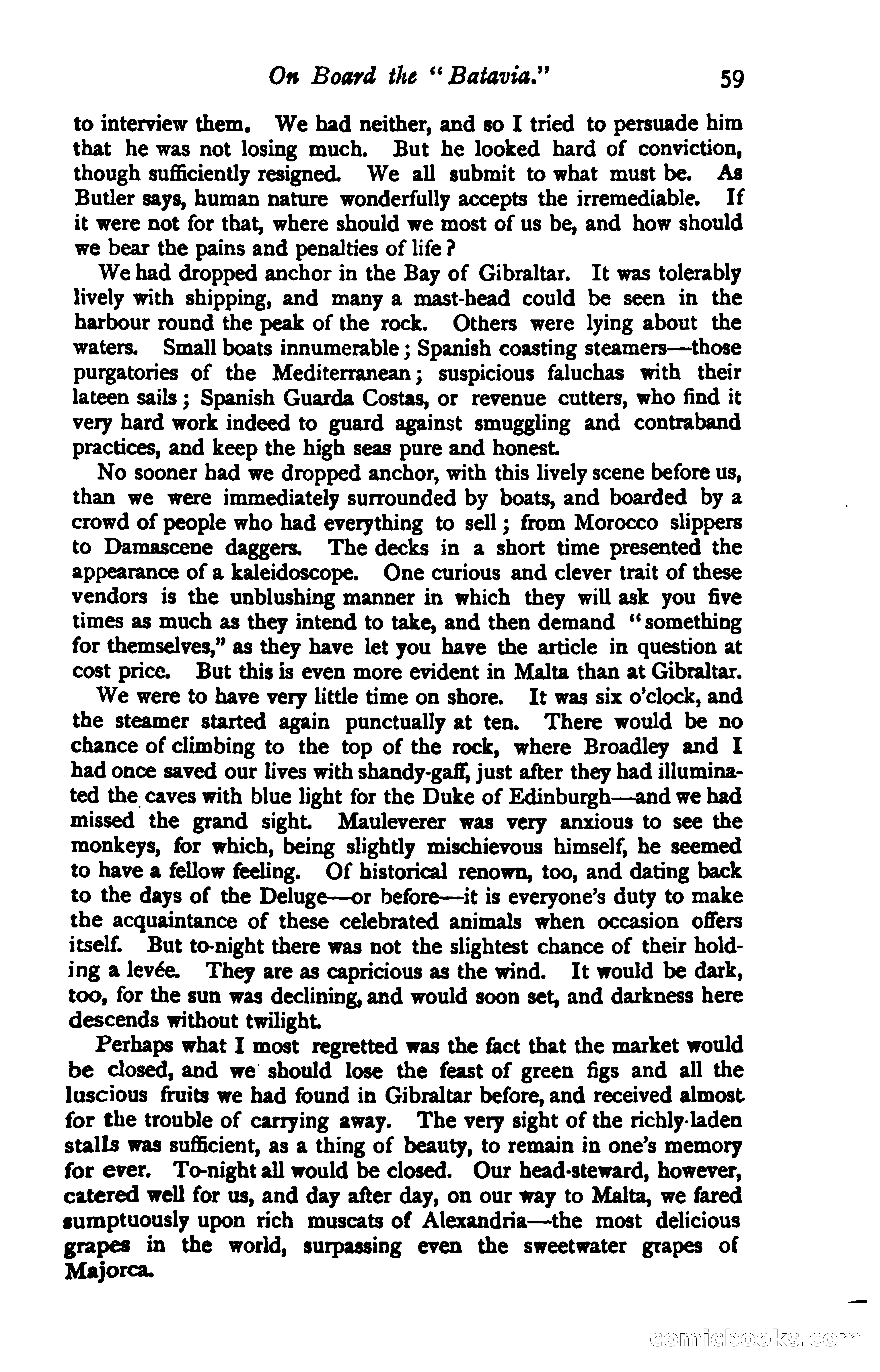
A restored page from Pulp Fiction, 1887. Page through the whole issue in the reader above.
📄 Transcribed text from this page (OCR, searchable)
Machine-transcribed from the original scan — historical spelling and the odd misread are preserved.
On Board the ** Batavia.” 59 to interview them. We had neither, and so I tried to persuade him that he was not losing much. But he looked hard of conviction, though sufficiently resigned. We all submit to what must be. As Butler says, human nature wonderfully accepts the irremediable. If it were not for that, where should we most of us be, and how should we bear the pains and penalties of life ? We had dropped anchor in the Bay of Gibraltar. It was tolerably lively with shipping, and many a mast-head could be seen in the harbour round the peak of the rock. Others were lying about the waters. Small boats innumerable ; Spanish coasting steamers—those purgatories of the Mediterranean; suspicious faluchas with their lateen sails ; Spanish Guarda Costas, or revenue cutters, who find it very hard work indeed to guard against smuggling and contraband practices, and keep the high seas pure and honest. No sooner had we dropped anchor, with this lively scene before us, than we were immediately surrounded by boats, and boarded by a crowd of people who had everything to sell ; from Morocco slippers to Damascene daggers. ‘The decks in a short time presented the appearance of a kaleidoscope. One curious and clever trait of these vendors is the unblushing manner in which they will ask you five times as much as they intend to take, and then demand ‘something for themselves,” as they have let you have the article in question at cost price. But this is even more evident in Malta than at Gibraltar. We were to have very little time on shore. It was six o’clock, and the steamer started again punctually at ten. There would be no chance of climbing to the top of the rock, where Broadley and I had once saved our lives with shandy-gaff, just after they had illumina- ted the caves with blue light for the Duke of Edinburgh—and we had missed the grand sight. Mauleverer was very anxious to see the monkeys, for which, being slightly mischievous himself, he seemed to have a fellow feeling. Of historical renown, too, and dating back to the days of the Deluge—or before—it is everyone’s duty to make the acquaintance of these celebrated animals when occasion offers itself. But to-night there was not the slightest chance of their hold- ing a levée. They are as capricious as the wind. It would be dark, too, for the sun was declining, and would soon set, and darkness here descends without twilight. Perhaps what I most regretted was the fact that the market would be closed, and we should lose the feast of green figs and all the luscious fruits we had found in Gibraltar before, and received almost for the trouble of carrying away. The very sight of the richly-laden stalls was sufficient, as a thing of beauty, to remain in one’s memory for ever. To-night all would be closed. Our head-steward, however, catered well for us, and day after day, on our way to Malta, we fared sumptuously upon rich muscats of Alexandria—the most delicious grapes in the world, surpassing even the sweetwater grapes of Majorca. GOnnGaoOo SS CO