
Pulp Fiction, 1887 · page 61 of 399
The Argosy — page 61: what you’re looking at
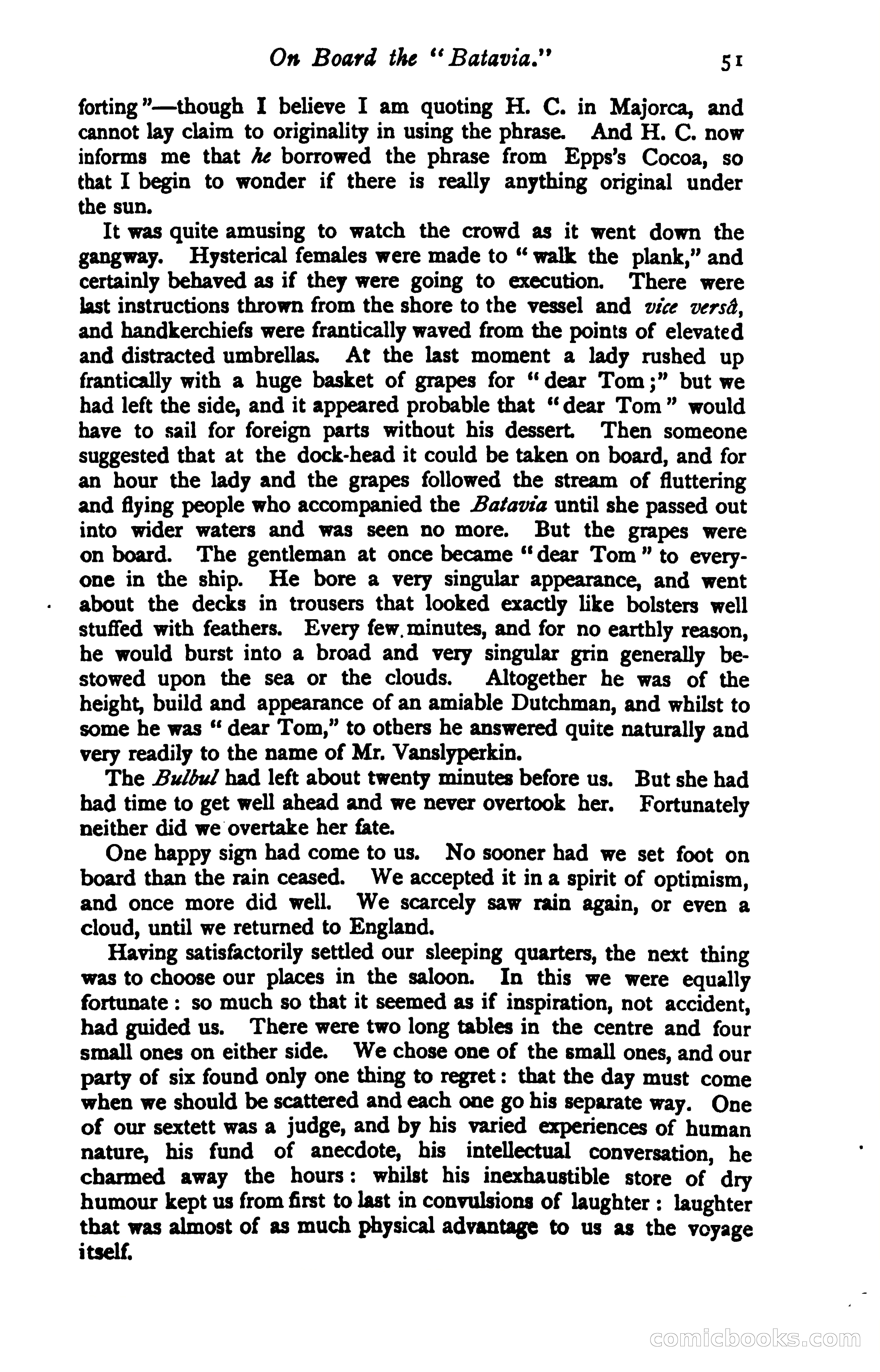
A restored page from Pulp Fiction, 1887. Page through the whole issue in the reader above.
📄 Transcribed text from this page (OCR, searchable)
Machine-transcribed from the original scan — historical spelling and the odd misread are preserved.
On Board the ‘‘ Batavia.” 51 forting ””—though I believe I am quoting H. C. in Majorca, and cannot lay claim to originality in using the phrase. And H. C. now informs me that Ae borrowed the phrase from Epps’s Cocoa, so that I begin to wonder if there is really anything original under the sun. It was quite amusing to watch the crowd as it went down the gangway. Hysterical females were made to “ walk the plank,” and certainly behaved as if they were going to execution. There were last instructions thrown from the shore to the vessel and wice versd, and handkerchiefs were frantically waved from the points of elevated and distracted umbrellas. At the last moment a lady rushed up frantically with a huge basket of grapes for ‘“‘dear Tom;” but we had left the side, and it appeared probable that “dear Tom” would have to sail for foreign parts without his dessert. Then someone suggested that at the dock-head it could be taken on board, and for an hour the lady and the grapes followed the stream of fluttering and flying people who accompanied the Aaéazva until she passed out into wider waters and was seen no more. But the grapes were on board. The gentleman at once became “dear Tom” to every- one in the ship. He bore a very singular appearance, and went about the decks in trousers that looked exactly like bolsters well stuffed with feathers. Every few, minutes, and for no earthly reason, he would burst into a broad and very singular grin generally be- stowed upon the sea or the clouds. Altogether he was of the height, build and appearance of an amiable Dutchman, and whilst to some he was “ dear Tom,” to others he answered quite naturally and very readily to the name of Mr. Vanslyperkin. The Bulbul had left about twenty minutes before us. But she had had time to get well ahead and we never overtook her. Fortunately neither did we overtake her fate. One happy sign had come to us. No sooner had we set foot on board than the rain ceased. We accepted it in a spirit of optimism, and once more did well. We scarcely saw rain again, or even a cloud, until we returned to England. Having satisfactorily settled our sleeping quarters, the next thing was to choose our places in the saloon. In this we were equally fortunate : so much so that it seemed as if inspiration, not accident, had guided us. There were two long tables in the centre and four small ones on either side. We chose one of the small ones, and our party of six found only one thing to regret: that the day must come when we should be scattered and each one go his separate way. One of our sextett was a judge, and by his varied experiences of human nature, his fund of anecdote, his intellectual conversation, he charmed away the hours: whilst his inexhaustible store of dry humour kept us from first to last in convulsions of laughter : laughter that was almost of as much physical advantage to us as the voyage itself. GOnnGaoOo SS CO