
Pulp Fiction, 1887 · page 397 of 399
The Argosy — page 397: what you’re looking at
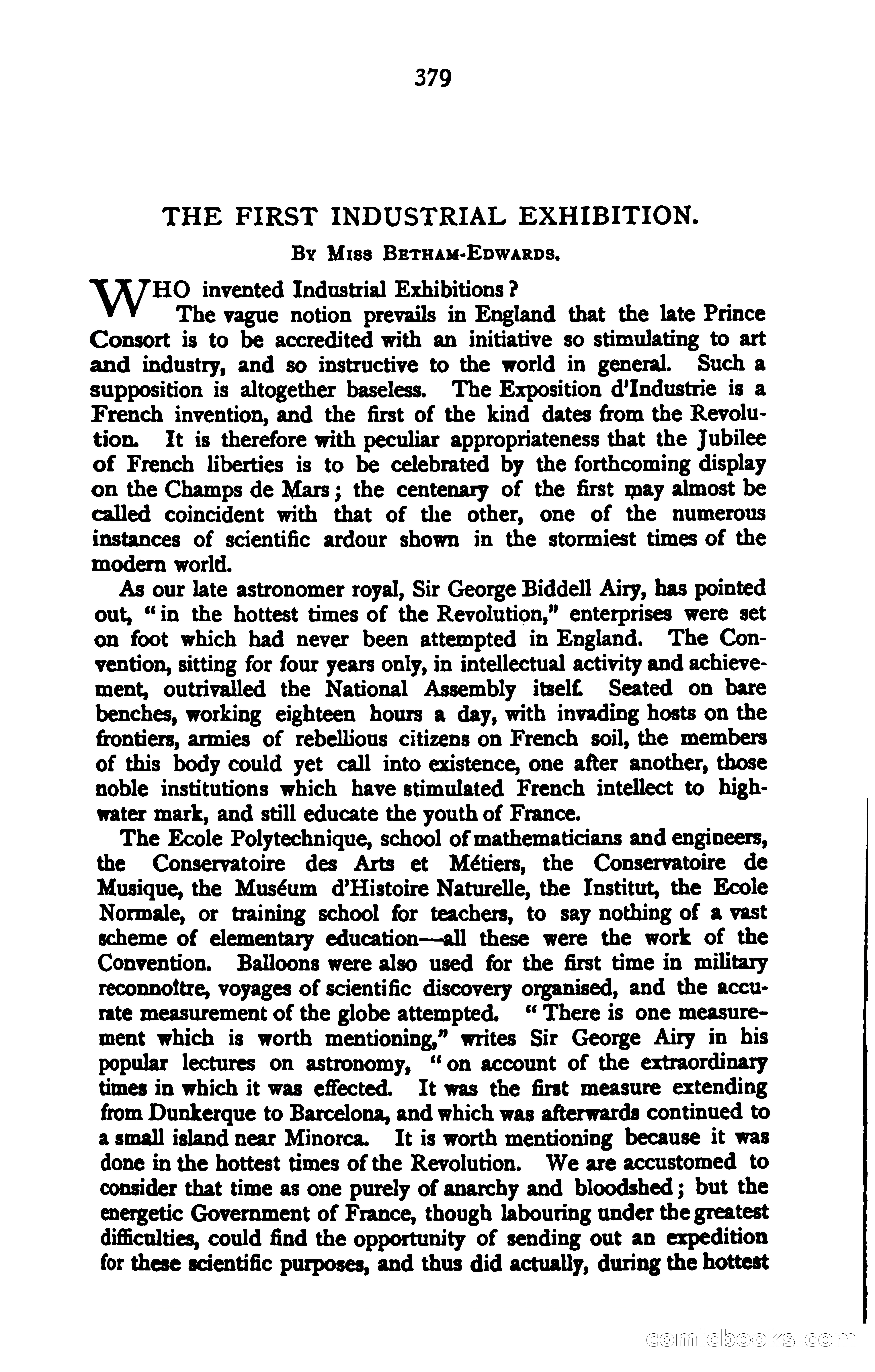
A restored page from Pulp Fiction, 1887. Page through the whole issue in the reader above.
📄 Transcribed text from this page (OCR, searchable)
Machine-transcribed from the original scan — historical spelling and the odd misread are preserved.
379 THE FIRST INDUSTRIAL EXHIBITION. By Miss BETHAM-EDWARDS, HO invented Industrial Exhibitions ? The vague notion prevails in England that the late Prince Consort is to be accredited with an initiative so stimulating to art and industry, and so instructive to the world in general. Such a supposition is altogether baseless. ‘The Exposition d’Industrie is a French invention, and the first of the kind dates from the Revolu- tion. It is therefore with peculiar appropriateness that the Jubilee of French liberties is to be celebrated by the forthcoming display on the Champs de Mars; the centenary of the first may almost be called coincident with that of the other, one of the numerous instances of scientific ardour shown in the stormiest times of the modern world. As our late astronomer royal, Sir George Biddell Airy, has pointed out, “in the hottest times of the Revolution,” enterprises were set on foot which had never been attempted in England. The Con- vention, sitting for four years only, in intellectual activity and achieve- ment, outrivalled the National Assembly itself. Seated on bare benches, working eighteen hours a day, with invading hosts on the frontiers, armies of rebellious citizens on French soil, the members of this body could yet call into existence, one after another, those noble institutions which have stimulated French intellect to high- water mark, and still educate the youth of France. The Ecole Polytechnique, school of mathematicians and engineers, the Conservatoire des Arts et Métiers, the Conservatoire de Musique, the Muséum d’Histoire Naturelle, the Institut, the Ecole Normale, or training school for teachers, to say nothing of a vast scheme of elementary education—all these were the work of the Convention. Balloons were also used for the first time in military reconnoitre, voyages of scientific discovery organised, and the accu- rate measurement of the globe attempted. ‘There is one measure- ment which is worth mentioning,” writes Sir George Airy in his popular lectures on astronomy, ‘on account of the extraordinary times in which it was effected. It was the first measure extending from Dunkerque to Barcelona, and which was afterwards continued to a small island near Minorca. It is worth mentioning because it was done in the hottest times of the Revolution. We are accustomed to consider that time as one purely of anarchy and bloodshed ; but the energetic Government of France, though labouring under the greatest difficulties, could find the opportunity of sending out an expedition for these scientific purposes, and thus did actually, during the hottest GOL GOOO @ Ss (GO)