
Pulp Fiction, 1887 · page 365 of 399
The Argosy — page 365: what you’re looking at
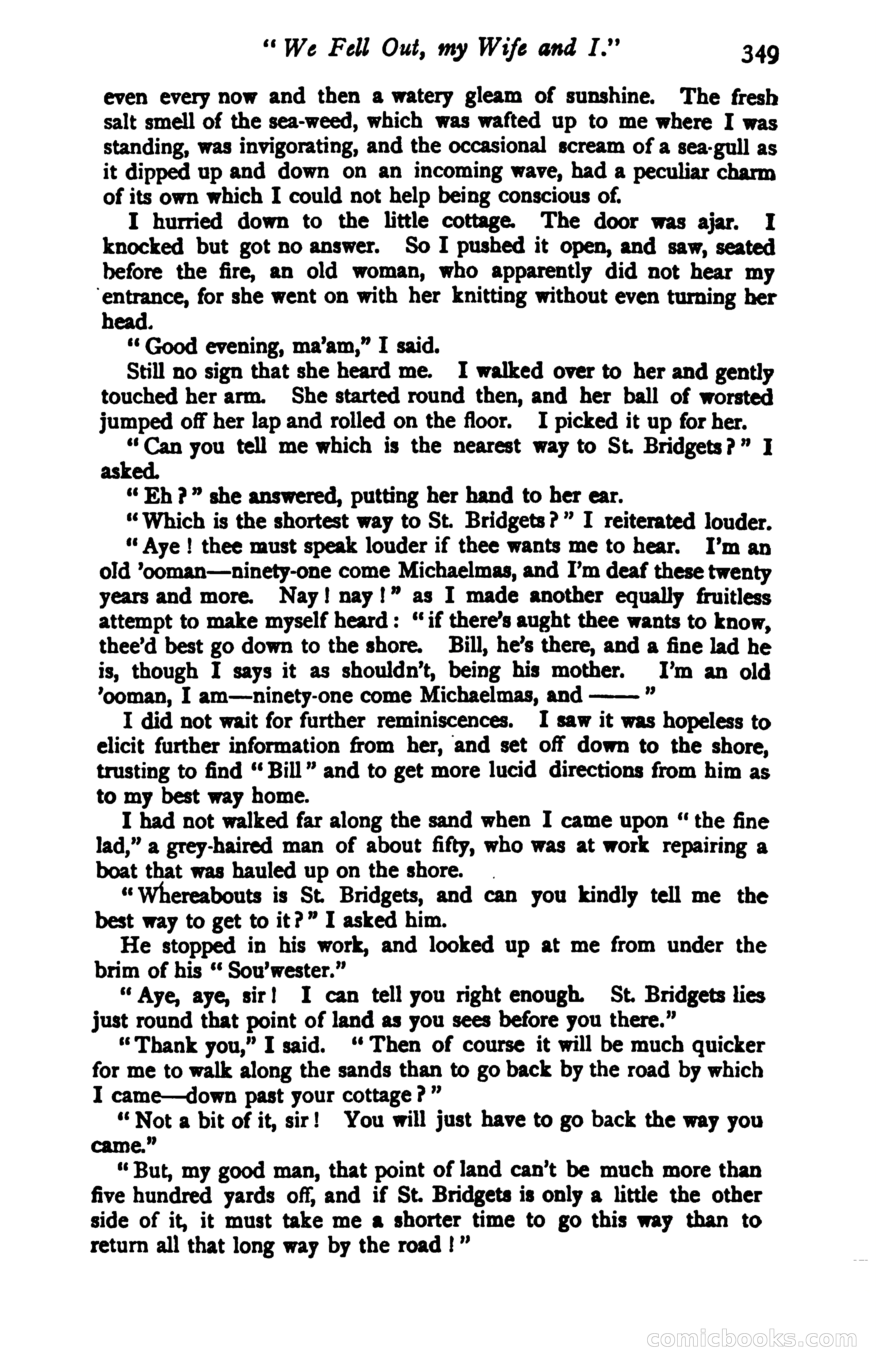
A restored page from Pulp Fiction, 1887. Page through the whole issue in the reader above.
📄 Transcribed text from this page (OCR, searchable)
Machine-transcribed from the original scan — historical spelling and the odd misread are preserved.
‘““We Fell Out, my Wife and I.” 349 even every now and then a watery gleam of sunshine. The fresh salt smell of the sea-weed, which was wafted up to me where I was standing, was invigorating, and the occasional scream of a sea-gull as it dipped up and down on an incoming wave, had a peculiar charm of its own which I could not help being conscious of. I hurried down to the little cottage. The door was ajar. I knocked but got no answer. So I pushed it open, and saw, seated before the fire, an old woman, who apparently did not hear my entrance, for she went on with her knitting without even turning her head. ‘¢ Good evening, ma’am,” I said. Still no sign that she heard me. I walked over to her and gently touched her arm. She started round then, and her ball of worsted jumped off her lap and rolled on the floor. I picked it up for her. ‘Can you tell me which is the nearest way to St. Bridgets?” J asked. ‘Eh ?” she answered, putting her hand to her ear. ‘Which is the shortest way to St. Bridgets?” I reiterated louder. * Aye ! thee must speak louder if thee wants me to hear. I’m an old ’ooman—ninety-one come Michaelmas, and I’m deaf these twenty years and more. Nay! nay!” as I made another equally fruitless attempt to make myself heard: “if there’s aught thee wants to know, thee’d best go down to the shore. Bill, he’s there, and a fine lad he is, though I says it as shouldn’t, being his mother. I’m an old 7ooman, I am—ninety-one come Michaelmas, and —— ” I did not wait for further reminiscences. I saw it was hopeless to elicit further information from her, and set off down to the shore, trusting to find “ Bill” and to get more lucid directions from him as to my best way home. I had not walked far along the sand when I came upon “ the fine lad,” a grey-haired man of about fifty, who was at work repairing a boat that was hauled up on the shore. ‘‘Whereabouts is St. Bridgets, and can you kindly tell me the best way to get to it?” I asked him. He stopped in his work, and looked up at me from under the brim of his ‘* Sou’wester.” * Aye, aye, sir! I can tell you right enough St. Bridgets lies just round that point of land as you sees before you there.” Thank you,” I said. ‘* Then of course it will be much quicker for me to walk along the sands than to go back by the road by which I came—down past your cottage ? ” ‘“‘ Not a bit of it, sir! You will just have to go back the way you came.” ‘But, my good man, that point of land can’t be much more than five hundred yards off, and if St. Bridgets is only a little the other side of it, it must take me a shorter time to go this way than to return all that long way by the road !” EOMRRIC OOO SS (GO) i