
Pulp Fiction, 1887 · page 359 of 399
The Argosy — page 359: what you’re looking at
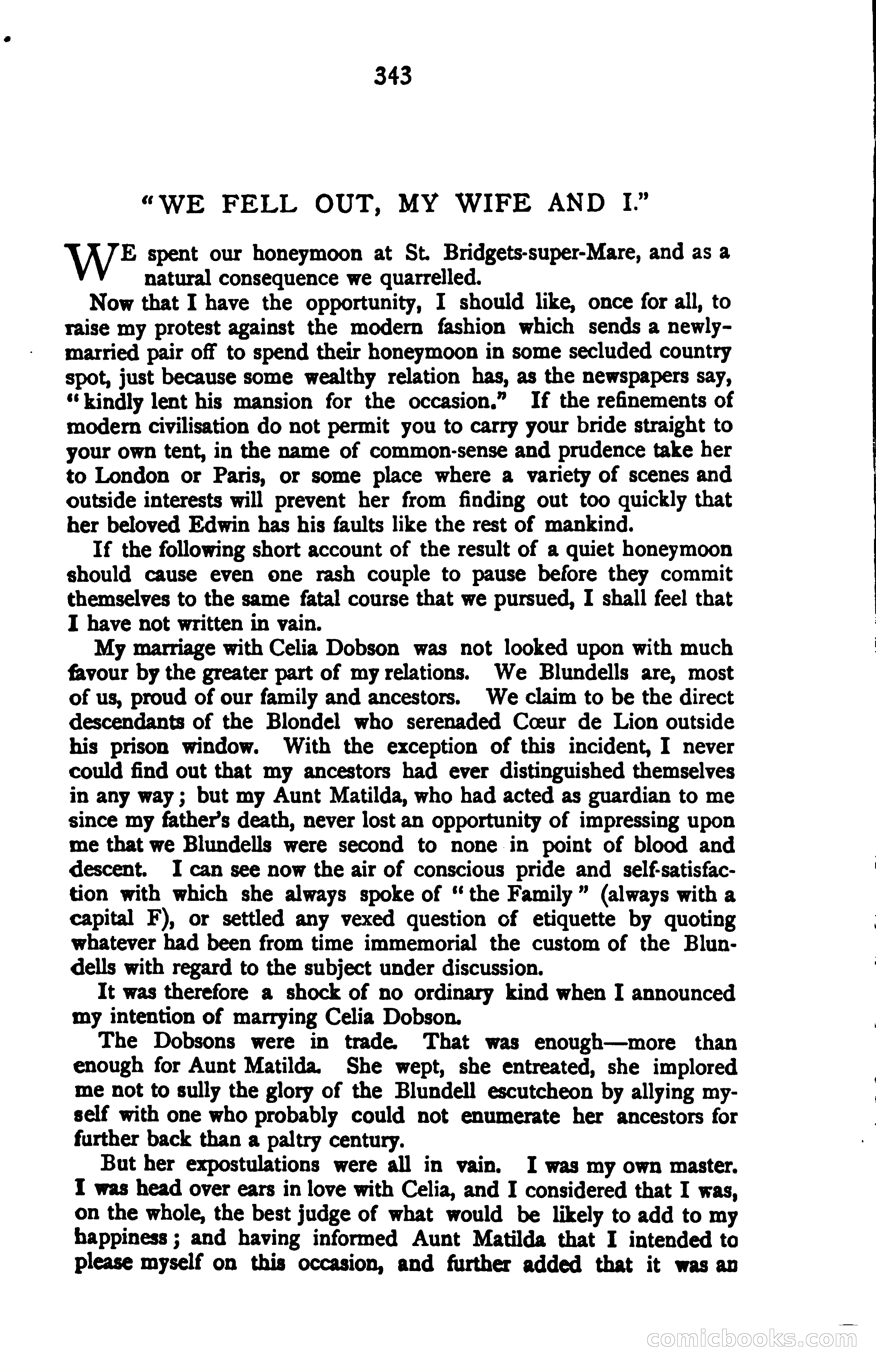
A restored page from Pulp Fiction, 1887. Page through the whole issue in the reader above.
📄 Transcribed text from this page (OCR, searchable)
Machine-transcribed from the original scan — historical spelling and the odd misread are preserved.
343 “WE FELL OUT, MY WIFE AND I.” WE spent our honeymoon at St. Bridgets-super-Mare, and as a natural consequence we quarrelled. Now that I have the opportunity, I should like, once for all, to raise my protest against the modern fashion which sends a newly- married pair off to spend their honeymoon in some secluded country spot, just because some wealthy relation has, as the newspapers say, ‘‘kindly lent his mansion for the occasion.” If the refinements of modern civilisation do not permit you to carry your bride straight to your own tent, in the name of common-sense and prudence take her to London or Paris, or some place where a variety of scenes and outside interests will prevent her from finding out too quickly that her beloved Edwin has his faults like the rest of mankind. If the following short account of the result of a quiet honeymoon should cause even one rash couple to pause before they commit themselves to the same fatal course that we pursued, I shall feel that I have not written in vain. My marriage with Celia Dobson was not looked upon with much favour by the greater part of my relations. We Blundells are, most of us, proud of our family and ancestors. We claim to be the direct descendants of the Blondel who serenaded Cceur de Lion outside his prison window. With the exception of this incident, I never could find out that my ancestors had ever distinguished themselves in any way; but my Aunt Matilda, who had acted as guardian to me since my father’s death, never lost an opportunity of impressing upon me that we Blundells were second to none in point of blood and descent. I can see now the air of conscious pride and self-satisfac- tion with which she always spoke of “the Family ” (always with a capital F), or settled any vexed question of etiquette by quoting whatever had been from time immemorial the custom of the Blun- dells with regard to the subject under discussion. It was therefore a shock of no ordinary kind when I announced my intention of marrying Celia Dobson. The Dobsons were in trade. That was enough—more than enough for Aunt Matilda. She wept, she entreated, she implored me not to sully the glory of the Blundell escutcheon by allying my- self with one who probably could not enumerate her ancestors for further back than a paltry century. But her expostulations were all in vain. I was my own master. I was head over ears in love with Celia, and I considered that I was, on the whole, the best judge of what would be likely to add to my happiness ; and having informed Aunt Matilda that I intended to please myself on this occasion, and further added that it was an EOMRRIC OOO SS (GO) i