
Pulp Fiction, 1887 · page 351 of 399
The Argosy — page 351: what you’re looking at
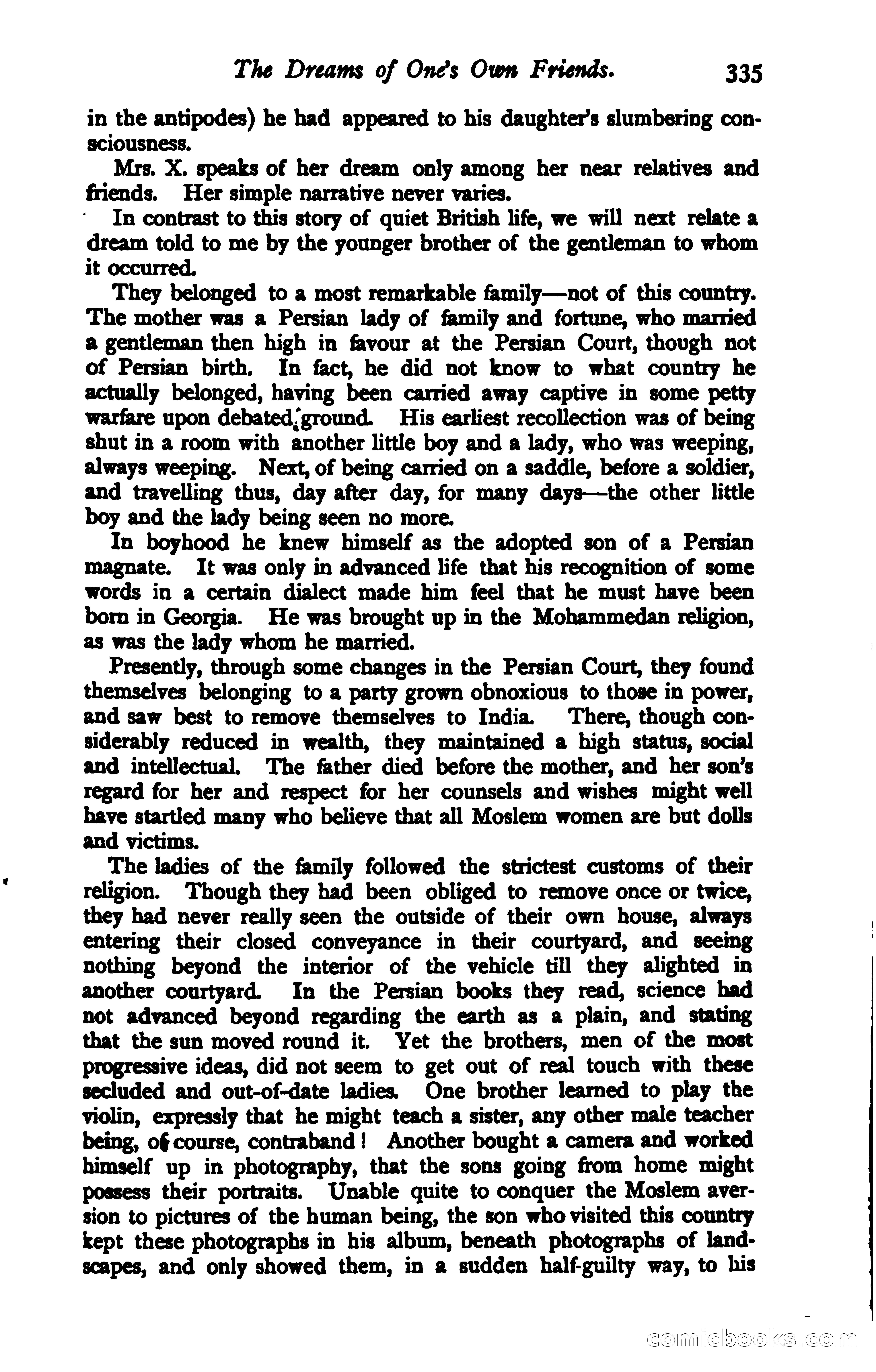
A restored page from Pulp Fiction, 1887. Page through the whole issue in the reader above.
📄 Transcribed text from this page (OCR, searchable)
Machine-transcribed from the original scan — historical spelling and the odd misread are preserved.
The Dreams of One's Own Friends. 335 in the antipodes) he had appeared to his daughter’s slumbering con- sciousness. Mrs. X. speaks of her dream only among her near relatives and friends. Her simple narrative never varies. In contrast to this story of quiet British life, we will next relate a dream told to me by the younger brother of the gentleman to whom it occurred. They belonged to a most remarkable family—not of this country. The mother was a Persian lady of family and fortune, who married a gentleman then high in favour at the Persian Court, though not of Persian birth. In fact, he did not know to what country he actually belonged, having been carried away captive in some petty warfare upon debated.ground. His earliest recollection was of being shut in a room with another little boy and a lady, who was weeping, always weeping. Next, of being carried on a saddle, before a soldier, and travelling thus, day after day, for many days—the other little boy and the lady being seen no more. In boyhood he knew himself as the adopted son of a Persian magnate. It was only in advanced life that his recognition of some words in a certain dialect made him feel that he must have been born in Georgia. He was brought up in the Mohammedan religion, as was the lady whom he married. Presently, through some changes in the Persian Court, they found themselves belonging to a party grown obnoxious to those in power, and saw best to remove themselves to India. There, though con- siderably reduced in wealth, they maintained a high status, social and intellectual. The father died before the mother, and her son’s regard for her and respect for her counsels and wishes might well have startled many who believe that all Moslem women are but dolls and victims. The ladies of the family followed the strictest customs of their religion. Though they had been obliged to remove once or twice, they had never really seen the outside of their own house, always entering their closed conveyance in their courtyard, and seeing nothing beyond the interior of the vehicle till they alighted in another courtyard. In the Persian books they read, science had not advanced beyond regarding the earth as a plain, and stating that the sun moved round it. Yet the brothers, men of the most progressive ideas, did not seem to get out of real touch with these secluded and out-of-date ladies. One brother learned to play the violin, expressly that he might teach a sister, any other male teacher being, of course, contraband! Another bought a camera and worked himself up in photography, that the sons going from home might possess their portraits. Unable quite to conquer the Moslem aver- sion to pictures of the human being, the son who visited this country kept these photographs in his album, beneath photographs of land- scapes, and only showed them, in a sudden half-guilty way, to his (GO) i EOMRRIC OOO SS