
Pulp Fiction, 1887 · page 349 of 399
The Argosy — page 349: what you’re looking at
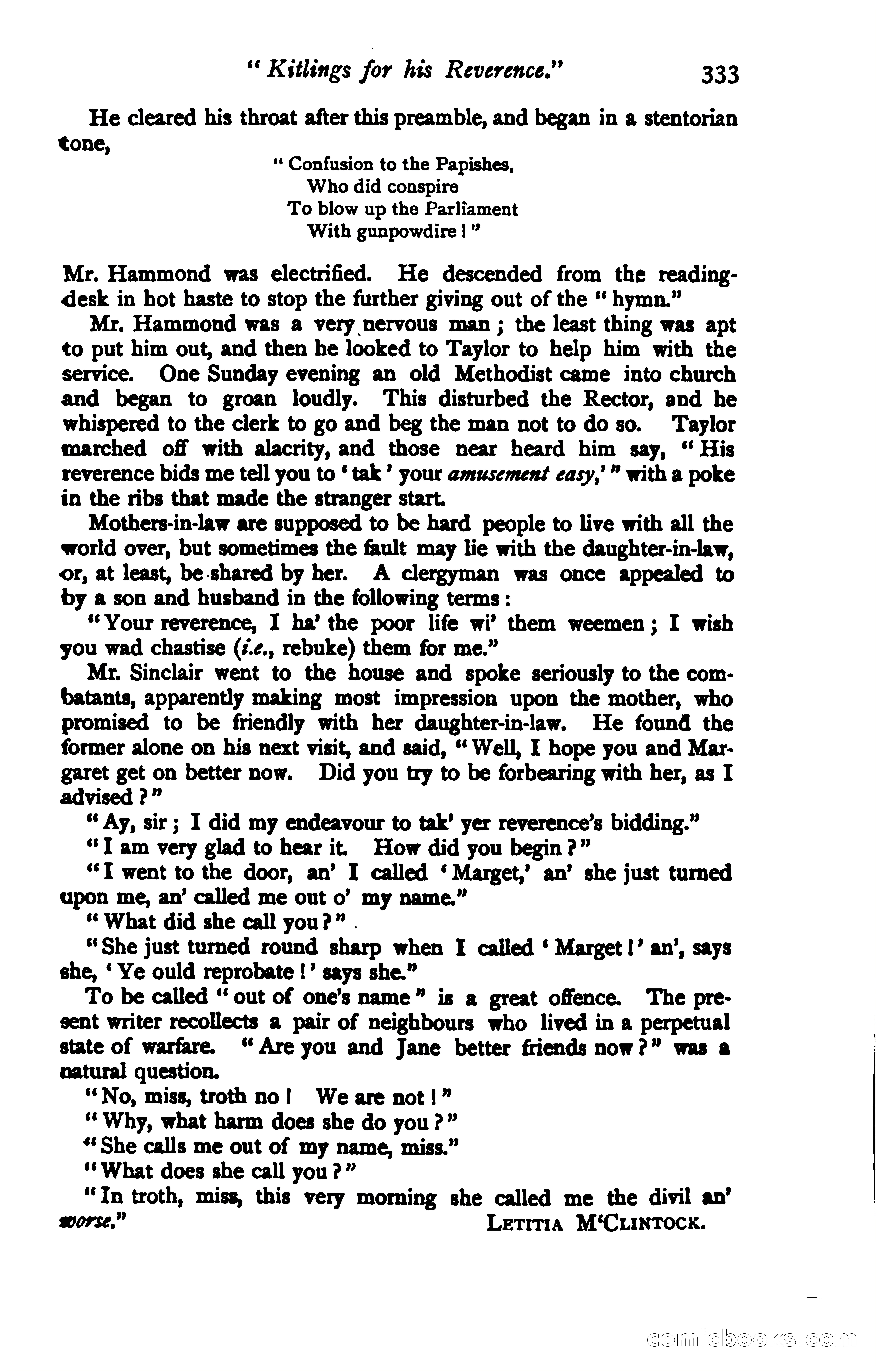
A restored page from Pulp Fiction, 1887. Page through the whole issue in the reader above.
📄 Transcribed text from this page (OCR, searchable)
Machine-transcribed from the original scan — historical spelling and the odd misread are preserved.
“* Kutlings for his Reverence.” 333 He cleared his throat after this preamble, and began in a stentorian tone , ‘‘ Confusion to the Papishes, Who did conspire To blow up the Parliament With gunpowdire !” Mr. Hammond was electrified. He descended from the reading- desk in hot haste to stop the further giving out of the ‘‘ hymn.” Mr. Hammond was a very nervous man ; the least thing was apt ¢o put him out, and then he looked to Taylor to help him with the service. One Sunday evening an old Methodist came into church and began to groan loudly. This disturbed the Rector, and he whispered to the clerk to go and beg the man not to do so. ‘Taylor marched off with alacrity, and those near heard him say, “ His reverence bids me tell you to ‘tak’ your amusement easy,’” with a poke in the nbs that made the stranger start. Mothers-in-law are supposed to be hard people to live with all the world over, but sometimes the fault may lie with the daughter-in-law, or, at least, be-shared by her. A clergyman was once appealed to by a son and husband in the following terms: ‘¢ Your reverence, I ha’ the poor life wi’ them weemen; I wish you wad chastise (#.¢., rebuke) them for me.” Mr. Sinclair went to the house and spoke seriously to the com- batants, apparently making most impression upon the mother, who promised to be friendly with her daughter-in-law. He found the former alone on his next visit, and said, “* Well, I hope you and Mar- garet get on better now. Did you try to be forbearing with her, as I advised ?” “ Ay, sir; I did my endeavour to tak’ yer reverence’s bidding.” “‘T am very glad to hear it. How did you begin ?” ‘I went to the door, an’ I called ‘ Marget,’ an’ she just turned upon me, an’ called me out o’ my name.” “What did she call you?” . ‘She just turned round sharp when I called ‘ Marget!’ an’, says she, ‘ Ye ould reprobate !’ says she.” To be called “‘ out of one’s name” is a great offence. The pre- sent writer recollects a pair of neighbours who lived in a perpetual state of warfare. ‘Are you and Jane better friends now?” was a natural question. ‘*No, miss, troth no! We are not!” ‘Why, what harm does she do you ?” “* She calls me out of my name, miss.” ‘* What does she call you ?” “In troth, miss, this very morning she called me the divil an’ soorse,” Letit1a M‘CLINTOCK. EOMRRIC OOO SS (GO) i