
Pulp Fiction, 1887 · page 337 of 399
The Argosy — page 337: what you’re looking at
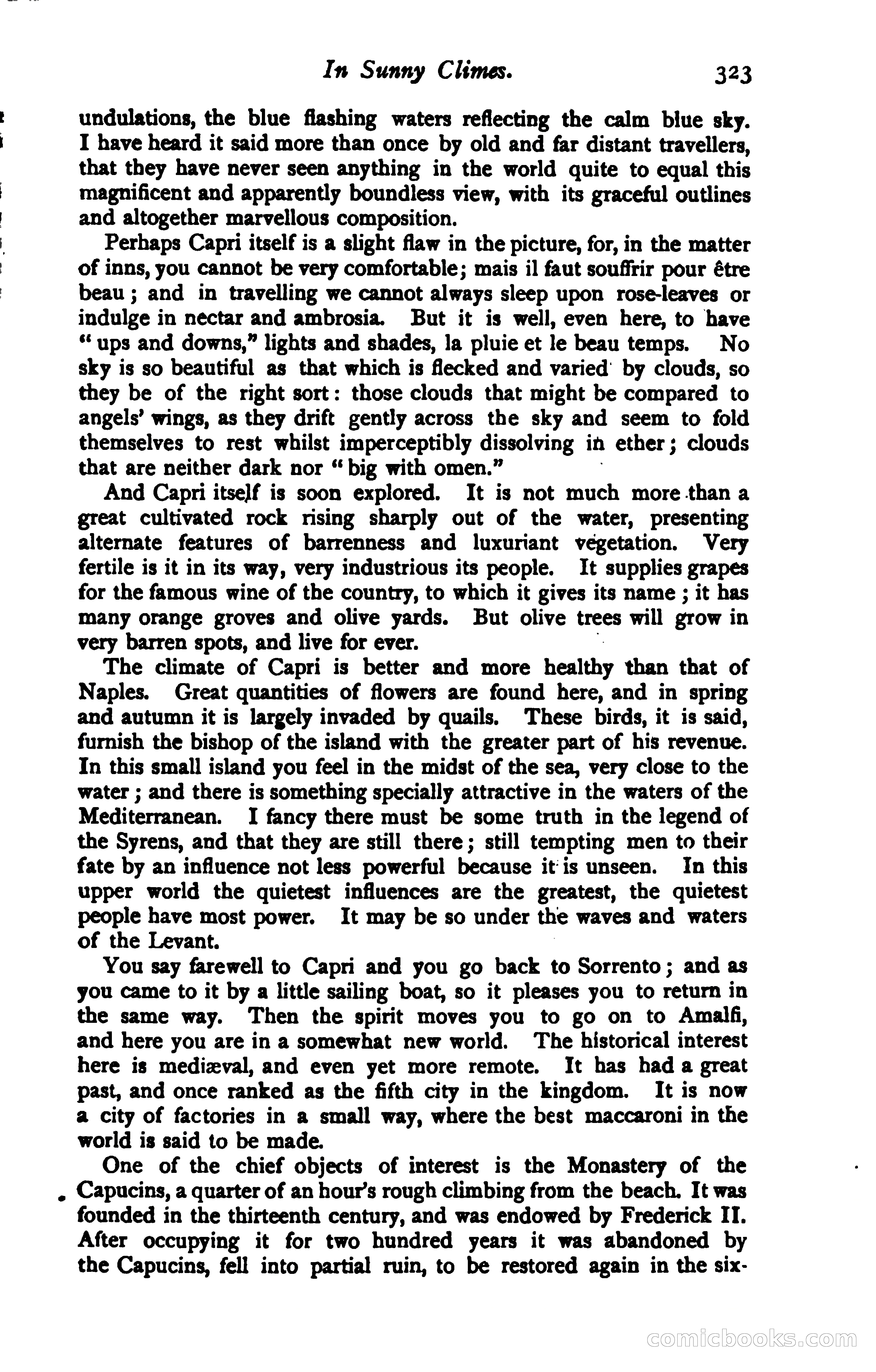
A restored page from Pulp Fiction, 1887. Page through the whole issue in the reader above.
📄 Transcribed text from this page (OCR, searchable)
Machine-transcribed from the original scan — historical spelling and the odd misread are preserved.
In Sunny Climes. 323 undulations, the blue flashing waters reflecting the calm blue sky. I have heard it said more than once by old and far distant travellers, that they have never seen anything in the world quite to equal this magnificent and apparently boundless view, with its graceful outlines and altogether marvellous composition. Perhaps Capri itself is a slight flaw in the picture, for, in the matter of inns, you cannot be very comfortable; mais il faut souffrir pour étre beau ; and in travelling we cannot always sleep upon rose-leaves or indulge in nectar and ambrosia. But it is well, even here, to have ‘ups and downs,” lights and shades, la pluie et le beau temps. No sky is so beautiful as that which is flecked and varied’ by clouds, so they be of the right sort: those clouds that might be compared to angels’ wings, as they drift gently across the sky and seem to fold themselves to rest whilst imperceptibly dissolving in ether ; clouds that are neither dark nor “ big with omen.” And Capri itself is soon explored. It is not much more than a great cultivated rock nsing sharply out of the water, presenting alternate features of barrenness and luxuriant vegetation. Very fertile is it in its way, very industrious its people. It supplies grapes for the famous wine of the country, to which it gives its name ; it has many orange groves and olive yards. But olive trees will grow in very barren spots, and live for ever. ; The climate of Capri is better and more healthy than that of Naples. Great quantities of flowers are found here, and in spring and autumn it is largely invaded by quails. These birds, it is said, furnish the bishop of the island with the greater part of his revenue. In this small island you feel in the midst of the sea, very close to the water ; and there is something specially attractive in the waters of the Mediterranean. I fancy there must be some truth in the legend of the Syrens, and that they are still there; still tempting men to their fate by an influence not less powerful because it'is unseen. In this upper world the quietest influences are the greatest, the quietest people have most power. It may be so under the waves and waters of the Levant. | You say farewell to Capri and you go back to Sorrento; and as you came to it by a little sailing boat, so it pleases you to return in the same way. Then the spirit moves you to go on to Amalfi, and here you are in a somewhat new world. The historical interest here is medizval, and even yet more remote. It has had a great past, and once ranked as the fifth city in the kingdom. It is now a city of factories in a small way, where the best maccaroni in the world is said to be made. One of the chief objects of interest is the Monastery of the Capucins, a quarter of an hour’s rough climbing from the beach. It was founded in the thirteenth century, and was endowed by Frederick IT. After occupying it for two hundred years it was abandoned by the Capucins, fell into partial ruin, to be restored again in the six- EOMRRIC OOO SS (GO) i