
Pulp Fiction, 1887 · page 174 of 399
The Argosy — page 174: what you’re looking at
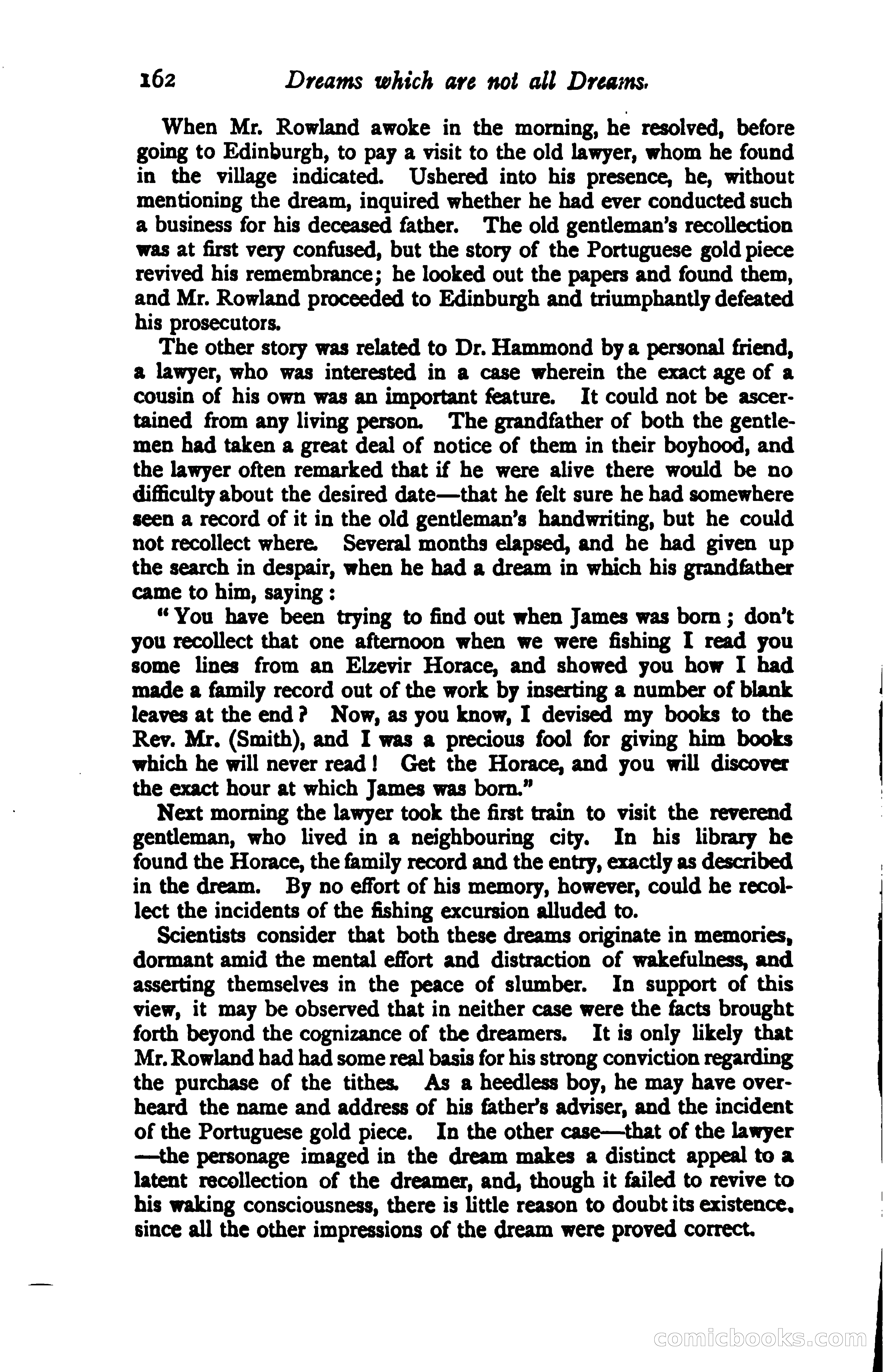
A restored page from Pulp Fiction, 1887. Page through the whole issue in the reader above.
📄 Transcribed text from this page (OCR, searchable)
Machine-transcribed from the original scan — historical spelling and the odd misread are preserved.
162 Dreams which are not all Drea:ns. When Mr. Rowland awoke in the morning, he resolved, before going to Edinburgh, to pay a visit to the old lawyer, whom he found in the village indicated. Ushered into his presence, he, without mentioning the dream, inquired whether he had ever conducted such a business for his deceased father. The old gentleman’s recollection was at first very confused, but the story of the Portuguese gold piece revived his remembrance; he looked out the papers and found them, and Mr. Rowland proceeded to Edinburgh and triumphantly defeated his prosecutors, The other story was related to Dr. Hammond by a personal friend, a lawyer, who was interested in a case wherein the exact age of a cousin of his own was an important feature. It could not be ascer- tained from any living person. The grandfather of both the gentle- men had taken a great deal of notice of them in their boyhood, and the lawyer often remarked that if he were alive there would be no difficulty about the desired date—that he felt sure he had somewhere seen a record of it in the old gentleman’s handwriting, but he could not recollect where. Several months elapsed, and he had given up the search in despair, when he had a dream in which his grandfather came to him, saying : “You have been trying to find out when James was born ; don’t you recollect that one afternoon when we were fishing I read you some lines from an Elzevir Horace, and showed you how I had made a family record out of the work by inserting a number of blank leaves at the end? Now, as you know, I devised my books to the Rev. Mr. (Smith), and I was a precious fool for giving him books which he will never read! Get the Horace, and you will discover the exact hour at which James was born.” Next morning the lawyer took the first train to visit the reverend gentleman, who lived in a neighbouring city. In his library he found the Horace, the family record and the entry, exactly as described in the dream. By no effort of his memory, however, could he recol- lect the incidents of the fishing excursion alluded to. Scientists consider that both these dreams originate in memories, dormant amid the mental effort and distraction of wakefulness, and asserting themselves in the peace of slumber. In support of this view, it may be observed that in neither case were the facts brought forth beyond the cognizance of the dreamers. It is only likely that Mr. Rowland had had some real basis for his strong conviction regarding the purchase of the tithes. As a heedless boy, he may have over- heard the name and address of his father’s adviser, and the incident of the Portuguese gold piece. In the other case—that of the lawyer —the personage imaged in the dream makes a distinct appeal toa latent recollection of the dreamer, and, though it failed to revive to his waking consciousness, there is little reason to doubt its existence. since all the other impressions of the dream were proved correct. ECOMiCcOOolkKS —_— (CO