
Pulp Fiction, 1887 · page 171 of 399
The Argosy — page 171: what you’re looking at
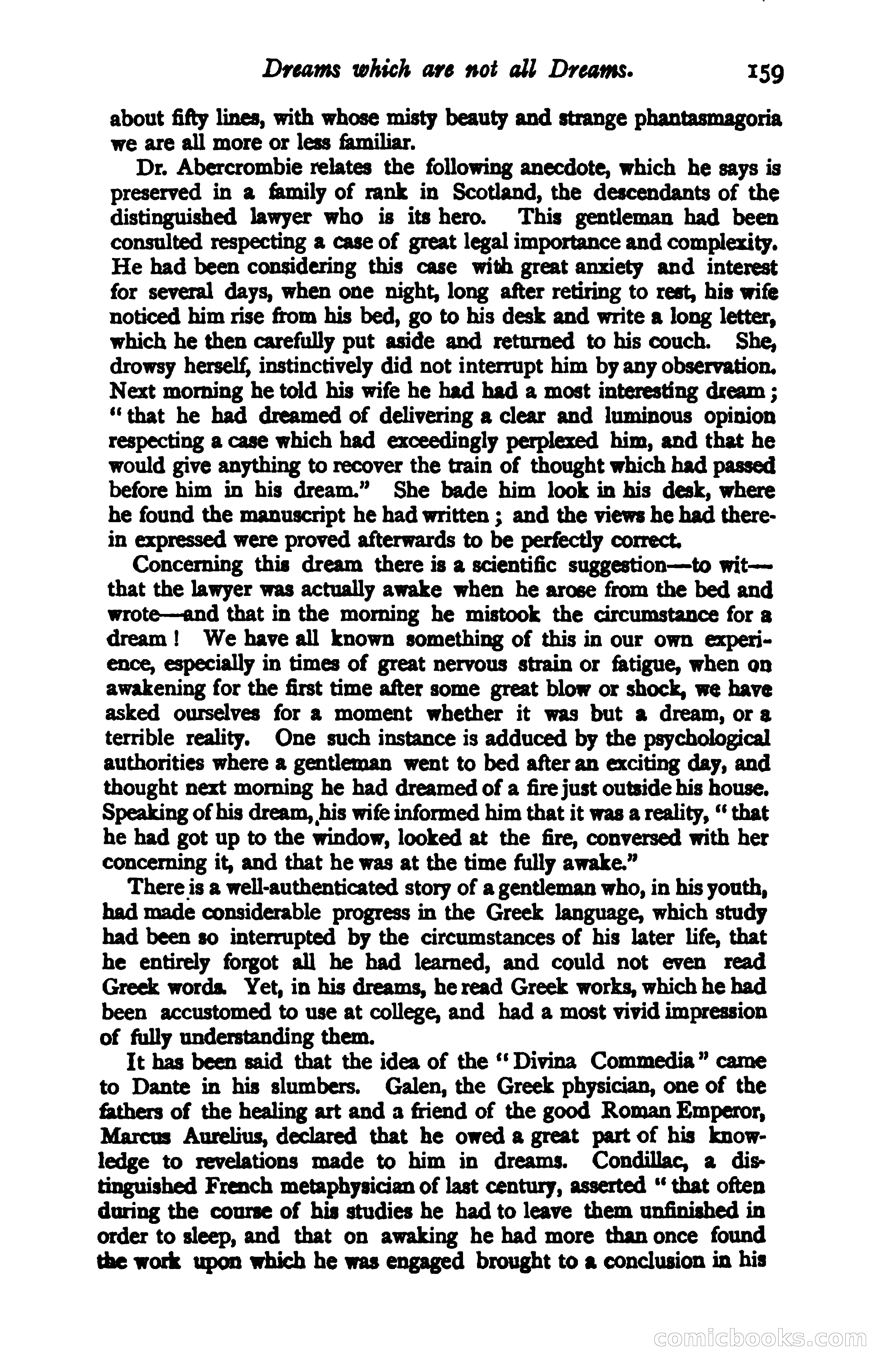
A restored page from Pulp Fiction, 1887. Page through the whole issue in the reader above.
📄 Transcribed text from this page (OCR, searchable)
Machine-transcribed from the original scan — historical spelling and the odd misread are preserved.
Dreams which are not all Dreams. 159 about fifty lines, with whose misty beauty and strange phantasmagoria we are all more or less familiar. Dr. Abercrombie relates the following anecdote, which he says is preserved in a family of rank in Scotland, the descendants of the distinguished lawyer who is its hero. This gentleman had been consulted respecting a case of great legal importance and complexity. He had been considering this case with great anxiety and interest for several days, when one night, long after retiring to rest, his wife noticed him rise from his bed, go to his desk and write a long letter, which he then carefully put aside and returned to his couch. She, drowsy herself, instinctively did not interrupt him by any observation. Next morning he told his wife he had had a most interesting dream ; ‘that he had dreamed of delivering a clear and luminous opinion respecting a case which had exceedingly perplexed him, and that he would give anything to recover the train of thought which had passed before him in his dream.” She bade him look in his desk, where he found the manuscript he had written ; and the views he had there- in expressed were proved afterwards to be perfectly correct. Concerning this dream there is a scientific suggestion—to wit— that the lawyer was actually awake when he arose from the bed and wrote—and that in the morning he mistook the circumstance for a dream! We have all known something of this in our own experi- ence, especially in times of great nervous strain or fatigue, when on awakening for the first time after some great blow or shock, we have asked ourselves for a moment whether it was but a dream, or a2 terrible reality. One such instance is adduced by the psychological authorities where a gentleman went to bed after an exciting day, and thought next morning he had dreamed of a fire just outside his house. Speaking of his dream, his wife informed him that it was a reality, “ that he had got up to the window, looked at the fire, conversed with her concerning it, and that he was at the time fully awake.” There is a well-authenticated story of a gentleman who, in his youth, had made considerable progress in the Greek language, which study had been so interrupted by the circumstances of his later life, that he entirely forgot all he had learned, and could not even read Greek words. Yet, in his dreams, he read Greek works, which he had been accustomed to use at college, and had a most vivid impression of fully understanding them. It has been said that the idea of the ** Divina Commedia” came to Dante in his slumbers. Galen, the Greek physician, one of the fathers of the healing art and a friend of the good Roman Emperor, Marcus Aurelius, declared that he owed a great part of his know- ledge to revelations made to him in dreams. Condillac, a dis- tinguished French metaphysician of last century, asserted ‘‘ that often during the course of his studies he had to leave them unfinished in order to sleep, and that on awaking he had more than once found the work upon which he was engaged brought to a conclusion in his COnmicloooel —_— SS (CO