
Pulp Fiction, 1887 · page 161 of 399
The Argosy — page 161: what you’re looking at
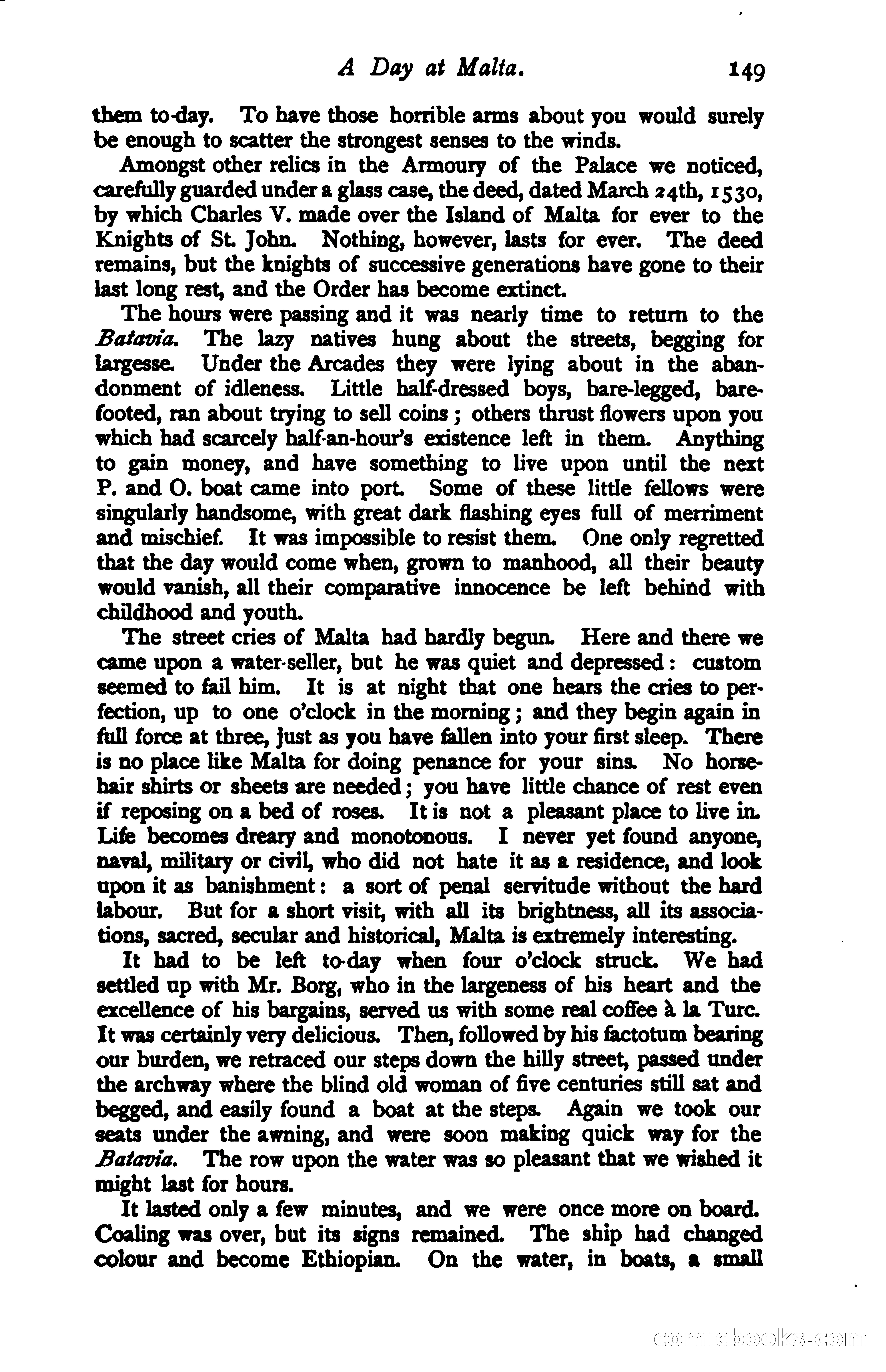
A restored page from Pulp Fiction, 1887. Page through the whole issue in the reader above.
📄 Transcribed text from this page (OCR, searchable)
Machine-transcribed from the original scan — historical spelling and the odd misread are preserved.
A Day at Malta. 149 them to-day. To have those horrible arms about you would surely be enough to scatter the strongest senses to the winds. Amongst other relics in the Armoury of the Palace we noticed, carefully guarded under a glass case, the deed, dated March 24th, 1530, by which Charles V. made over the Island of Malta for ever to the Knights of St. John. Nothing, however, lasts for ever. The deed remains, but the knights of successive generations have gone to their last long rest, and the Order has become extinct. The hours were passing and it was nearly time to return to the Batavia, The lazy natives hung about the streets, begging for largesse. Under the Arcades they were lying about in the aban- donment of idleness. Little half-dressed boys, bare-legged, bare- footed, ran about trying to sell coins ; others thrust flowers upon you which had scarcely half-an-hour’s existence left in them. Anything to gain money, and have something to live upon until the next P. and O. boat came into port. Some of these little fellows were singularly handsome, with great dark flashing eyes full of merriment and mischief. it was impossible to resist them. One only regretted that the day would come when, grown to manhood, all their beauty would vanish, all their comparative innocence be left behind with childhood and youth. The street cries of Malta had hardly begun. Here and there we came upon a water-seller, but he was quiet and depressed: custom seemed to fail him. It is at night that one hears the cries to per- fection, up to one o'clock in the morning ; and they begin again in full force at three, just as you have fallen into your first sleep. There is no place like Malta for doing penance for your sins. No horse- hair shirts or sheets are needed; you have little chance of rest even if reposing on a bed of roses. Itis not a pleasant place to live in. Life becomes dreary and monotonous. I never yet found anyone, naval, military or civil, who did not hate it as a residence, and look upon it as banishment: a sort of penal servitude without the hard labour. But for a short visit, with all its brightness, all its associa- tions, sacred, secular and historical, Malta is extremely interesting. It had to be left today when four o’clock struck. We had settled up with Mr. Borg, who in the largeness of his heart and the excellence of his bargains, served us with some real coffee 4 la Turc. It was certainly very delicious. Then, followed by his factotum bearing our burden, we retraced our steps down the hilly street, passed under the archway where the blind old woman of five centuries still sat and begged, and easily found a boat at the steps. Again we took our seats under the awning, and were soon making quick way for the Batavia. The row upon the water was so pleasant that we wished it might last for hours. It lasted only a few minutes, and we were once more on board. Coaling was over, but its signs remained. The ship had changed colour and become Ethiopian. On the water, in boats, a smail COnmicloooel —_— SS (CO