
Pulp Fiction, 1887 · page 151 of 399
The Argosy — page 151: what you’re looking at
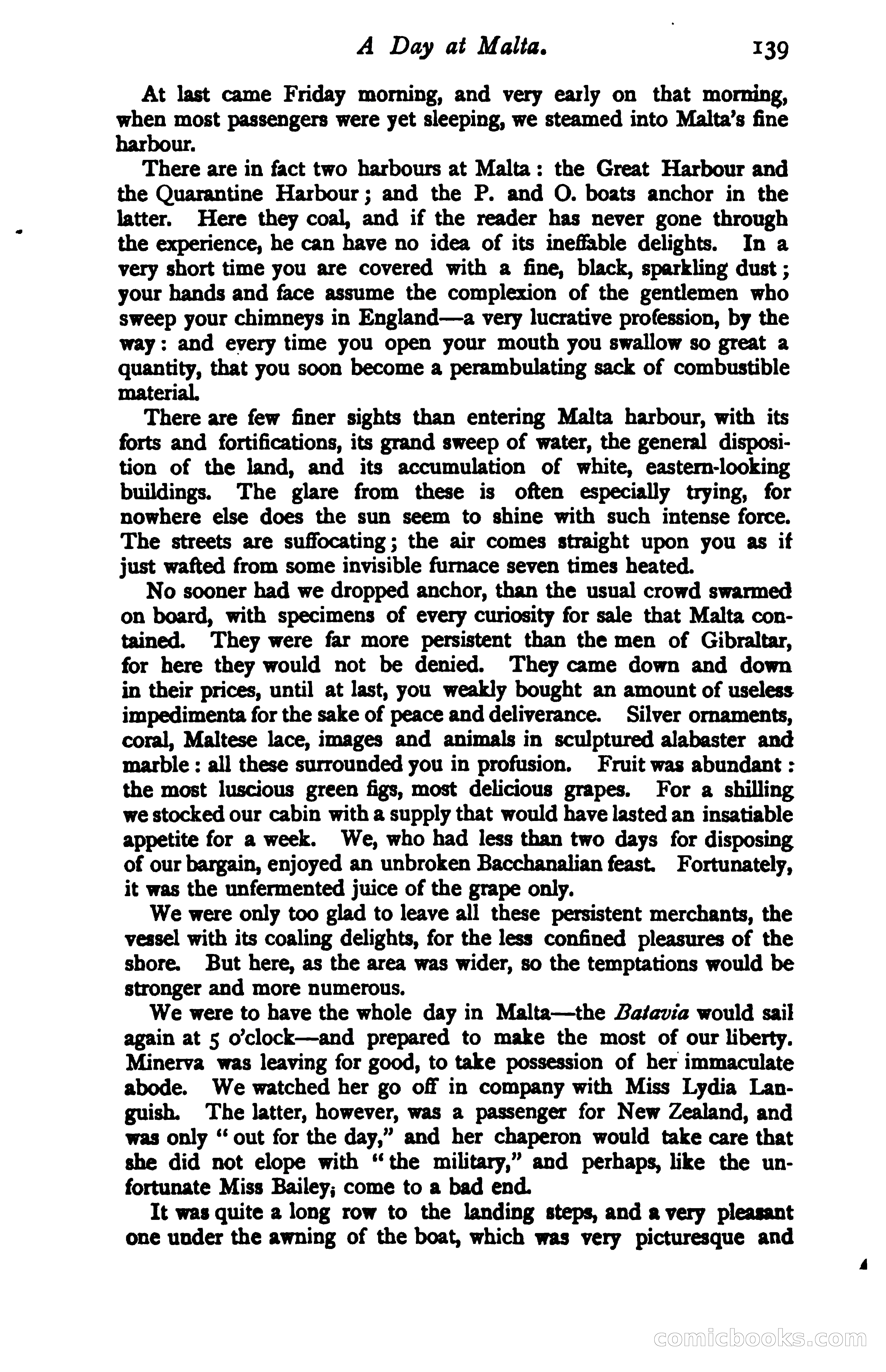
A restored page from Pulp Fiction, 1887. Page through the whole issue in the reader above.
📄 Transcribed text from this page (OCR, searchable)
Machine-transcribed from the original scan — historical spelling and the odd misread are preserved.
A Day at Malta. | 139 At last came Friday morning, and very early on that morning, when most passengers were yet sleeping, we steamed into Malta’s fine harbour. There are in fact two harbours at Malta: the Great Harbour and the Quarantine Harbour; and the P. and QO. boats anchor in the latter. Here they coal, and if the reader has never gone through the experience, he can have no idea of its ineffable delights. Ina very short time you are covered with a fine, black, sparkling dust ; your hands and face assume the complexion of the gentlemen who sweep your chimneys in England—a very lucrative profession, by the way: and every time you open your mouth you swallow so great a quantity, that you soon become a perambulating sack of combustible material. There are few finer sights than entering Malta harbour, with its forts and fortifications, its grand sweep of water, the general disposi- tion of the land, and its accumulation of white, eastern-looking buildings. The glare from these is often especially trying, for nowhere else does the sun seem to shine with such intense force. The streets are suffocating; the air comes straight upon you as if just wafted from some invisible furnace seven times heated. No sooner had we dropped anchor, than the usual crowd swarmed on board, with specimens of every curiosity for sale that Malta con- tained. They were far more persistent than the men of Gibraltar, for here they would not be denied. They came down and down in their prices, until at last, you weakly bought an amount of useless impedimenta for the sake of peace and deliverance. Silver ornaments, coral, Maltese lace, images and animals in sculptured alabaster and marble : all these surrounded you in profusion. Fruit was abundant : the most luscious green figs, most delicious grapes. For a shilling we stocked our cabin with a supply that would have lasted an insatiable appetite for a week. We, who had less than two days for disposing of our bargain, enjoyed an unbroken Bacchanalian feast. Fortunately, it was the unfermented juice of the grape only. We were only too glad to leave all these persistent merchants, the vessel with its coaling delights, for the less confined pleasures of the shore. But here, as the area was wider, so the temptations would be stronger and more numerous. We were to have the whole day in Malta—the Batavia would sail again at 5 o’clock—and prepared to make the most of our liberty. Minerva was leaving for good, to take possession of her immaculate abode. We watched her go off in company with Miss Lydia Lap- guish. The latter, however, was a passenger for New Zealand, and was only “ out for the day,” and her chaperon would take care that she did not elope with “the military,” and perhaps, like the un- fortunate Miss Bailey; come to a bad end. It was quite a long row to the landing steps, and a very pleasant one under the awning of the boat, which was very picturesque and ECOMiCcOOolkKS —_— (CO